Review: Special, Silent DiscoBriefs: Much Ado About Nothing, CrossedReview: A Behanding in Spokane, No-ShowReview: The City/Bare WitnessReview: Triple Bill of Wild Delight, Little MercyReview: Lloyd Beckmann, BeekeeperReview: The Drowsy Chaperone/Acts of DeceitFringe: Attract/Repel, The Ridiculusmus ReadingsReview: Happy Days, Care InstructionsReview: Aviary ~ theatre notes
Showing posts with label la mama. Show all posts

Tuesday, August 09, 2011

Review: Special, Silent Disco

I wish I could adequately explain the irrational joy that The Rabble's latest work, Special, invoked in me when I saw it last week. There is something in it of pure theatre, unafraid act, that set a flame in the gloom that has bedevilled me this long Melbourne winter. Or maybe it's just liberating to see something this angry.

In Special, The Rabble confront the psychic disintegration of contemporary life. Emma Valente and her collaborators tap into the increasingly ominous sense that it is later than we think, that the endemic violence that powers the machinery of our society - violence against people, against meaning and relationship, against the living systems of our planet - is accumulating to a point of crisis. In such a time, what can meaning mean?

We are left with the absurd, the abyss over which our attempts at continuity and knowledge and purpose flail and expose their emptiness. Yet what The Rabble track in their vignettes is not, for all its sardonic exposures of failure, a trajectory towards nihilism, but a strange and exhilarating affirmation. "If nothing had any meaning, [nihilism] would be right," said Camus in the 1940s. "But there is something that still has a meaning." It's that "something" - relationship, the possibility of transformation - that is at the centre of this extraordinary work of theatre.

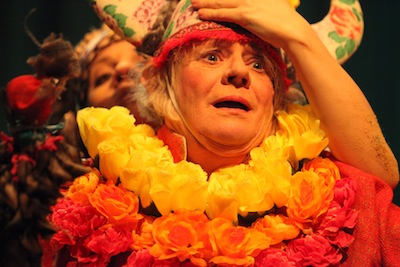
In Kate Davis's design, the stage is surfaced with a deep layer of earth, topped with a thin layer of a disconcertingly artificial green, with the earth mounded on one side to create a small hill. On three sides it's surrounded by what appear at first to be white curtains but which are in fact white paper streamers. Special consists of a series of scenes between the spectacularly pregnant Special (Mary Helen Sassman) and her mother Goldie (Liz Jones). When the lights first come up, Jones, in a white pantsuit, is slogging away on an exercise bike, while Sassman, decked out in a huge Indian headdress, is lying on her back, ostentatiously licking an ice cream. It's worth seeing for this image alone, which somehow evokes the emptiness of consumerism in one gloriously absurd moment.

The lighting and set emphasise toxic hues of green or oxidic white, so it seems that our characters are enclosed in a world which unsuccessfully mimics the natural world. Within this frame of the artificial, Sassman's pregnant belly (no illusion, there's a real baby in there) and the exposed earth suggest a chthonic anarchy on the point of eruption. This eruption - of anger, desire, violence, love - is more or less what happens through the show. Valente exploits some extremely effective lighting and sound design to create an almost Artaudian sense of transformation. Only this is - how do I put it? - a distinctly female exploration, in which conception and rebirth are much more than metaphors appropriated into masculinised meanings. There's a strong whiff of Hélène Cixous's "repressed" about the whole thing.

The relationship between Goldie and Special is both antagonistic and mutually dependent, and it's this relationship which gives vitality and shape to the bizarre rituals which they explore during the course of the performance. They collect the rubble of transcendence, scraps and fragments of ritual stolen from a grab bag of cultures - Native American, Spanish American, Catholic, tribal African - which they pile into an increasingly grotesque pastiche of faith.

Goldie announces it is her "special day", which involves an elaborately solemn costuming and which collapses into comic anti-climax. Instead, the mysteriously pregnant Special, whose child we begin to suspect is immaculately conceived, begins to create her own ritual. What's interesting is how this sense of transformation is embedded in the ridiculous: there's a lot that makes no sense, or at least, doesn't make any common sense. But it's riveting theatre.

Its theatrical movement makes me think of Octavio Paz's comments in his book on the sacred, Conjunctions and Disjunctions: "History is a discourse. But the rebellions of the twentieth century have violated both the rules of dramatic action and those of representation. We have unforeseen irruptions that disturb the linear nature of history ... both the events and the actors betray the text of the play. They write another text, or rather invent one. This is the end of discourse and rational legibility." Special mimics the formation of this "other text", opening possibility beyond the enclosures of words.

I haven't seen all The Rabble's work, having missed their Sydney productions, but Special is the first show I've seen that isn't hobbled by a sense of over-aestheticised seriousness. It's funny, tough, unafraid, and beautifully realised.


Silent Disco, which is part of the Full Tilt season at the Victorian Arts Centre, arrives from Sydney with a raft of glowing reviews. It's fair to say that the glow didn't transfer to me; without exactly hating it, I was scratchily disappointed. I guess I expected more than a competently realised, conventional social drama.

Lachlan Philpott's play about a doomed relationship between two misfit kids is directed by Lee Lewis, last seen here with her beautiful production of Twelfth Night for Bell Shakespeare. As with Robert Reid's The Joy of Text, the play is set in a school, and related through the matrix of educators; but in its tracking of adolescent breakdown, it recalls Declan Greene's Moth, recently remounted at the Malthouse. Unlike Moth, which created an authentic theatrical diction for its characters, Silent Disco never escapes the sense that this is an adult vision of young people. It's not surprising to find that Philpott has been a teacher.

Unlike Reid's The Joy of Text, teaching itself is presented unproblematically, as a known (if sometimes failing) function: a central character is the well-meaning English teacher Mrs Petchall (Camilla Ah Kin), observing with concern the disconnected, alienated generation hooked up to their iPods and Facebook. The "silent disco" of the title is one in which everyone dances to his or her own headphone music, which here becomes a somewhat obvious metaphor for social disconnection. I'm not sure it's that simple: this is an authority's perception of youth culture, which only awkwardly enters into the experience of what that culture is.

The central characters are troubled teens Tamara (Sophie Hensser) and Squid (Meyne Wyatt) who wind up towards inevitable crisis. In both cases, slightly disturbingly, their problem is absent, uncaring mothers - Tamara lives with her gay father, the Indigenous Squid with his auntie. Their awkward romance is derailed by Squid's criminal brother Dane (Kirk Page), who targets Tamara for seduction as revenge for being thrown out of the family house, and to undercut Squid's nascent ambitions to make something of himself.

Silent Disco affirms all sorts of worthy impulses - concern for deprived youth, the role of education, and so on - in the lingua franca of heightened naturalism. In two acts, it's overwritten and you can hear the dramatic shifts coming a mile off. The odd verbal or theatrical pyrotechnics don't prevent its being weighed down by predictability. The British have a brilliant tradition of socially committed work that looks at the experiences of alienated or deprived young people - think Ken Loach's devastating film Kes, or Tony Richardson's The Loneliness of the Long Distance Runner, or more recently Shane Meadowes's This Is England. Philpott's intentions are clearly in the same arena, but Silent Disco never gets near this kind of plain-speaking anger or emotional power, and it certainly isn't anywhere close in terms of political intelligence.

With her hard working and committed cast, Lee Lewis's direction injects the production with moments of vitality. There's Tamara's evocation of her first experience of sex, a delicate subject that here attains a moment of real theatrical power, or a comic portrayal of check-out chicks at the supermarket, sharply observed vignettes of social irony. Aside from these moments, it seldom touched me. It's fine, as far as it goes; it just doesn't go very far.

Pictures: Top: Liz Jones in Special. Photo: Marg Howell. Bottom: Meyne Wyatt (left) and Sophie Hensser in Silent Disco.

Special, directed by Emma Valente, concept by Emma Valente, Mary Helen Sassman. Devised and performed by Liz Jones and Mary Helen Sassman. Lighting, sound and composition by Emma Valente. The Rabble @ La Mama Courthouse, until August 21.

Silent Disco by Lachlan Philpott, directed by Lee Lewis. Designed by Justin Nadella, lighting design by Ross Graham, sound design and composition by Stefan Gregory. With Camilla Ah Kin, Sophie Hensser, Kirk Page and Meyne Wyatt. Griffin Theatre Company, Hothouse Theatre and Australian Theatre for Young People, at the Victorian Arts Centre Fairfax Studio, until August 13.

Read More.....

Monday, June 20, 2011

Briefs: Much Ado About Nothing, Crossed

I'm a sucker for Shakespeare's comedies. They reveal his profound knowledge of the stage, and his pleasure in its vulgar tricks and conventions gives us some of the most sublimely funny scenes ever written. In Much Ado About Nothing, Shakespeare steals freely from a bunch of popular contemporary sources, from Luigi Pasaquaglio's Il Fedele to Ariosto's Orlando Furioso, in which a virtuous woman becomes the victim of vicious intrigue. Transposing the story from tragedy to comedy through the language of courtly wit, he invents two of his most charming lovers, Benedick and Beatrice.


It's a deeply enjoyable play, in which Shakespeare modulates his comedic satire with scenes of real feeling. And John Bell's production for Bell Shakespeare, now on at the Arts Centre, uses his own profound knowledge of stage business to burnish its pleasures to a deep lustre. This is the best production of Bell's that I've seen: exhilarating, vital and surely crafted, with nothing of the fustian.

Stephen Curtis's design sets the action in a quasi-fifties Messina, with full-circle skirts and army uniforms with red sashes. Here the concept runs seamlessly with the play, a fantasia that gives its fantasies life without intruding itself. The action takes place in a basketball court, an institutional setting wrested to other uses of pleasure, with lush Tintoretto-esque wall murals to lift it out of the literal. Alan John's music, performed live, springs organically out of the performances, heightening its sense of carnival. And in the play's tomb scene, a central turning point of death and rebirth, the music becomes ritual itself with a glorious a cappella drawn from male voice Corsican choirs.

Benedick and Beatrice are equals in intelligence and vivacity, sceptics whose condemnation of love arises from their distrust of its sentimental cliches. Their verbal fencing is, as their mischievous friends recognise when they decide to trick the two into marrying each other, the showiest of courtships. They keep each other "waking and in continuall exercise", each pushing the other to more dazzling feats of wit. As in almost every Georgette Heyer romance, all that needs to occur is for each partner to recognise this as attraction, rather than as hostility: what occurs through the play is not a transformation of feeling, but an understanding of it.

This love story runs parallel with the fortunes of Hero (Alexandra Fisher) and Claudio (Sean Hawkins). When Hero is maliciously framed as unfaithful, Claudio mercilessly shames and abandons her in the midst of their wedding. Here, despite his lack of faith in his beloved, he is not portrayed as merely shallow; the insecurity of his passion drives him to a display of cruel machismo. Both couples must negotiate the deception and tricks of others to find the truth of their feeling through the miasma of appearance.

The key is the depth of its casting: every performance is worth the watching. Toby Schmitz and Blazey Best as Benedick and Beatrice create true electric play, the enlivening contrast to the more conventionally drawn lovers of Hero and Claudio. The whole is rich with comic invention: notably Max Gillies's Dogberry, the malapropic watchman, and Sean O'Shea's Don John, a kind of evil Mr Bean in a Mafia suit, the asocial wrench in this otherwise genial machine of sociality. The darker themes of war and malice are threaded lightly, present as shade in a complex comedic texture. A delight.

*

Chris Summers's Crossed was the second of two plays by this promising young writer to premiere within weeks of each other. It consists of five intersecting monologues, all revolving around the same traumatic event - the police shooting of "the smiley-faced boy" - which loosely recalls the fatal shooting of a 15 year old boy in Northcote in 2008. It's hard to imagine a better production, done in traverse in La Mama's Courthouse Theatre under the direction of Matt Scholten with a more than capable cast. And it shows that Summers has a sure gift for demotic speech, and an ability to create contradictory characters that lift out of stereotype into vital life.

There's a touch of the worthily sociological here, however, that the play doesn't quite escape, and I couldn't help feeling that the play trips over its own ambition. Crossed consists of two distinct parts: an interwoven narration that culminates in the climactic shooting, and an afterword in which each character adds a postscript to their experience. Aside from the final scene, which ends the play powerfully, most of the epilogue could have been cut without hurt: mostly the writing here gives an unnecessary sense of ends being tied up, and it certainly has the clunkiest lines.

The most compelling role is that of Lee (Ioan Roberts), the young gay man with a cyber-crush on the absent protagonist. The other characters sometimes fall into a sense of having been constructed rather than imagined. The rebellious Muslim teen, the aging, ill mother missing her son, the bright wog boy, the surfie nationalist, are all carefully - maybe too carefully - turned to avoid cliche. But maybe what I wondered about most was the tense of the writing: it can slide into a prosaic sense of text written firmly in the past tense, rather than unfolding in a remembered present. As a consequence, there are moments when the writing seems more description than gestus. These are marks of an early work: equally clear is that Summers is a writer to watch.

Picture: Toby Schmitz and Blazey Best as Benedick and Beatrice in Much Ado About Nothing.

Much Ado About Nothing, by William Shakespeare, directed by John Bell. Designed by Stephen Curtis, lighting design by Matt Scott, composer Alan John. With Toby Schmitz, Blazey Best, Max Gillies, Tony Llewellyn-Jones, Matthew Walker, Sean O'Shea, Sean Hawkins, Alexandra Fisher, Nathan Lovejoy, Robert Alexander, Arky Michael, Andrew Tighe, Megan O'Connell, Lizzie Schebesta and Tyran Parke. Bell Shakespeare @ the Playhouse, Victorian Arts Centre, until June 25.

Crossed, by Chris Summers, directed by Matt Scholten. Set and costume design by Kat Chan, lighting design by Lisa Mibus, music and sound design by Pete Goodwin. With Prag Bhatia, Matthew Candeland, Nicholas Linehan, Jenny Lovell and Ioan Roberts. Platform Youth Theatre, Appetite Arts and La Mama, Courthouse Theatre. Closed.

Read More.....

Wednesday, February 16, 2011

Review: A Behanding in Spokane, No-Show

First, an apology of sorts: Ms TN is wearing another couple of hats at present, and has only so much forehead where they can fit. Worse, one of the hats is generating a bunch of psychic static that gets in the way of everything else. The reason I have no time for the argument that claims that criticism is just the same as making art is that, in my experience anyway, art demands everything that criticism does, and then eats your soul as well. Which means that these responses will be brief.

Secondly, a pointer to the 2010 Green Room Awards nominations, which were announced yesterday, prompting a flurry of tweets. Reading through the nominations reminded me how rich 2010 was for Melbourne theatre: so many shows were outstanding. Go thither and form your own thoughts: the winners will be announced on March 21.


Now to the two shows I saw last week. A Behanding in Spokane is Martin McDonagh's first new play for 15 years: as is well known, the six plays that made his name were drafted in a frenzied nine month period in 1994. Here McDonagh has moved his particular brand of Grand Guignol from a fantasy Ireland to a fantasy mid-West: the action is set in a seedy hotel somewhere in America, and revolves around the pathological state of a one-handed man, Carmichael (Colin Moody). His hand was severed by hillbillies 27 year earlier, and ever since, after exacting revenge on his tormentors, he has been searching for his missing appendage. Two young opportunists, Toby (Bert LaBonté) and Marilyn (Nicole da Silva) hear of his quest and attempt to sell him a hand to make a quick buck - but it is, of course, the wrong hand.

The play is basically about Toby and Marilyn's subsequent attempts to escape from the hotel room after the deal goes pear-shaped, with occasional interruptions from the bellhop Mervyn (Tyler Coppin), a man who has turned disappointment and indifference into an art form. It's swift, funny and black-humoured: a neatly structured four-hander which turns its theatrical tricks with style. It's a shiny version of Sam Shepard's early plays, with the sharper edges of Shepard's dark excavations of the American Dream rounded off: less memorable and strange, and concomitantly less interesting. But there's no doubt it's fun.

What's of note here is Peter Evans's production. From Christina Smith's angled stage-within-a-stage, lavishly draped with red curtains that reveal a hotel room of staggering squalor, to the pitch-perfect performances to Ben Grant's ominous sound design, it's a winner. It takes the absurd premise of the play and turns it into high comedy, stylishly meta-theatrical, holding the balance of belief in a sure hand. On the one hand, we know these characters are fantasies: on the other, in the magic box of the theatre, they generate their own compelling realism.

The performances are, without exception, first class. Colin Moody as Carmichael gives a bravura performance of psychotic obsession, baffled threat in his every footstep, nicely leavened with an undercutting petulance and credulity (some of the funniest dialogue is a phone conversation with his mother). Tyler Coppin equally explores the grotesque with his melancholy "reception guy", who is, like Carmichael, arrested in a permanent state of distorted adolescent fantasy. Both characters are much more childish than the two young people, whose comparative rationality and ordinariness plays against the grotesquerie of Mervyn and Carmichael: LaBonté and da Silva play their characters more or less straight, with just enough exaggerated edge.

The play was accused of racism in its US outing, and it's easy to see why: Carmichael is a white supremacist and the word "nigger" flies around freely. Mostly it was criticised for its stereotypical portrayal of black maleness. In this reading at least, the play seems more a piss-take on racism: LaBonté's characterisation certainly lifts Toby past crude caricature. If anything, it could be accused of sexism, since the least interesting role is the woman's: Marilyn exists mostly as a foil to the other characters, although Da Silva makes the most of the little she has. Each character is in fact a graphically sketched cartoon, but this production finds the life in them.

Richard Pettifer's No-Show (sadly, closed after a short season at La Mama) is at the other end of the theatrical spectrum. As Pettifer explains in his program, it came about because he "had a show fall over a few weeks ago" and made this show to replace it. The no show was a play called Smudged by Megan Twycross, which made a brief appearance at the Brisbane Festival before foundering on the rocks of theatrical difference.

Out of this catastrophe, Pettifer makes a poignant work of anti-theatre. As with all anti-theatre, the focus is on the immediate presence of the performer and the audience as the bedrock of theatrical experience. He is, as it were, surrounded by the rags of the absent show: the set is four chairs labelled with the names of the absent performers, and during the course of the 50 minutes he dons one costume after another, explaining what each character was meant to do. It's irresistibly reminiscent of Forced Entertainment's Spectacular, which I saw in 2009, but with this difference: where Spectacular left me with an empty sense that I'd been had, this show takes off the aesthetic protection and exposes something real and human about the risk that is theatre.

I'm going to cheat now and refer you to The Blogger Formerly Known As Neandellus, Andrew Furhman, who discusses this show with more thoughtfulness and intelligence than I can presently summon. Essential reading about theatre, failure and the avoidance of failure in two posts, here and here, at Primitive Surveys.

Picture: Colin Moody in A Behanding at Spokane. Photo: Jeff Busby

A Behanding at Spokane by Martin McDonagh, directed by Peter Evans. designed by Christina Smith, lighting by Matt Scott, sound design by Ben Grant. With Tyler Coppin, Nicole da Silva, Bert LaBonté and Colin Moody. Sumner Theatre, Melbourne Theatre Company, until March 19.

No-Show, by Richard Pettifer, with excerpts by Megan Twycross. Lighting non-design by Tilly Lunken, sound non-design by Alister Mew. La Mama Theatre. Closed.


Read More.....

Thursday, September 16, 2010

Review: The City/Bare Witness

I'm loath to say this, for several reasons, but nevertheless: sometimes you have to point out the obvious. (In Ms TN's case, pointing out the obvious is my raison d'etre). The City at Red Stitch and La Mama's Bare Witness at Fortyfivedownstairs are productions which demonstrate that our indie women directors can be as ambitious, imaginative, intelligent, out-there theatrical and aesthetically tough as any man.


As soon as you write it down, it looks ridiculous and patronising. And, given that last week I saw Lee Lewis' Twelfth Night at the Arts Centre, and next year am looking forward to a Malthouse season curated by Marion Potts, it even sounds redundant. The problem is that if you don't write it down, this fact gets too easily erased. Anyone mumbling that women have a specifically feminine aesthetic that forbids them from the main stages, or that there aren't many woman directors around, or that only exceptional women have what it takes to fill a stage, or any of the other weasel reasons which add up to women, in defiance of demographics, being a "minority" in the decision-making arts, should get out and see these shows.

In the directorial hands of Nadja Kostich, Mari Lourey's play Bare Witness becomes an outstanding piece of physical theatre: a punishing, sensually immersive investigation of trauma that never forgets to be intelligent. The story tracks the career of a photojournalist, Dany Hall, from her induction as a naive rooky during the Balkans war of the early 1990s to the desert wars of the present day. There's an irresistible romance, even among journalists, around war reporting, and the subject matter is an ethical and aesthetic minefield. Bare Witness, to its considerable credit, avoids almost all the traps, from the first deadly sin of theatre - earnestness - to the Hollywood-style romanticising of journalists to the thoughtless exploitation of atrocity.

It's a seamless marriage of its various parts, which add up to an overwhelming work of theatre. Kostich has a first-class technical set-up: Marg Howell's bare but sensual stage design, seemingly made of crumpled paper; a broodingly punishing electronic and percussive score played live by Jethro Woodward; Emma Valente's ad hoc lighting, created on stage by the actors and Valente herself, with fluorescent strips, flash-lights and swinging lamps lifting a claustrophobic darkness; and Michael Carmody's fluidly abstract video, which combines footage of wolves (a ruling image of the press pack, who are both hunters and hunted), projected numbers or place names, or dissolving animations that recall the decaying charcoals of William Kentridge.

Against this richly suggestive theatrical field, the bodies of the five performers - Isaac Drandic, Daniela Farinacci, Adam McConvell, Todd MacDonald and Maria Theodorakis - play and transform. This is among the most exciting physical theatre I've seen - inventive and exhilarating, demonstrating how the precision of actors' bodies is quite different from the miraculous accuracy of dance: more vernacular, perhaps, in its comparative coarseness, but when as passionately and skilfully performed as here, every bit as compelling.


As Bare Witness argues, war reporting is very like an addiction, and perhaps stems from the same kinds of emotional poverties and alienations as drug addiction does. And it can be just as fatal. Meanwhile, are journalists self-interested predators, or idealistic seekers of the truth, or adrenaline junkies? What difference does getting the news out actually make, in feeding the ravenous maw of a media machine hungry for the next image of atrocity and human suffering? In an image-saturated, media-manipulated world, how truthful can a photograph actually be? And what is the personal cost of a restless fascination with violence?

These questions are, for the most part, lightly raised, and the show evades moralising and sentimentalising its subject matter. In questioning the media, it also keeps in play the equally knotty question of artistic exploitation, which is no less distasteful. I found that its emotional impact registered just as the lights went down at the end, not during the course of the show. Its pace gives no time for reflection or thought, which, given its subject matter, seems wholly appropriate. Kostich's production is perhaps most exciting in its unapologetic seriousness: it's a relief to see a work that so directly, without naivety or cynicism or face-saving irony, addresses the complexities of real world calamity.

I thought the show around 20 minutes too long - there was a narrative detour around East Timor that edged the text into an earnestness and expositional looseness that it otherwise avoids. And work of this unrelenting intensity is difficult to sustain for more than around 90 minutes, without its effects becoming simply numbing. Even so, this is ambitious, smart, beautifully realised theatre. And quite unlike anything else that is on in Melbourne.

*


The City might be the best production I've seen at Red Stitch, even though, as ever with Martin Crimp, I came away feeling deeply ambivalent about the play. Adena Jacobs offers an uneasily stylised production which emphasises the brittleness and fractures of Crimp's dramaturgy, transforming the small space of Red Stitch into a haunting shadow box of middle-class nightmare.

I found The City intriguing, but perhaps not in the ways Crimp intended. (Although, who knows?) Ostensibly a play about an emotionally sterile marriage, it extends into a self-reflexive discussion of art. Clair (Fiona Macleod) is a literary translator, married to Christopher (Dion Mills), an office worker in the city who loses his job and ends up at the butcher's counter in Sainsburys. A third character, Jenny (Meredith Penman), is a neighbour - a nurse married to a doctor who is away at an unspecified and apparently secret war. There is a brief and unsettling appearance by a spooky daughter (Fantine Banulski/Georgie Hawkins), who has the alienated air of a demon child out of a horror movie.

By the end, I was all but convinced that this play is a confession by the playwright of his own psychic damage and aesthetic limitations. I would normally resist any such interpretation of a work as fatally impertinent: but here it's irresistible. The play progresses as a kind of self-interrogation, a dismantling of its own inabilities, until by the end its characters are questioning each other's reality. It finishes with a description of a war-devastated city, bombed flat like Fallujah or Grozny, that is the simulacrum of Clair's writerly imagination; and its final scene is of a child mangling a piece of piano music, presumably an illustration of what writers do to reality.

Clair's confession of her creative sterility, of her inability to create living realities, is too close to my major problem with Crimp's own plays not to give pause. Whether this is a fatally self-indulgent premise for a play is moot: in the hands of this director and cast, it creates some startlingly strange and unsettling moments of theatre. Yet even in this production, which brings everything possible out of the text, it never strikes deeply. The work is as it says it is - emotionally and intellectually cauterised.

What's troubling about this is that Crimp's confession of writing as an act of emotional nihilism is generalised to embrace all literature. Clair, for instance, is (as Crimp himself has often been) a translator rather than maker of texts. At the beginning of the play, she describes a chance encounter with a writer whom she later translates, Mohamed. Mohamed possesses all the authenticity that Clair, in her white middle-class comfort, feels she lacks: he is ethnically exotic, and has been imprisoned, tortured and exiled.

Yet this authenticity, as Clair recognises to her dismay, is as emotionally dead as Clair's. He can't work with his young daughter around, and so palms her off on his sister-in-law (a nurse, who regards him with contempt), and when he hears news of his daughter's accidental death, he feels not grief but exhilaration. Not only is he liberated from his responsibility, but he now has even more authenticity to throw into his creative mill. It's a bleak view of writing that is, in fact, a toxic romantic cliche: the problem is that you think that Crimp believes it.

The City opens with a domestic scene between a husband and wife that introduces one of my major problems with Crimp - that he so often seems like a cut-price version of Harold Pinter. Using a number of Pinteresque techniques - fragmented conversation, non sequiturs, declarations of emotion that in fact convey their opposite, narrative leaps and disjunctions - Crimp generates a sense of unease and anxiety. But I can't help asking, to what end?

Pinter miraculously (as in, say, Ashes to Ashes) uses these techniques to pierce through the protective carapace of denial to a place of real feeling, a moment of disturbing, sometimes shattering insight when perception suddenly and irrevocably shifts. Crimp clearly aims to do the same thing: but he mistakes nihilism for realism. If he's a lesser playwright than those he mimics - Harold Pinter and Howard Barker, in particular - it's because his plays lack the imaginative largeness to embrace human possibility: joy as well as pain.

For all their bleakness, neither Barker nor Pinter forget that love or justice are human realities, and that these realities are the only things that invest our crimes - intimate or global - with their proper outrage. (Echoes of Beckett: "But I do give a fuck!") After all, who cares what happens to numb puppets? Crimp, on the other hand, cannot seem to believe that love and justice, being human inventions, exist at all, which is quite different from writing about their lack or their failure: and in this, he shows himself to be a cynic. A carefully polished pessimism is, after all, seldom going to be proved wrong. On the other hand, it seldom has the foolishness that permits belief in fictions: and without that belief, a writer will never create a living imagined reality. Poets, as Heiner Mueller says, must always be a little bit stupid.

Clearly, this play intrigued me; in so frankly embodying its own imaginative and emotional failures, isn't it, by sleight of hand, retrieving a kind of success? It's certainly difficult to imagine a more intelligent production. Dayna Morrissey's design and Danny Pettingill's lighting tricks the eye, so that the tiny stage at Red Stitch suddenly has several extra dimensions, functioning as both a poetic and naturalistic setting. Jacobs shows a bold theatrical imagination, unafraid of stillness or of extending performative gestures, so there are moments of pure, abstract, theatre - Penman being eaten by a piano in the background of a bleak marital dialogue; the spooky child reciting obscene limericks.

And in this Jacobs is helped by her fearless cast, who handle the warped naturalism of the production with unfaltering assurance. The dialogue - which largely consists of fractured monologues spoken past the other characters - is addressed directly to the audience, its delivery switching between mannered excess and bitten precision. The result is often comic, in tandem with an increasing upwinding of tension that opens a sense of menacing estrangement. That this doesn't actually amount to much beyond a generalised expression of middle-class anxiety is the fault of the play, not the production. I noticed in the program that Jacobs is planning a production of Anne Carson's Elektra at the Dog Theatre later this year: it will be fascinating to see what she will achieve with a text that actually does something.

Pictures: Top, middle: images of Nadja Kostich's Bare Witness. Photo: Marg Howell. Bottom: Meredith Penman, Fiona Macleod and Dion Mills in The City. Photo: Jodie Hutchinson

Bare Witness by Mari Lourey, directed by Nadja Kostich. Composer/musician Jethro Woodward, set and costumes Marg Howell, video Michael Carmody, lighting Emma Valente. With Isaac Drandic, Daniela Farinacci, Adam McConvell, Todd MacDonald and Maria Theodorakis. La Mama Theatre @ Fortyfive Downstairs, until September 26.

The City by Martin Crimp, directed by Adena Jacobs. Set design Dayna Morrissey, lighting Danny Pettingill, sound design Jared Lewis. With Fiona Macleod, Dion Mills, Meredith Penman and Fantine Banulski/Georgie Hawkins. Red Stitch until September 25.

Read More.....

Sunday, March 21, 2010

Review: Triple Bill of Wild Delight, Little Mercy

The oft-asserted wisdom behind the categories "Fringe" and "Mainstream" runs something like this: the mainstream is mainstream because it is more fun, while the fringe is the fringe because it's so unremittingly serious its arty eyebrows disappear up its own fundament.

As those who read Ms TN with attention will know, she is a mortal enemy to these categories. Because one needs some kind of general handle, I prefer the slightly less unsatisfactory "main stage" and "independent" for distinguishing between companies with large institutional structures and those running on rags and hope, and I certainly never use them as aesthetic predictors or descriptors. Otherwise you fall into absurdities, such as Peter Craven's and Robin Usher's claims a few years ago that artists such as Jérôme Bel or Romeo Castellucci - who have played some of the largest venues in Europe - are "anti-mainstream". Whatever that means.

Anyway, the point is that fun occurs, or doesn't occur, across the entire spectrum of theatre. (Actually, "fun" is a depressing word, which for me evokes the spectre of cocktails with suggestive names in bleakly desperate nightclubs, or The Footy Show, or a certain scoutmaster I once encountered who had an extraordinary talent for killing any kind of social enjoyment by shouting: "Now everybody listen! We're all supposed to be having fun here! Will the mums stop chatting and line up so we can wrap them in toilet paper, ok? We're all having fun! Ok?")

There's "pleasure". Or "delight". Spontaneous joy. Whatever. It's a lightness of being that rises involuntarily and lifts us momentarily out of time on a gust of laughter. Like happiness, it can't be commanded - which is why that scoutmaster got it so wrong, and why it's so sheerly embarrassing to watch a bad comedian. In such moments of delight, we forget the weight of ourselves. We become bigger than we are, and more innocent; we might gasp at comic savagery, but our souls are never shrivelled by its calling to our meaner selves. So while the Sam Newmans of this world might claim they're "just having a bit of fun" by saying black people are just like monkeys, they never inspire delight. Sam's just saying he's the biggest boot on the block, and his obsequious followers snigger in the bully's shadow.

True delight is liberation rather than such enslavement. For instance, on Friday I spent five hours at La Mama, at Moira Finucane and Jackie Smith's Triple Bill of Wild Delight! (It comes with an exclamation mark). On a balmy autumn evening, the moon swinging high over our heads, it was hard to think of anywhere better to be. We arrived to find La Mama's courtyard decked out as a cantina, with coloured lights and candle-lit tables, serving pre-show sangria and barbecued corn cobs and chorizos, before being ushered into Finucane's one-woman storytelling fantasia, The Feast of Argentina Gina Catalina. Argentina Gina Catalina is - well, what is she? Her footsteps melt the pavement where she walks; her deadly gaze can freeze the hearts of two thousand pirates; she's the daughter of wolves and whales and a priestess who can make a cascade of oranges fall out of the sun. She is the embodiment of excess and desire, and she carries the tropes of magical realism beyond parody, into sheer hilarious poetry.

Finucane's performance is as over-the-top as her gorgeous costumes; she ignites a spectacle of desire that somehow, for all its excess, unwaveringly maintains its own reality. Duende, maybe? The sensuality of the language takes cliche and sets it on fire; even as our credulity is mischievously mocked by more and more outrageously absurd stories, we believe in Argentina Gina Catalina. In between each narrative, we're fed and watered with various delicious titbits: olives, bread, Spanish cured meats, mussels steamed in boullibaise, chocolate cake, ice cream and tequila (the food is provided by KT Prescott).

After a half hour's break in the Pleasure Garden, there's contemporary circus with Azaria Universe, Jesse Love and Derek Ives in Tooth & Nail: a show with trapeze and aerial acts (astounding in La Mama - who would have thought it?) in which the traditional circus tropes - especially the sexy showgirl - are undermined, mocked and also brilliantly realised. We still, after all, want to see deeds of derring do, even if the co-stars are bickering and putting razor-blades in each other's toffee apples. The final act, in which the naked performers stand before us wearing huge cartoon animal heads, is so blazingly strange that it knocks the performance into some other dimension. Perverse, disturbing and oddly beautiful.

And after that comes Salon de Dance DELUGE, hosted by Maude Davey, which features an all-star cast of performers mainly drawn from Melbourne's rich dance scene. It features 19 acts, performed inside and outside La Mama; they range from the absurd (two identical Frauleins with blond pigtails performing a bawdy version of the lederhosen slapping dance, or Moira Finucane, dressed as a prim waitress, orgasmically eating a meat pie to AC/DC's TNT) to the beautiful (Brian Lucas, performing a dance of yearning as he rises operatically from a sea of red fabric) to the macabre (Yumi Umiumare's weeping, faceless woman dancing in a dark forest, or Finacune's later adventures with a sauce bottle, as excruciating a performance of sexual loneliness as anything I've seen). Or there's Christopher Green's recital of Molly Bloom, as you've never heard it before, which gives us, as he points out, some "proper acting". As, indeed, it does.

Everything is directed with unobtrusive slickness: food is served, theatres re-dressed, costumes changed, tomato sauce mopped, with never a glitch in the action. Stage manager Cath Carmody must be working harder than anyone else in Melbourne. She and her staff of enablers, plus the first-class performers, add up to a show that reminds us why life is worth living. It's wit, poetry, hilarity, nonsense, pleasure, beauty, all rolled into a gloriously subversive, wickedly sexy evening that nourishes both soul and body. You can book each show separately, but I recommend seeing the lot if you possibly can. Long live Finucane and Smith, I say.

The night before, your fearless correspondent was pursuing pleasure at the Collingwood Underground Carpark. Plunging like a dark mouth beneath the tower blocks of Collingwood, it seems at first glance an unlikely venue for seekers of delight: but enter past the forbidding portal, and you are in another world, possibly Berlin circa 1984, where gorgeous denizens of the underworld gather around an incongruously cosy bar, as music blares at a decibel level beyond the range of the human ear.

The occasion here was Sisters Grimm's production of Little Mercy. At the proper time - or, to be more accurate, a little after the proper time - audience members were led along a path in the darkness marked out, like an airport landing strip, by rows of candles, to a surprisingly intimate theatre scratched together somewhere in the bowels of the carpark.

Little Mercy is an absurdity devised by Declan Greene and Ash Flanders, a fond pisstake of that staple of Hollywood horror movies, the demon child. Roger Summers (Sean-James Murphy) and his wife Virginia (Ash Flanders) are the successful power couple: he is a celebrated musical director, his wife a successful glamour alcoholic. There is only one grief in their life: they have no child. As the play opens, they are rushing off to the premiere of Annie when Virginia (searching for her earrings) discovers a letter from an orphanage mysteriously left beneath a couch. Just as she reads the contents, lightning flashes, thunder rolls and the child itself, Mercy (Susie Dee, in frilly dress and pigtails) appears at their front door.

A carnivorous cuckoo, Mercy settles into the house and begins her murderous career by killing the adored but ancient cat (a stuffed toy which scuttles in and out of the stage on a skateboard) and blinding her tutor (Cara Mitchell) by substituting sulphuric acid for her eye drops. The one difference from the Hollywood version is that, instead of being sent back to the Abyss from whence she came, Mercy wins the day.

It's acted with the appropriate po-faced melodramatic passion by its cast, with some ingenious stage tricks and multi-media. In some ways, it recalls The Thirty Nine Steps, which the MTC produced in 2008: it has the same light hearted delight in meta-theatrical camp, the same low-tech pleasures. And the production and performances are high quality, with Ash Flanders as the soft-hearted innocent Virginia stealing the night, so by the end I wholly believed his performance. Nonsense, yes, but irresistibly funny nonsense, delivered with brio and flair.

Finucane & Smith's Triple Bill of Wild Delight: The Feast of Argentina Gina Catalina, Salon de Dance DELUGE and Tooth & Nail. Devised by Moira Finucane and Jackie Smith, with numerous collaborators. La Mama Theatre, until March 28. Check the La Mama website for details of performance times.

Little Mercy, by Ash Flanders and Declan Greene, directed by Declan Greene. Costume design by Alice Swing, lighting design by Katie Sfetkidis, print media design by Andrew Downer. With Ash Flanders, Cara Mitchell, Sean-James Murphy and Susie Dee. Sisters Grimm @ Collingwood Underground Carpark, 48 Harmsworth St, Collingwood, until March 27. Bookings: Sisters Grimm.

Read More.....

Monday, February 15, 2010

Review: Lloyd Beckmann, Beekeeper

Lloyd Beckmann Beekeeper, a particularly personal show devised by Tim Stitz and Kelly Somes, is suffused with an old-fashioned, home-made charm. In the sympathetic environs of La Mama, Stitz summons up his own grandfather and, sometimes in dialogue with himself, unearths some painful family history. And, as the title suggests, the audience learns a lot about bees and beekeeping along the way.

For millennia, bees have been a symbol of fertility and industry. They are a miracle of natural production: they gather pollen and transform it into honey. But this symbol has a sweetness cut with a bitter tang: in Lloyd Beckmann Beekeeper, the old man narrating his story uses the brutal life cycle of the bees, who evict their queen from the hive when she gets too old to be useful, as a metaphor for the inevitability of his own aging and death.


The show begins outside, in La Mama's newly extended courtyard, as Lloyd Beckmann, in full bee-keeping regalia, enters with his smoke machine and welcomes his visitors. After a short lecture on the habits of bees, larded with some comic gallantry for the ladies, we are invited into the theatre, which is transformed into a simulacra of an old man's bedsit, complete with family photos, old furniture and pot-plants. Here we are given drinks and nibbles, and a taste of honey, and learn a little about Mr Beckmann.

Gradually, the conceit shifts from our being visitors to Beckmann's bedsit, to our being witnesses to the relationship between Stitz and his grandfather, with Stitz playing both roles. Stitz's performance is slightly stylised and heightened, with a touch of music hall. In his grandfather he recreates a recognisable Australian speech-pattern that is now mostly lost, except perhaps in the country. It's careful to the point of pedantic, and the major curse-word is "flaming". Beckmann also reanimates a kind of courtesy that is forgotten in our tell-all age. We now assume talking out our troubles is therapeutic, but to another more stoic, and perhaps more proud, generation, any self-dramatising was considered in the worst of taste. Sorrow and pain were private matters, and self-pity was for sissies.

It's a reticence that can't but be admirable, but it's also frustrating for anyone who wishes, like Stitz himself, to push past the boundaries of silence. A major tragedy in Beckmann's life is the death of his baby grand-daughter in a car accident and the subsequent suicide of his son, who is Stitz's father; but when Stitz asks what his father was like, all Beckmann can do is offer him some of his old belongings, his boots and clothes.

The show is in fact a complex meditation on memory and the scraps and fragments that ultimately constitute history. It exposes how the act of remembering is not only a reclamation but an act of imagining. Imagination, in the best Proustian tradition, is helped along by sensory triggers: taste and smell matter as much as hearing and sight. The emotional tenor is calibrated by a supple and effective lighting and sound design, which allows Stitz to shift between direct, unadorned performance and a heightened theatricality.

It's charming for its conceit, which literally invites the audience into the experience (it's something to see a theatre full of people unselfconsciously craning their necks to look at a family photograph, as if they really were visiting an old relative). But its achievement is in its tact, which leaves the unanswerable questions unanswered.

Lloyd Beckmann, Beekeeper, devised by Tim Stitz and Kelly Somes, directed by Kelly Somes, performed by Tim Stitz. Lighting design by Bronwyn Pringle, composition and sound design by Li Stringer, sound design and realisation by Neddwellyn Jones, aroma design by Jodie Ahrens. La Mama Theatre, closed.

Read More.....

Tuesday, January 26, 2010

Review: The Drowsy Chaperone/Acts of Deceit

It's Australia Day today. As our national day of celebration, it acts as a post for all sorts of flags. Once, in more innocent times - or at least, in the days when White Australia was a harmless nationalistic masthead that merely signified cutting off the pigtails of Chinese goldminers - it meant the Land of the Long Weekend was nearing the end of its summer hols. The Australian Worker returned to his factory in the worker's paradise, there to cock his snook in a suitably larrikin fashion at the Boss, while stealing his copper piping.


Then our Indigenous people were given the vote, and we found that a sizeable slice of the Australian population thought that Captain Arthur Phillip's arrival at Botany Bay marked a day of calamity. In response to this and other kinds of thoughtfulness, Australia Day has become an occasion for bashing Indian students, dubious dress-sense and general boganoogery, which itself prompts a wave of horror from the anti-thug brigade in the national press.

I'm not sure that Australia is more racist than it has been. A certain zombie element is certainly expressing its racism in worse taste and with more confidence, and - seizing the commercial opportunity - supermarkets, insurance salesmen and furniture barns are cashing in on the patriotic ka-ching. Luckily, that's not all of Australia. It's certainly not the Australia I know. As a proud, card-carrying "arts extremist" and, well, ordinary urban citizen, I can testify to the tolerance, intelligence, ingenuity, passionate thoughtfulness and, yes, decency (George Orwell valued decency highly, and so do I) of the Australia I inhabit.

Phew. Just had to get that off my chest. Now from the editorial to the reviews: which will, I fear, be brief. Today is somewhat crowded. and I am working against other deadlines at present which limit my time.

The splashy opening of last week was, of course, the Melbourne Theatre Company's production of the Broadway hit The Drowsy Chaperone. If anything expresses Australian colonialism, it's a willingness to take the cultural lead from the traditional Anglo centres of culture, Britain and the US; in theatre's case, Broadway and the West End. However, the paradox of colonialism - as cricket and soccer demonstrate so well - is that the damn colonials end up doing the mother country's culture better than the mother country itself: and Simon Phillips's production here is a case in point.

The Drowsy Chaperone might usher in a subtext of nostalgia for the days when we - meaning white, middle class audiences - could comfortably laugh at wops and dagoes with funny accents. And it unashamedly claims that theatre is about entertainment and escapism, and nothing else. (It's actually the "nothing else" clause that I object to - I know very few extremist arts elitists who aren't up for popcorn). But its ironic self-commentary means that it has its cake and eats it too.

Disliking The Drowsy Chaperone would be like disliking kittens: pointless and somehow inhuman. This is a preposterous cocktail of a show, delivered with just enough lemon to cut against the syrup, and Phillips has given it a superb production. It plays homage to the golden age of musicals, when life was grand (if you were rich enough): it evokes 1920s Broadway, when Dorothy Parker was sharpening her pen at the Algonquin Round Table, Gershwin and Cole Porter were shaping the tunes and the Great White Way was paved with rhinestones and sequins.

What makes it more than merely an exercise in nostalgia is its simple but ingenious framing. When the lights go down at the start, they stay down: we sit in the anxious darkness that precedes every show, and Geoffrey Rush’s voice, refracted through a New York accent, floats across the auditorium. "I hate theatre," he says. "Well, it's so disappointing, isn't it?" And he tells us the prayer he delivers before every show: that it will be fun, that it will be short, that the actors will strictly observe the fourth wall and stay out of the audience, and that it will deliver an escape from the mundane travails of ordinary life.

The light lifts on a small, unimpressive apartment to reveal Rush, whose character doesn’t even have a name – he is simply the Man in the Chair. He is a musical theatre geek – for him, Elton John is a decadent shadow of Gershwin, and Cameron Mackintosh’s spectaculars are an unspeakable vulgarity. The Man has the blues, or at least an ill-defined anxiety he calls the blues, and to combat his melancholy, he proposes to share one of his favourite albums – a 1928 cast recording of a chestnut called The Drowsy Chaperone. He fussily puts it on the turntable and the overture begins.

And suddenly the blinds lift on his windows to reveal a real band playing outside. The walls ascend to reveal another, more glamorous world, the characters enter one by one, and the musical comes to life in his apartment. The musical itself is a ludicrous parody, performed by an outstanding cast with a brio that lifts it beyond its undistinguished score. It’s wittily annotated throughout by the lugubrious Man in the Chair, with occasional unwelcome interruptions from the “real” life he wishes so desperately to escape.

As well as theatrical stars like Rush, Richard Piper and Robyn Nevin (whose technical control is, in case we've forgotten, superb), Phillips has cast from experienced music theatre stagers, with a lineup that includes Adam Murphy, Shane Jacobsen, Rhonda Burchmore. And it's the cast - which has depth as well as breadth - that makes this show. Choroegrapher Andrew Hallsworth has put together some ripping dance routines - I'd forgotten, for example, how sheerly pleasurable it can be to watch a great tap duet. It all generates pure comic showbiz, with a sparkle heightened by Dale Ferguson’s ingenious set and spectacular costumes. A sure-fire crowd pleaser.

At the other end of the scale is Gary Abraham's Acts of Deceit (Between Strangers in a Room). At La Mama's Courthouse Theatre as part of the Midsumma Festival, this shows Melbourne's indie scene at its considerable best. It's loosely based on James Baldwin's second novel, Giovanni’s Room, which explored the alienation of a young, gay American man in 1950s Paris, his inability to reconcile his homosexuality with his ideals of manhood, and the catastrophic consequences. It is, in fact, the kind of thing that in lesser hands could be teeth-achingly pretentious. When delivered with the skill and passion you get here, what occurs is gut-wrenching, compelling theatre.

David (Jay Bowen) is waiting in Paris for his would-be fiancee Hella (Joanne Trentini), who is travelling Spain as she decides whether to marry him. While she's away, he meets a young West African barman, Ku-Jean (Terry Yeboah), and begins a passionate affair. His deceptions of his lover, his fiancee, his gay friend Jacques (Dion Mills) and a young woman whom he sexually exploits (Zoe Ellerton-Ashley) begins, of course, with his self-deception.

The major change in Abrahams' sensitive adaptation of Baldwin's novel is to transform the race of David's lover from Italian to West African. It's appropriate: as a black, gay man, Baldwin was himself one of the most insightful commentators on race relations in post-war literature; it also introduces a subtext about illegal immigrants that gives the text a contemporary spin. Also impressive is how the text wears its intelligence lightly, echoing Baldwin's literary sophistication without weighing down the play's dramatic force.

Perhaps what I most admired about this show - besides the passionate and, above all, accurate performances, which are truly extraordinary - is the delicacy and honesty with which the production explores a complex emotional and moral situation, eschewing judgment for insight. The design team - lighting, sound and set - use simple strokes to effectively evoke the glamorous squalor of jazz-era Paris. But don't take my word for it. Go see it for yourself.

Picture: The Australia I adore: Melbourne cafes.

Shorter versions of these reviews appear in the Australian.

The Drowsy Chaperone, music and lyrics by Lisa Lambert and Greg Morrison, book by Bob Martin and Don McKellar, directed by Simon Phillips. Melbourne Theatre Company. Playhouse Theatre, Victorian Arts Centre. January 21. Until February 27. Tickets: $115. Bookings: 1300 723 038.

Acts of Deceit (Between Strangers in a Room), directed and written by Gary Abrahams, from a novel by James Baldwin. Sets and costumes by Kat Chan, lighting design by Katie Sfetkidis, sound design by Jim Westlake, music composition by Lachlan Tan and Geoff Chan. With Jay Bowen, Terry Yeboah, Dion Mills and Zoe Ellerton-Ashley. Dirty Theatre and La Mama Theatre, 2010 Midsumma Festival. Courthouse Theatre. January 22. Until February 7. Bookings: (03) 9347 6142. Tickets: $25.

Read More.....

Sunday, October 04, 2009

Fringe: Attract/Repel, The Ridiculusmus Readings

Attract/Repel is an intriguing work of theatre at the Store Room which meets, head-on, the question of racism. One of the best things about it is how it does so without fuss or apology, yet instead of visiting the expected arguments of victimisation or entitlement it manages - delicately and with humour - to excavate something of the complexities of human social relationships, to explore the fluidity of the categories of "us" and "them".

A devised work directed by Ming-Zhu Hii, and generated in collaboration with the performers (Jing-Xuan Chan, Fanny Hanusin, Georgina Naidu and Terry Yeboah), Attract/Repel it has a pleasing transparency about its motives and aesthetic which focuses on the particularities of experience to illuminate general truths, rather than the other way around. The most important aspect of this approach is that contradiction is embraced rather than glossed.


As it begins, the four cast members enter the space one by one, each carrying a suitcase. Each is regarded with suspicion by those already occupying the territory of the stage, until they find their own space. It's an elegant introduction, and is almost a theatrical illustration of an image used by the poet Hans Magnus Enzensberger. In an essay on migration, he describes how one passenger in a train carriage will immediately occupy it. When another enters, he is regarded with mistrust, even veiled hostility; but once he has settled in, he too occupies the carriage. When a third passenger enters, both will regard the new occupant with the same mistrust, until she too has settled in. Enzensberger uses this metaphor to describe the tensions between successive waves of immigrants, pointing out that migration has been the essential history of human beings for millennia. Difference always generates hostility until it is absorbed into the fabric of a society, at which point it becomes part of the "us" that makes a "them".

Once all four performers are on stage, they introduce themselves by asking each other their full names. Because they are from different cultures - Chinese/Australian, Chinese/Indonesian, Indian/Celtic, Ghanaian - they each have names that immediately signal their differences: none has a standard western christian and surname, although their names have all been "translated" into western formats. They ask each other how many languages they speak (an average of about three each, as I recall). They ask each other to say "I love you" in their native language. Georgina's native language is English.

And so begins an intriguing exploration of the mechanics of making human beings "other". The achievement of Attract/Repel is that it at once enters the realm of personal experience and frames it in a series of wider questions: what is racism? Who is racist? Is racism only a question for white privilege? How, in a supposedly multicultural society, does it actually function? What does it feel like to encounter racism? And through these apparently simple questions, which immediately subvert themselves in ways that are comic, unexpected and moving, a picture emerges of something that is not simple at all: a social texture that is full of ambiguity and contradiction, and which is reinforced by the most apparently trivial of gestures as much as by its coarser manifestations.

Ming-Zhu Hii has learned a lot from Jérôme Bel, notably from the apparently straightforward simplicity of his approach in Pichet Klunchun and Myself. However, she has framed this work in a sculptural installation of neon lights designed by Damien McLean, originally inspired by a Dan Flavin installation. This framing makes it more self-consciously theatrical and less joyously transparent than Bel's work, but has its own attractions. The cast use chalk to write on blackboard walls, giving the work a pedagogical frame that is undermined by the playfulness of the performance. There is some stylised movement which doesn't always throw off the smell of studio improvisation, but on the whole the conceit is startlingly successful. The stern simplicity of the work liberates a sense of play, which in turn releases a very human complexity that evades the traps of earnestness or simple moralising.

What makes this work is ultimately the generosity and skill of the performers; they slip with grace and subtlety between raw expressiveness and artifice, keeping both qualities constantly in play. We are never quite permitted to forget that this is a performance, that these performers are playing characters, even if those characters are themselves. At the same time they bring to this consciously theatrical construction a disturbing ability to generate authentically naked emotion. It's intelligent and deeply felt theatre, alert to all its possible pitfalls and evading most of them. Ming-Zhu Hii and her collaborators have created a work that seems to be all light surfaces but which resonates in some deep places.

The Ridiculusmus Readings were, as the name suggests, a series of play-readings of works in progress by Ridiculusmus, the British comic duo, David Woods and Jon Haynes, who brought us an unforgettable The Importance of Being Earnest a few years ago. Over four nights, they read differing combinations of three plays, one of which involved a volunteer cast of around 50 people.

I'm not quite sure how to describe the reading I saw, which included the play with the cast of 50 (a hyper-theatrical and possibly awful play about Princess Diana called Goodbye Princess). For one thing, in the tiny La Mama space, the cast outnumbered the actual audience, although maybe it's truer to say that in many ways the cast and the audience were the same. Which made it a peculiarly immersive experience.

Both plays were reflections on contemporary Britain. Total Football is a two-hander about a PR campaign to jazz up enthusiasm for British Identity by finding golden moments in British public history (including Winston Churchill's declaration of war on Germany and a winning goal by David Beckham). It was a sly and hilarious pisstake on nationalism as a brand, performed with faultless comic timing by Haynes and Woods. Goodbye Princess was read by practically everyone. I guess it had the same concerns as the first play, with added metatheatrics and idiot royals. But what made it totally enjoyable was being in the middle of this anarchic communal reading, complete with misreadings, missing characters and lots of coarse acting. Totally irresistible fun.

Picture: Attract/Repel at the Store Room Theatre.

Attract/Repel, conceived and directed by Ming-Zhu Hii. Lighting design and dinstallation by Damien MacLean, with Rachel Burke, music by Yusuke Akai. With Jing -Xuan Chan, Fanny Hanusin, Georgina Naidu and Terry Yeboah. The Melbourne Town Players @ The Store Room, Melbourne Fringe Festival, until October 10.

Ridiculusmus Readings by David Woods and John Haynes. La Mama Theatre, Melbourne Fringe Festival. Closed.

Read More.....

Thursday, July 23, 2009

Review: Happy Days, Care Instructions

Over the past few days. Ms TN and the man to whom she's a spectacularly Bad Wife (although, of course, a deeply empathic partner and awesome literary colleague) have been discussing whether to revisit Samuel Beckett's Happy Days, which both of us saw on opening night at the Malthouse. It ended up being a peculiarly Kierkegaardian dialogue.

"I think," said my beloved, "that I'd prefer to stay home. It was such a brilliant experience, it gave me so much, that I would only be trying to repeat it. And I'd prefer to treasure the experience I already have, rather than to overlay it with another memory." "On the other hand," said I, "I'm dying to see how Julie Forsyth's performance has evolved since opening night. It won't be the same experience, sure. But it would certainly deepen the memory." "Yes..." said the Man, a true Forsyth fan and so sorely tempted. "Lemme think about it."


The upshot of this kitchen table philosophising is that I'm going again, shepherding my eager offspring who are, encouragingly, all Beckett fans. And the man of the house, observing the dictum that you can't enter the same river twice, is staying home in the unusual quiet, perhaps trying to write his own play, or washing up the dinner dishes, or waiting impatiently for the next stage of Le Tour de France. And so peace reigns among the Croggon/Keenes.

Domestic voyeurism aside (which is not, after all, entirely inappropriate for this play) the point is that this is an unusual conversation. My crowded diary means I very seldom think about seeing a show more than once, no matter how much I enjoyed it. Michael Kantor's production of Happy Days is, however, a work of theatre that rewards on every level: emotionally, intellectually, sensually, spiritually. It's up there with The War of the Roses as one of my peak theatrical experiences this year, leaving me with that boundless elation that is the true rush of the theatre addict. As I said in my review for The Australian, employing my best reviewerese, it's "a great performance of a great play by two of our great actors".

It's difficult to do justice to elation, which might be why I've been shilly-shallying so much in writing about it for the blog. Another reason is that I wrote about Beckett a couple of months ago, when I saw André Bastian's season of short plays at La Mama, and I hate repeating myself. Much of what I wrote about the short plays applies to Happy Days: Beckett's uncompromising truthfulness, his stern theatricality, his strong relationship to visual art, his profound tenderness and compassion. But maybe what leaps most vividly out of this production of Happy Days, even more than his vaudevillean comic gift, is Beckett's attention to beauty.

Beauty is not a word often associated with our Sam. He's considered to be, well, hard work: worthy but glum, the province of humourless intellectuals who enjoy having the meaninglessness of life jammed down their throats. Yet, as even the briefest survey of his work attests, he paid a great deal of attention to the beauty of form. His work has never been especially biddable to those ideals which claim beauty as a conventionalising template of perception, a kind of anodyne fodder for the cultural consumer that anaesthetises the contradictory pains of living; but it's beautiful all the same.

Perhaps it's worth divagating for a moment to consider what beauty might be. As Ezra Pound said poignantly in the Pisan Cantos, "Beauty is difficult". The German composer Helmut Lachenmann has written compellingly on this question, in an essay called The 'beautiful' in music today (published in an early print edition of Masthead). Noting that the idea of beauty was "downright suspect" among the avant garde of the mid-20th century, he goes on to suggest that beauty has a profound moral dimension which artists ignore at their peril. As he says:

Today the call for beauty is more suspect than ever - whether the concept is a pluralism embracing all conceivable types of hedonism, or else a reactionary hangover after false hopes and promises, or just academicism of whatever sort. Its proponents betray themselves over and over again as they cry out for 'nature', for tonality, for something positive, 'constructive', for 'comprehensibility at last'... It is high time for the concept of beauty to be rescued from the speculations of corrupt spirits, and the cheap pretensions of avant-garde hedonists, sonority-chefs, exotic-meditationists and nostalgia-merchants. The mission of art lies neither in fleeing from, nor in flirting with, the contraditions which mould the consciousness of our society, but in coming to grips with them and dialectically mastering them...

Yet we still try to cultivate the hope that the human genus is capable of acting rightly, which presupposes that it is capable of recognising its own structure, and that of reality. We still believe in a human potential. Beauty is what we call that feeling of happiness which in art, as a human message, is released by the communication of some sort of belief. And yet such belief, even in its most illusion-free variants – such as in Beckett's art – is not contained in a philosophical or intellectually encoded message, but in the experience, communicated by sensory perception, of people who succeed in expressing themselves … knowing full well that the artist has not something to say, but something to create.

It's a good description of the kind of beauty Beckett creates. In Kantor's production of Happy Days sensory pleasure is foregrounded, paradoxically focusing Beckett's uncompromising attention to an illusion-free reality. Kantor's gift for theatrical excess is squeezed to a diamond focus by Beckett's unforgiving strictness, making the best of both of them. All the production elements - Anna Cordingley's spectacularly curtained set, Russell Goldsmith's bold sound design and Paul Jackson's lighting design - frame and amplify the performances, driving the experience home to the heart, where it most truly belongs.

The core is, of course, performance and text. Winnie is one of Beckett's most poignant characters: trapped in a mound of earth under a pitiless sun, her days shaped by the tyranny of an alarm bell, Winnie (Julie Forsyth) passes the time by chattering to her mostly invisible and mostly silent husband, Willie (Peter Carroll). With bright, unquenchable, but doomed courage, she finds consolation for the unbearable - encroaching death, soul-corroding loneliness - in the most trivial aspects of daily routine. And each discovery is greeted with rapture. "That is what I find so wonderful," she tells Willie. "Not a day goes by without some blessing."

Winnie's courage is in her lack of self-deception: she knows there is no hope, and that her life has no meaning beyond its immediate actions. But she persists anyway. So familiar is Beckett's language, so intimately real in all its theatrical absurdity, that Winnie gets under your skin. She is all of us, a soul trapped in the material decay of the body, longing to be loved, yearning towards the "holy light". Yet Happy Days is not only a shatteringly moving picture of loneliness endured. It's startlingly contemporary in its picture of humankind trapped in exhausted nature, a world in which the sun beats down so harshly that Winnie's umbrella catches fire. Like any great writer, Beckett made faceted metaphors which attract new meanings in every era, and climate change gives Happy Days a grimly apt relevance.

Forsyth - ironic, funny, despairing, heart-rendingly brave - finds every nuance in the fragile rhythms of Beckett's prose, creating a performance of limpid clarity. I still remember Forsyth in the Anthill production of Happy Days 20 years ago, and there are resonances of that performance here, refined and focused and deepened. I'm convinced that this is one of the great performances of the role.

Importantly, Kantor paid serious attention to casting Willie, which is, superficially at least, an unrewarding role: he's barely seen on stage, and when he is visible is mainly seen with his back to the audience. And yet, for all that, Willie is crucial to the play, as Winnie's (mostly) absent interlocutor. Peter Carroll is an inspired choice: he crawls around the set like a broken clown, and even when not visible he is palpably present. He almost steals the show with just seven lines.

And yes, I'm looking forward intensely to seeing it again tonight.


In some graceful programming, the Malthouse is simultaneously presenting Care Instructions in the Tower Theatre. An Aphids show directed by Margaret Cameron, it demonstrates how Beckett's tradition is still a living theatrical force. This show enchanted me at its premiere at La Mama's Courthouse Theatre last year, and it's no less enjoyable to revisit.

This production is sharper, its theatrical gestures heightened and thrown into relief. Care Instructions is basically a fairytale about washing. Its central theme - if one can speak about themes in a work like this - is the bad fairy in Sleeping Beauty who curses the young princess, and the show itself is a process of exorcism, a lifting of the curse. Cynthia Troup's allusive, fluid language makes this not so much a play as a spell.

Margaret Cameron's direction unites the Joycean fluidity of Troup's script with a Beckettian aesthetic: the three women appear in white mob caps and linen laundry bags against a black background. But the design also recalls the unsettlingly erotic sculptures of Louise Bourgeois. It's a reminder that an important strand of modernism, the great artistic movement of the early 20th century, was a liberating assault on the stereotypes of gender. James Joyce's famous Molly Bloom monologue at the end of Ulysses has, for example, been cited as an exemplary feminine text.

Just as important was the influence of brilliant women artists, not only giants such as Virginia Woolf or Gertrude Stein, but equally interesting if less well-known talents such as Mina Loy, Djuna Barnes or H.D. Troup's text, drawing on these traditions, is scored as accurately as music, and demands a similar kind of listening. Using myth, song, nursery rhyme, poetry and the washing instructions on labels of clothes, Care Instructions explores the archetypal figure of the godmother.

Personified by the laundresses Jane Bayly, Liz Jones and Caroline Lee, she is an ambiguous figure: slyly wicked, anarchic and disobedient, she's also a guardian and an agent of liberation. At the core of the performance is a delight in the small pleasures of sensual life: the smell of clean washing, the feel of wind and sunlight. The opening monologue by Jones, projected on to the front of a clothes dryer, is perhaps a few beats too long, slightly imbalancing the performance. But this show evades mere whimsy, generating an irresistibly playful charm.

Earlier versions of these reviews were published in The Australian.

Happy Days by Samuel Beckett, directed by Michael Kantor. Set And costume design by Anna Cordingley, lighting design by Paul Jackson, sound by Russell Goldsmith. With Peter Carroll and Julie Forsyth. Malthouse @ the Merlyn Theatre, CUB Malthouse until July 25.

Care Instructions by Cynthia Troup, directed by Margaret Cameron. Music by David Young, lighting by Danny Pettingill. With Jane Bayly, Liz Jones and Caroline Lee. Aphids and Malthouse Theatre @ the Tower Theatre until July 26.

Read More.....

Tuesday, July 21, 2009

Review: Aviary

Aviary at La Mama is an elegant showcase for three young writers: Anna Barnes, Dan Giovannoni and Ming-Zhu Hii. It stems from an intriguing premise, which in its way is exemplary: director Melanie Beddie commissioned these short works using Darryl Cordell's striking design as the creative stimulus. This immediately throws the focus onto the space, demanding that the writers think in three dimensions.


And the design does open a lot of possibility. La Mama has been transformed - the famous staircase is hidden by a wall, and the kitchen area is covered by another staircase, which leads up to a flat upper level surmounted by a television. The set is dominated by a Beckett-esque tree, with space beneath the stairs that can be used in different ways, as concealment or as extra rooms.

Unsurprisingly, it's prompted very different responses - although they loosely revolve around common themes about intimate moments and relationships (and, as the title suggests, images of birds), these works demonstrate a variety of approaches to writing and theatrical aesthetics. Performed by three actors, Chloe Gordon, HaiHa Le and Carl-Nilsson Polias (I'm beginning to see a pattern here), the whole evening has a nicely disciplined sense of formal shape. However, the writing itself is a bit of a mixed bag.

It opens promisingly with Anna Barnes' Revelation or Bust, which is the most interesting writing of the evening. This is a poetic piece voiced by three characters which pulls on contemporary apocalyptic terrors, both religious millennial fantasies and more concrete anxieties about climate change. Barnes brings the vocabulary of the MySpace generation to bear on ancient fears about the end of the world, crafting a work which shifts elliptically, like neurotic subterranean thoughts, around personal and universal death.

The central obsessions are two events which took place last summer: the deadly Victorian bushfires, and the terrible incident where a man threw his four-year-old daughter to her death off the West Gate Bridge. I have to register my discomfort with the second: although the metaphor is gracefully used and not in the least offensive, I found myself worrying yet again about the ethics of so directly exploiting real human suffering for the purposes of art.

Despite this reservation, the writing marries a very contemporary diction, the notion of evolution and Blakean images of flight and freedom to pull off what is a rather beautiful work. This play is light without being slight, and demonstrates Barnes's sure control of her chosen form. As her ideas deepen and extend, as I am sure they will, she be a writer to watch.

Edmund and Grace by Don Giovannoni and Ming-Zhu Hii's Small Movements for Three Actors are not so successful, although they are equally ambitious. Giovannoni's play is about two brothers (played without attention to gender by Carl Nilsson-Polias and Chloe Gordon). They narrate a dark fairytale while playing Pinteresque games of power, one scrambling over the other for dominance and each stealing the other's identity, as a shadowy older man lurks sinisterly in the background. The gender-play here is potentially interesting: the weaker brother is always the one with the feminine name. But not much is really made of this idea.

The primary problem with this script, aside from a great deal of repetition that adds little to its complexity but a lot to its running time, is that it doesn't make much emotional sense. For a surreal narration like this to catch attention, the movements of feeling beneath the words must be mercilessly clear: here the action seems to emerge randomly, with the sense that the characters are illustrating some kind of thesis rather than emerging from any real emotional place. Despite the heroic efforts of the actors, Edmund and Grace end up being confusingly obscure rather than, say, mysteriously compelling.

Small Movements for Three Actors is basically baffling. A series of fragmentary dialogues between a couple, there is a Beckettian touch in the third performer who sits on top of the staircase echoing parts of the dialogue and at various times swapping roles with the other performers. The performance has touches that end up feeling superfluous - actors running from one end of the set to the other and slamming into walls, the television images of vegetation - simply because you can't work out why they are there. A monologue by Nilsson-Polias about caring for a parent with dementia begins to generate some dramatic interest, but this then dissolves back into the flux, leaving the impression that another play has wandered in by mistake.

I'm assuming this text is meant to make us attend to each moment, with little eddies of emotional clarity emerging from the Heraclitan chaos of living; but if that is the intention, it calls for a paradoxically steely discipline in the writing that is lacking here. The play feels like a collection of half-thought ideas randomly jumbled together, and never seems to quite decide what it wants to be. Perhaps it's simply that writing like this is in fact very difficult to pull off, and - as with free verse as opposed to rhyme - its successful execution requires a command of the traditional techniques.

For all that, I was impressed with the production and the performances. Melanie Beddie's direction is inventive and clean, and gives these texts a lively attention, employing an attractive lighting design by Bronwyn Pringle and a various, evocative soundscape by Natasha Anderson. It's certainly gorgeous to look at.

Aviary: New Writing for the Near Future, directed by Melanie Beddie. By Anna Barnes, Dan Giovannoni and Ming-Zhu Hii. Design by Darryl Cordell, lighting design by Bronwyn Pringle and music by Natasha Anderson. With Chloe Gordon, HaiHa Le and Carl Nilsson-Polias. La Mama Theatre until August 2.

Read More.....