Review: Special, Silent DiscoReview: The Harry Harlow ProjectReview: Poet No. 7 ~ theatre notes
Showing posts with label full tilt. Show all posts

Tuesday, August 09, 2011

Review: Special, Silent Disco

I wish I could adequately explain the irrational joy that The Rabble's latest work, Special, invoked in me when I saw it last week. There is something in it of pure theatre, unafraid act, that set a flame in the gloom that has bedevilled me this long Melbourne winter. Or maybe it's just liberating to see something this angry.

In Special, The Rabble confront the psychic disintegration of contemporary life. Emma Valente and her collaborators tap into the increasingly ominous sense that it is later than we think, that the endemic violence that powers the machinery of our society - violence against people, against meaning and relationship, against the living systems of our planet - is accumulating to a point of crisis. In such a time, what can meaning mean?

We are left with the absurd, the abyss over which our attempts at continuity and knowledge and purpose flail and expose their emptiness. Yet what The Rabble track in their vignettes is not, for all its sardonic exposures of failure, a trajectory towards nihilism, but a strange and exhilarating affirmation. "If nothing had any meaning, [nihilism] would be right," said Camus in the 1940s. "But there is something that still has a meaning." It's that "something" - relationship, the possibility of transformation - that is at the centre of this extraordinary work of theatre.

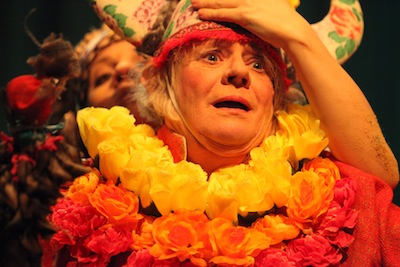
In Kate Davis's design, the stage is surfaced with a deep layer of earth, topped with a thin layer of a disconcertingly artificial green, with the earth mounded on one side to create a small hill. On three sides it's surrounded by what appear at first to be white curtains but which are in fact white paper streamers. Special consists of a series of scenes between the spectacularly pregnant Special (Mary Helen Sassman) and her mother Goldie (Liz Jones). When the lights first come up, Jones, in a white pantsuit, is slogging away on an exercise bike, while Sassman, decked out in a huge Indian headdress, is lying on her back, ostentatiously licking an ice cream. It's worth seeing for this image alone, which somehow evokes the emptiness of consumerism in one gloriously absurd moment.

The lighting and set emphasise toxic hues of green or oxidic white, so it seems that our characters are enclosed in a world which unsuccessfully mimics the natural world. Within this frame of the artificial, Sassman's pregnant belly (no illusion, there's a real baby in there) and the exposed earth suggest a chthonic anarchy on the point of eruption. This eruption - of anger, desire, violence, love - is more or less what happens through the show. Valente exploits some extremely effective lighting and sound design to create an almost Artaudian sense of transformation. Only this is - how do I put it? - a distinctly female exploration, in which conception and rebirth are much more than metaphors appropriated into masculinised meanings. There's a strong whiff of Hélène Cixous's "repressed" about the whole thing.

The relationship between Goldie and Special is both antagonistic and mutually dependent, and it's this relationship which gives vitality and shape to the bizarre rituals which they explore during the course of the performance. They collect the rubble of transcendence, scraps and fragments of ritual stolen from a grab bag of cultures - Native American, Spanish American, Catholic, tribal African - which they pile into an increasingly grotesque pastiche of faith.

Goldie announces it is her "special day", which involves an elaborately solemn costuming and which collapses into comic anti-climax. Instead, the mysteriously pregnant Special, whose child we begin to suspect is immaculately conceived, begins to create her own ritual. What's interesting is how this sense of transformation is embedded in the ridiculous: there's a lot that makes no sense, or at least, doesn't make any common sense. But it's riveting theatre.

Its theatrical movement makes me think of Octavio Paz's comments in his book on the sacred, Conjunctions and Disjunctions: "History is a discourse. But the rebellions of the twentieth century have violated both the rules of dramatic action and those of representation. We have unforeseen irruptions that disturb the linear nature of history ... both the events and the actors betray the text of the play. They write another text, or rather invent one. This is the end of discourse and rational legibility." Special mimics the formation of this "other text", opening possibility beyond the enclosures of words.

I haven't seen all The Rabble's work, having missed their Sydney productions, but Special is the first show I've seen that isn't hobbled by a sense of over-aestheticised seriousness. It's funny, tough, unafraid, and beautifully realised.


Silent Disco, which is part of the Full Tilt season at the Victorian Arts Centre, arrives from Sydney with a raft of glowing reviews. It's fair to say that the glow didn't transfer to me; without exactly hating it, I was scratchily disappointed. I guess I expected more than a competently realised, conventional social drama.

Lachlan Philpott's play about a doomed relationship between two misfit kids is directed by Lee Lewis, last seen here with her beautiful production of Twelfth Night for Bell Shakespeare. As with Robert Reid's The Joy of Text, the play is set in a school, and related through the matrix of educators; but in its tracking of adolescent breakdown, it recalls Declan Greene's Moth, recently remounted at the Malthouse. Unlike Moth, which created an authentic theatrical diction for its characters, Silent Disco never escapes the sense that this is an adult vision of young people. It's not surprising to find that Philpott has been a teacher.

Unlike Reid's The Joy of Text, teaching itself is presented unproblematically, as a known (if sometimes failing) function: a central character is the well-meaning English teacher Mrs Petchall (Camilla Ah Kin), observing with concern the disconnected, alienated generation hooked up to their iPods and Facebook. The "silent disco" of the title is one in which everyone dances to his or her own headphone music, which here becomes a somewhat obvious metaphor for social disconnection. I'm not sure it's that simple: this is an authority's perception of youth culture, which only awkwardly enters into the experience of what that culture is.

The central characters are troubled teens Tamara (Sophie Hensser) and Squid (Meyne Wyatt) who wind up towards inevitable crisis. In both cases, slightly disturbingly, their problem is absent, uncaring mothers - Tamara lives with her gay father, the Indigenous Squid with his auntie. Their awkward romance is derailed by Squid's criminal brother Dane (Kirk Page), who targets Tamara for seduction as revenge for being thrown out of the family house, and to undercut Squid's nascent ambitions to make something of himself.

Silent Disco affirms all sorts of worthy impulses - concern for deprived youth, the role of education, and so on - in the lingua franca of heightened naturalism. In two acts, it's overwritten and you can hear the dramatic shifts coming a mile off. The odd verbal or theatrical pyrotechnics don't prevent its being weighed down by predictability. The British have a brilliant tradition of socially committed work that looks at the experiences of alienated or deprived young people - think Ken Loach's devastating film Kes, or Tony Richardson's The Loneliness of the Long Distance Runner, or more recently Shane Meadowes's This Is England. Philpott's intentions are clearly in the same arena, but Silent Disco never gets near this kind of plain-speaking anger or emotional power, and it certainly isn't anywhere close in terms of political intelligence.

With her hard working and committed cast, Lee Lewis's direction injects the production with moments of vitality. There's Tamara's evocation of her first experience of sex, a delicate subject that here attains a moment of real theatrical power, or a comic portrayal of check-out chicks at the supermarket, sharply observed vignettes of social irony. Aside from these moments, it seldom touched me. It's fine, as far as it goes; it just doesn't go very far.

Pictures: Top: Liz Jones in Special. Photo: Marg Howell. Bottom: Meyne Wyatt (left) and Sophie Hensser in Silent Disco.

Special, directed by Emma Valente, concept by Emma Valente, Mary Helen Sassman. Devised and performed by Liz Jones and Mary Helen Sassman. Lighting, sound and composition by Emma Valente. The Rabble @ La Mama Courthouse, until August 21.

Silent Disco by Lachlan Philpott, directed by Lee Lewis. Designed by Justin Nadella, lighting design by Ross Graham, sound design and composition by Stefan Gregory. With Camilla Ah Kin, Sophie Hensser, Kirk Page and Meyne Wyatt. Griffin Theatre Company, Hothouse Theatre and Australian Theatre for Young People, at the Victorian Arts Centre Fairfax Studio, until August 13.

Read More.....

Tuesday, December 01, 2009

Review: The Harry Harlow Project

Love is a wondrous state, deep, tender, and rewarding. Because of its intimate and personal nature it is regarded by some as an improper topic for experimental research. But, whatever our personal feelings may be, our assigned mission as psychologists is to analyze all facets of human and animal behavior into their component variables. So far as love or affection is concerned, psychologists have failed in this mission.

The little we know about love does not transcend simple observation, and the little we write about it has been written better by poets and novelists. But of greater concern is the fact that psychologists tend to give progressively less attention to a motive which pervades our entire lives. Psychologists, at least psychologists who write textbooks, not only show no interest in the origin and development of love or affection, but they seem to be unaware of its very existence.


So begins Harry Harlow's classic paper The Nature of Love, delivered to the Annual Convention of the American Psychological Association in Washington DC in 1958. And so begins too The Harry Harlow Project, James Saunders' fascinating theatrical examination of Harlow's controversial experiments on baby rhesus monkeys.

The irony - more, the perversity - of Harlow's experiments is that, while they were driven by Harlow's almost lyrically expressed desire to understand something as unscientific as love, they were exemplary in their cruelty. He radically demonstrated the importance of maternal love - the security of physical affection - to the physical and psychological development of an infant by showing what happened to monkeys that received no affection and no socialisation. The result, unsurprisingly, was psychotic monkeys.

Then he went further, producing babies by forcing female monkeys raised in isolation - and who were so asocial they couldn't mate - into what he unblinkingly called his "rape pack", a wire restraining device which he used to force-mate females. Finally, he created his most notorious experiment,the "pit of despair", a cage of total isolation in which monkeys were sometimes confined for two years, with which he deliberately engineered clinical depression.

Aside from their ingenious cruelty, it's not difficult to discern a disturbing subtext of misogyny beneath some of these experiments: Harlow's "hostile mother", a machine of teeth and spikes that shot cold air on the unfortunate babies, seems like a caricature of a pathology. Yet these experiments revolutionised contemporary attitudes towards child rearing, changing practice in orphanages and rewriting the book on infant psychology. And he initiates a theory of fatherhood - "It is cheering ... to realize that the American male is physically endowed with all the really essential equipment to compete with the American female on equal terms in one essential activity: the rearing of infants," he noted at the end of his paper - which still has reverberations today.

In Harlow's day, childrearing authorities recommended that one should never kiss a child good night, but shake his or her hand. A generation of mothers listened in anguish to their crying babies, sure that should they obey their instincts and comfort them, they should be bad mothers. Harlow changed all that, legitimising human affection as more than mere "indulgence". For all that, it's hard to contemplate these experiments with any sense of ease. And it's hard to escape the thought that, by scientifically proving that maternal love was necessary to develop a healthy child, Harlow convinced the men in white coats of wisdoms that women in so-called "primitive" societies have known since, well, the beginning of time.

It's an ambiguous heritage, and James Saunders accesses much of its bleak emotional resonance in The Harry Harlow Project, which manages to be at once harrowing and funny without either cancelling the other out. The stage becomes a slapstick simulacra of Harlow's psyche, with some deft video work by Martyn Coutts and a subliminally disturbing score by Kelly Ryall framing a bravura performance by Saunders. The conceit - a just one, since in later life Harlow had ECG treatment for depression - is that in his increasingly sadistic experiments Harlow is enacting his own mental distress.

As a theatrical evocation of the hell of alienation, parts of this show are hard to beat. The stage - a white box scattered with minimal props - is fronted by sound and lighting boards, with the artists, their backs to the audience, orchestrating the show like lab technicians. A sequence where the actor interacts with his life-size projection - reaching out, like Michelangelo's God, to his fleshly human image, but finally unable to touch - is masterly. It's set up by an earlier sequence where Saunders is interviewed by a television, a device that works seamlessly through split-second timing but which here is comedic. Saunders' performance invokes the damaged monkeys through physical movement, which itself also presages Harlow's death through Parkinson's disease.

The narrative is told through fragmentary episodes that examine the experiments in tandem with glimpses of Harlow's personal life. At one point Saunders puts on a wig and becomes his own biographer; at another, he becomes Harlow's son. Curiously, in both these enactments he doesn't cease to be Harry Harlow: these other characters seem like mere projections. Perhaps what I found most interesting is how Lipson's direction coins a kind of dramaturgy of anxiety: from the beginning the comedy is uneasy, and despite the explosive release of laughter the tension subliminally winches up, not permitting any release, until the show is over. It left me with all that anxiety still in my body, bleeding out a slow release over the following days.

Perhaps because its black and white aesthetic so successfully evokes the sixties, it got me in personal places that I wouldn't have predicted from its set-up or subject. It made me think of how my father was sent to boarding school when he was four years old, and of my mother's unhappiness, raising babies alone in a mining village at the same time as Harlow was torturing monkeys. It made me think of the post-war scientist-god, certain that all human knowledge can be dissected and measured, sure in his march towards the ultimate good of Progress. It made me ponder again how such smart animals as human beings can get things so wrong.

Picture: James Saunders as Harry Harlow. The Harry Harlow Project, written and performed by James Saunders, directed and designed by Brian Lipson. Composition and sound design by Kelly Ryall, video art by Martyn Coutts, dramaturgy by Kate Sulan. Full Tilt, Fairfax Studio, Victorian Arts Centre until December 5.

Read More.....

Monday, June 15, 2009

Review: Poet No. 7

Any play with "poet" in the title is going to catch Ms TN's attention, although I have to admit that poetry doesn't necessarily fare well on the stage. Some of the worst nights of theatre I've suffered through have been misguidedly romantic imaginings about famous (and satisfactorily tragic) poets. Oh, the sins that have been committed in the names of Akhmatova and Mandelstam...

Ben Ellis is, however, far too tactful a writer to do this to us. The poet of his title is nameless: he has reached a truly poetic state of anonymity, and has even forgotten his own name. When X, a character driven mad by war, love and psychotropic drugs, takes his hand in greeting, the poet is dismembered by a bomb. X runs in a blind panic through burning GM crops (grown for military purposes) holding the poet's hand. "and i realise", says X, "that i have been running / for several kilometers of corn / with a dead man's arm / still shaking my hand".


This fragment of poet represents the fragment of poetry that informs the structure of this play - the idea that the light of stars is, literally, the manifestation of different times. As X says, the poet tells him that "that star there / that's three million years ago / and that star there / that's four years ago / what you are witnessing / is all different times / converging upon you". For Ellis's poet, this is a sign of hope. Andre Schwarz-Bart's brilliant novel on the Holocaust, The Last of the Just, works with a similar idea - "our eyes register the light of dead stars" - but more bleakly. For Schwarz-Bart, starlight is the touch of death, the irrevocable past that is only now news to us, but which in our belated present we can we can neither enter nor correct.

Nevertheless, like Schwarz-Bart (whose novel has other resonances with this play, including a character who turns into dog), Ellis is concerned with a series of apocalyptic presents, at once individual and global. Poet No. 7 is a series of four interwoven monologues that come from different fictional times and collide in the present of the stage. The four voices are Ella (Edwina Wren), a librarian who has fallen shatteringly in love; Mark (Merfyn Owen), a corporate executive in love with a younger woman who is selling patented indigenous crops to a big US company; Gillian (Georgina Capper), a woman who investigates the deaths of isolated people and who has to deliver a eulogy for a dead woman, and X (Simon King).

Through these monologues, Ellis creates a fictional world a micro-step away from ours. Australia is torn apart by some undefined war, its indigenous berries patented and genetically modified by corporate interests to make deadly military weapons. And in this imagined world, as in ours, people fall blindingly in love and die alone in apartments to be discovered weeks later.

It is an ambitious work, written in a plainly poetic vernacular that segues to moments of almost surreal lyricism. And as part of the Arts Centre's Full Tilt program, it's given a fascinating production by Ellis's long-time collaborator, Daniel Schlusser. The disappointing thing is that the writing can't sustain the pressure of the production: for too much of the play, the production and text are working at cross-purposes.

The first ten minutes or so, before any words are spoken, are riveting. Meg White's design, a thrust with audience on three sides and the sound and light technicians visible at a raised desk on the fourth, is plunged into darkness. What we see is a series of shrouded shapes, briefly illuminated by deep amber lights that pulse up to an unbearable brightness and then at once sink back into darkness. Then there is a camera's flash, illuminating three performers in face masks and rubber gloves and a fourth lying on the floor, a corpse draped in a plastic sheet. As we watch the performers scrutinise and file the objects on stage, we begin to understand that this is a forensic investigation.

The performers draw plastic sheets off the shrouded objects and turn on lights, revealing a strange landscape of glass tanks with a miscellany of things inside them: stuffed animals, a plastic penguin stranded in a desert of sand, even a live white mouse. It's unsettling, sinister and mysterious. One performer (Simon King) is creeping around the edges of the stage, hiding from the others. Later we discover that he is X, at once marginal and central to the action, the character through which the emotional action flows through madness and violence towards forgivenness.

By the time the performers begin to speak, we are already in another world. The transition to the text, which is already fragmented, is confusing: it takes quite a while to work out that the four monologues are autonomous, even if (as we discover) related, and to sort out their various stories. For the next fifteen minutes or so, I found my concentration constantly shifting, and mostly away from the text: I was so busy watching the various performers (and, at times, the very sanguine mouse) that sometimes I forgot to listen to the text altogether.

Then it began to come together in a different way, and the voices in this richly detailed production began to resonate against each other and drive its splintered narrative. This generates moments of real theatrical power, a poetic suspension of everything except the present moment. And in these moments, the whole thing begins to flower as a wholly integrated work of theatre.

There's much to see here, not least some astounding performances. The actors are totally focused for the duration, bringing a coherence to their stage presences that binds their often inscrutable actions with a compelling intention. There are three sound designers - Darrin Verhagen, Martin Kay and Nick van Cuylenburg - that provide collectively an elegantly evocative sonic environment. And Kimberly Kwa's lighting design, which uses both theatre lights and found lighting turned on and off by the performers, is stunningly good.

All the same, I suspect Ellis's play might have been better served with a production that tried to do less with it, with minimal staging and without the meta-narrative that Schlusser weaves around it. A lucid introduction of the different monologues might have solved a lot of my initial confusion. But then, perhaps the text's weaknesses would have been more exposed: I'm not entirely sure it could sustain a barer production. In any case, I had to go away and read it afterwards in order to understand better what the play was doing.

It's by no means badly written, and it's an interesting and ambitious take on a difficult theme: or maybe more accurately, many difficult themes (it's kind of like Ellis is dealing with Everything That's Wrong With The World, refracted through intimate moments of passionate human interaction). But I think that the text has dramaturgical problems: the voices, despite their differing narratives, are all too rhythmically similar to generate the electrifying contrasts that otherwise might have more clearly driven the play's emotional arc.

What I missed most was the steely language and rhythms that are the heart of lyric, a certain torque in the language itself. There are too many lines like " i look at flowers and cry / once i cried for longing / now i cry for sharing the beauty", lines that signal emotional intention but are too poetically generalised to rise past the bathos of cliché. And Ellis's writing can fall jarringly into didacticism. As soon as the torque in the language loosened, it ceased to be amplified by the theatrical context, but rather disappeared behind it.

Which makes it a deeply interesting production to think about, especially given the contemporary arguments about the relationship between writing and theatre. And, for all my reservations, it's well worth a look.

Picture: Edwina Wren in Poet No. 7. Photo: Daisy Noyes

Poet No. 7 by Ben Ellis, directed by Daniel Schlusser. Designed by Meg White, sound design and composition by Darrin Verhagen, Martin Kay and Nick van Cuylenburg, lighting design by Kimberly Kwa, costume design by Jemimah Reidy. With Edwina Wren, Merfyn Owen, Simon King and Georgina Capper. Full Tilt @ the Black Box, Victorian Arts Centre, until June 20.

Read More.....