Review: Special, Silent DiscoReview: The Hollow, The Bedroom ProjectReview: CagelingMonday reportReview: Osama the Hero/Ying Tong/Circus Oz ~ theatre notes
Showing posts with label the rabble. Show all posts

Tuesday, August 09, 2011

Review: Special, Silent Disco

I wish I could adequately explain the irrational joy that The Rabble's latest work, Special, invoked in me when I saw it last week. There is something in it of pure theatre, unafraid act, that set a flame in the gloom that has bedevilled me this long Melbourne winter. Or maybe it's just liberating to see something this angry.

In Special, The Rabble confront the psychic disintegration of contemporary life. Emma Valente and her collaborators tap into the increasingly ominous sense that it is later than we think, that the endemic violence that powers the machinery of our society - violence against people, against meaning and relationship, against the living systems of our planet - is accumulating to a point of crisis. In such a time, what can meaning mean?

We are left with the absurd, the abyss over which our attempts at continuity and knowledge and purpose flail and expose their emptiness. Yet what The Rabble track in their vignettes is not, for all its sardonic exposures of failure, a trajectory towards nihilism, but a strange and exhilarating affirmation. "If nothing had any meaning, [nihilism] would be right," said Camus in the 1940s. "But there is something that still has a meaning." It's that "something" - relationship, the possibility of transformation - that is at the centre of this extraordinary work of theatre.

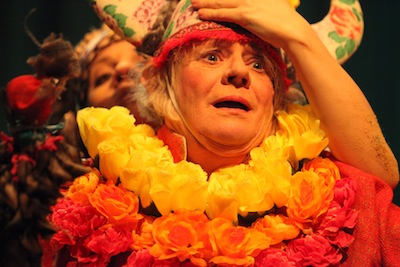
In Kate Davis's design, the stage is surfaced with a deep layer of earth, topped with a thin layer of a disconcertingly artificial green, with the earth mounded on one side to create a small hill. On three sides it's surrounded by what appear at first to be white curtains but which are in fact white paper streamers. Special consists of a series of scenes between the spectacularly pregnant Special (Mary Helen Sassman) and her mother Goldie (Liz Jones). When the lights first come up, Jones, in a white pantsuit, is slogging away on an exercise bike, while Sassman, decked out in a huge Indian headdress, is lying on her back, ostentatiously licking an ice cream. It's worth seeing for this image alone, which somehow evokes the emptiness of consumerism in one gloriously absurd moment.

The lighting and set emphasise toxic hues of green or oxidic white, so it seems that our characters are enclosed in a world which unsuccessfully mimics the natural world. Within this frame of the artificial, Sassman's pregnant belly (no illusion, there's a real baby in there) and the exposed earth suggest a chthonic anarchy on the point of eruption. This eruption - of anger, desire, violence, love - is more or less what happens through the show. Valente exploits some extremely effective lighting and sound design to create an almost Artaudian sense of transformation. Only this is - how do I put it? - a distinctly female exploration, in which conception and rebirth are much more than metaphors appropriated into masculinised meanings. There's a strong whiff of Hélène Cixous's "repressed" about the whole thing.

The relationship between Goldie and Special is both antagonistic and mutually dependent, and it's this relationship which gives vitality and shape to the bizarre rituals which they explore during the course of the performance. They collect the rubble of transcendence, scraps and fragments of ritual stolen from a grab bag of cultures - Native American, Spanish American, Catholic, tribal African - which they pile into an increasingly grotesque pastiche of faith.

Goldie announces it is her "special day", which involves an elaborately solemn costuming and which collapses into comic anti-climax. Instead, the mysteriously pregnant Special, whose child we begin to suspect is immaculately conceived, begins to create her own ritual. What's interesting is how this sense of transformation is embedded in the ridiculous: there's a lot that makes no sense, or at least, doesn't make any common sense. But it's riveting theatre.

Its theatrical movement makes me think of Octavio Paz's comments in his book on the sacred, Conjunctions and Disjunctions: "History is a discourse. But the rebellions of the twentieth century have violated both the rules of dramatic action and those of representation. We have unforeseen irruptions that disturb the linear nature of history ... both the events and the actors betray the text of the play. They write another text, or rather invent one. This is the end of discourse and rational legibility." Special mimics the formation of this "other text", opening possibility beyond the enclosures of words.

I haven't seen all The Rabble's work, having missed their Sydney productions, but Special is the first show I've seen that isn't hobbled by a sense of over-aestheticised seriousness. It's funny, tough, unafraid, and beautifully realised.


Silent Disco, which is part of the Full Tilt season at the Victorian Arts Centre, arrives from Sydney with a raft of glowing reviews. It's fair to say that the glow didn't transfer to me; without exactly hating it, I was scratchily disappointed. I guess I expected more than a competently realised, conventional social drama.

Lachlan Philpott's play about a doomed relationship between two misfit kids is directed by Lee Lewis, last seen here with her beautiful production of Twelfth Night for Bell Shakespeare. As with Robert Reid's The Joy of Text, the play is set in a school, and related through the matrix of educators; but in its tracking of adolescent breakdown, it recalls Declan Greene's Moth, recently remounted at the Malthouse. Unlike Moth, which created an authentic theatrical diction for its characters, Silent Disco never escapes the sense that this is an adult vision of young people. It's not surprising to find that Philpott has been a teacher.

Unlike Reid's The Joy of Text, teaching itself is presented unproblematically, as a known (if sometimes failing) function: a central character is the well-meaning English teacher Mrs Petchall (Camilla Ah Kin), observing with concern the disconnected, alienated generation hooked up to their iPods and Facebook. The "silent disco" of the title is one in which everyone dances to his or her own headphone music, which here becomes a somewhat obvious metaphor for social disconnection. I'm not sure it's that simple: this is an authority's perception of youth culture, which only awkwardly enters into the experience of what that culture is.

The central characters are troubled teens Tamara (Sophie Hensser) and Squid (Meyne Wyatt) who wind up towards inevitable crisis. In both cases, slightly disturbingly, their problem is absent, uncaring mothers - Tamara lives with her gay father, the Indigenous Squid with his auntie. Their awkward romance is derailed by Squid's criminal brother Dane (Kirk Page), who targets Tamara for seduction as revenge for being thrown out of the family house, and to undercut Squid's nascent ambitions to make something of himself.

Silent Disco affirms all sorts of worthy impulses - concern for deprived youth, the role of education, and so on - in the lingua franca of heightened naturalism. In two acts, it's overwritten and you can hear the dramatic shifts coming a mile off. The odd verbal or theatrical pyrotechnics don't prevent its being weighed down by predictability. The British have a brilliant tradition of socially committed work that looks at the experiences of alienated or deprived young people - think Ken Loach's devastating film Kes, or Tony Richardson's The Loneliness of the Long Distance Runner, or more recently Shane Meadowes's This Is England. Philpott's intentions are clearly in the same arena, but Silent Disco never gets near this kind of plain-speaking anger or emotional power, and it certainly isn't anywhere close in terms of political intelligence.

With her hard working and committed cast, Lee Lewis's direction injects the production with moments of vitality. There's Tamara's evocation of her first experience of sex, a delicate subject that here attains a moment of real theatrical power, or a comic portrayal of check-out chicks at the supermarket, sharply observed vignettes of social irony. Aside from these moments, it seldom touched me. It's fine, as far as it goes; it just doesn't go very far.

Pictures: Top: Liz Jones in Special. Photo: Marg Howell. Bottom: Meyne Wyatt (left) and Sophie Hensser in Silent Disco.

Special, directed by Emma Valente, concept by Emma Valente, Mary Helen Sassman. Devised and performed by Liz Jones and Mary Helen Sassman. Lighting, sound and composition by Emma Valente. The Rabble @ La Mama Courthouse, until August 21.

Silent Disco by Lachlan Philpott, directed by Lee Lewis. Designed by Justin Nadella, lighting design by Ross Graham, sound design and composition by Stefan Gregory. With Camilla Ah Kin, Sophie Hensser, Kirk Page and Meyne Wyatt. Griffin Theatre Company, Hothouse Theatre and Australian Theatre for Young People, at the Victorian Arts Centre Fairfax Studio, until August 13.

Read More.....

Tuesday, November 09, 2010

Review: The Hollow, The Bedroom Project

Ms TN spent most of last week in her bathchair with smelling salts taped under her nose, which partly accounts for the belatedness of these reviews. But it's also because Daniel Schlusser, who directed The Hollow, and The Rabble, who created The Bedroom Project, are among our more restless experimental artists. The work of both is an on-going interrogation of theatre, and consequently they make shows that are quite difficult to write about. Not many hooks, see, and those that are offered tend to be illusory.

Schlusser's relationship with the VCA has been a fruitful one. A trilogy of projects - A Dollhouse, Life is a Dream and Peer Gynt - took classic texts and applied extreme theatrical pressure, resulting in some of the most interesting theatre that Melbourne has seen over the past three years. And, intriguingly, after tackling Ibsen and Calderón, he has turned to... Agatha Christie. Agatha Christie? Well, maybe it's not unlikely; not only does theatre feature as a major trope in much of Christie's writing, but her novels, which have now sold in their billions, have been widely adapted into hugely popular plays, screenplays and television dramas.


The Hollow is one of Christie's Hercule Poirot novels, although she left Poirot (as Schlusser has) out of her stage adaptation. It has the usual Christie motifs. Like almost all her detective fiction, it creates a fantasia of upper middle class England, with a cast of privately wealthy characters who are imprisoned in a belljar (a hotel, a country house, a village) noxious with repressed desire. In The Hollow, Poirot arrives at a country house to find a murder scene which he initially believes, because of its obvious contrivance, is a poorly judged joke by his hosts. The surprise twist is that what is set up as an obvious falsehood is in fact the actual case: the mousy wife of a glamorous and unfaithful Harley St doctor has murdered her husband.

It's unfair to Christie to say that her novels are little more than a series of cleverly turned tropes, but it's is one reason why she remains so enduringly popular. Her characters are not quite stereotypes, but they are instantly recognisable, with enough wit and authentic feeling in their portrayal to plump out their legible outlines, and the predictability of the outcome - the solution of the crime - is satisfyingly played out against the variables of character and class, until a proper order is at last restored.

The forward momentum of her crime fiction exists in the continually delayed moment of satisfaction, the moment when the crime that threatens the gleaming surface of her characters' lives is dragged out into the open air and expiated through its rational explanation. Detective novels are perhaps the popular fiction par exemplar of the Enlightenment: they shimmer with the promise of rationality dragging out and vanquishing the murderous monsters of the id.

Schlusser makes of this a theatre that is almost entirely a formal investigation of the tension between artifice and authenticity. Unlike the other three productions, this is not a show that brings profundities to the surface. It's more a kind of gothic pantomime, disinterestedly lifting generic rocks in order to poke the wriggling uglinesses of the English class system that Christie's novels reveal.

Its near two hour duration is a hypnotic and often comic unravelling of the events that led to the crime: or, to be more precise, the non-events in between the events. It is mostly a series of apparently unstudied moments, which puts the audience in the position of naturalists observing human behaviour. These scenes are offered to us raw, seemingly without mediation: we witness half-heard conversations, unhurried domestic routines, inconsequential games, punctuated every now and then by a sudden flurry of activity that leads to a tightness of focus: a quarrel, a dance routine, an infidelity.

Effectively, The Hollow is a theatrical exploration of frustration. Delayed satisfaction is the entirety of its dramatic mechanism: all the way through characters are holding cigarettes, calling for matches that never arrive until the final moment, when an actress showily lights and inhales. The characters of The Hollow circulate on stage in little whirlpools of private activity that seems to lead nowhere, constant eddies of tension and relaxation that slowly and inexorably wind up the tension to the single moment of truth: the murder, stripped of its theatrical falsity.

These mundane moments are fractured by elements that are both sinister and absurd - monkey masks, rubber ducks, rabbit traps - that prevent this apparent naturalism from being merely illustrative. The distinctions of privilege, threatened by the crime, are brutally enforced, as is particularly clear with the servants; the maid is humiliated, the butler ends up as a parody in blackface. The murder itself is genuinely disturbing, a sudden moment of messy authenticity in what has been a continuous exhibition of artifice. It's richly ironised, of course, by our knowledge that we are watching a work of theatre: what occurs is a sudden shifting of key from one kind of theatrical contrivance to another, the second generating a moment of genuine affect.

Schlusser orchestrates these spiralling energies with a fine attention to the respiration of the stage, its choreography and rhythm, teetering on the edge of boredom with a finesse that for me intensified the fascination. The set, a kind of stylised abstraction of Edwardian decor, continually transforms: often you don't see the mechanism, so objects and people seem to appear and disappear of their own accord, as if the stage itself is malign. Its irrational evolutions and surreal excess reminded me rather of AES+F's photographic series, The Feast of Trimalchio, which was here for the Melbourne Festival. The Acting Company 2010 perform more than creditably, although Elizabeth Debicki as the naif murderess made wonder what might have happened if all the cast could have generated her unstudied, exact presence.

*


If Melbourne has an equivalent to the Pre-Raphaelite Brotherhood, it surely has to be The Rabble. A loose collection of artists who have been making theatre in Melbourne and Sydney for several years, they are producing some of the most densely serious performances and provocations seen here recently, valuing the "direct and serious and heartfelt" in a way that rebukes any shallowness of response.

Theirs is a high-risk altitude, and - as with their last show, Cageling - it doesn't always work for me: innocence might segue into naivety, or fruitful ambiguity into a sudden jarring obviousness; sometimes there seems to be no invitation into their meanings, and what should be a refusal of ease simply locks the audience out. Yet for all that, it's impossible to deny that The Rabble's explorations can produce astonishingly powerful creations that vibrate unsettlingly in the mind long afterwards.

Their work unabashedly expresses a post-romantic nostalgia for innocence and beauty, and touches an oneiric strangeness that leans on the verge of consciousness, vibrating in the liminal state between waking and dream. Perhaps, as much as the Pre-Raphaelite twilight, they belong with the Symbolists: this work expresses delirium, perversion, corrupted purity, erotic ambiguity, an almost mediaeval sense of the hieratic.

The Rabble's performances have often seemed as much installation as theatre, and so it's not surprising that The Bedroom Project should have found a home at Linden Centre for Contemporary Arts. The Bedroom Project is first of all a series of installations in five different rooms, constructed by Emma Valente, Kate Davis and Dan Spielman. They are all weird memory boxes: in one, The Glass Mattress and The Silver Sword, an oval ring is suspended above a grubby mattress, from which sweep metal bars that enclose the bed rather like a strange bird cage. The room looks as if it is the site of an obscure ritual: a number of octagonal fishtanks are placed around the mattress, each half-full of white wax or watery milk, on top of which floats a silver dagger.

The Room of Regrets is another bedroom, with a disembowelled mattress, again with a construction suspended above it: this time a kind of curtain made of individual sheets of toilet paper joined together with metal rings, each marked with orange and yellow stains, suspended from an ovoid ring. An art deco dressing table with large mirrors is cluttered with jars, an electric jug, a teapot and heaped with salt, which is also scattered on the floor. A third room, Pink Dreams, is simply a corridor illuminated by shifting red light. The floor is covered with a thick layer of feathers; on the walls hangs a crude skull mask made from cardboard and from the ceiling are suspended white nightdresses.

Inside the Mattress is so full of smoke you can barely see the walls, although a single torch illuminates a dim spot on the wall. In the centre you can make out a many-sided construction that seems to be a drinking fountain. The final room, Tonics and Poisons, is the biggest and is mostly empty: at one end is a kind of low, white altar with a fountain trickling out streams of blue water. Suspended above it is a bright yellow, intricately constructed hanging made of marigolds.

In performance, with the help of a complex soundscape of subliminal electronic sounds and ambient natural noises by Tommy Spender, all these spaces are animated into environments of dream. This is work that is inescapably feminine (as opposed, say, to being about the feminine); it's impossible not to think of Christina Rossetti. The audience is divided into three and led separately into different galleries, where each witnesses interlocking performances by Dana Miltins and Mary Helen Sassman. How you experience it depends in which order you encounter the rooms: I was in The Glass Mattress room first, followed by Inside The Mattress, and lastly The Room of Regrets. The audience joins for the final part of the performance in Tonics and Poisons.

The Bedroom Project is a love story: "Isabella and Irena are lovers. Isabella has killed a bird. Irena has killed Isabella." Imprisoned in their solitary sublunar worlds, Miltins and Sassman, dressed in Pre-Raphaelite white nighties, enact mysterious rituals that express desire and alienation, hatred and love. During the first three parts, we can overhear the performances in the other rooms, which generates an increasingly unsettling sense of absence: as those overheard sounds - cries, crowd noises, impassioned declamations - explain themselves when we witness them, they become the more inexplicable.

The performance is at its most powerful when it is suspended in mystery, when, as happens often, an extraordinary theatrical image - a half-seen figure groping along a wall, a bandaged woman cursing as she violently hurls handfuls of salt on the floor - seems to knock on the door of meaning, without quite entering. What text there is is often jarringly obvious, pushing us towards a narrative that is the weakest part of the work. It could be that it might be more fruitful for the company to explore the etiolations of a poet such as Mallarmé than the crude neo-Romanticism they use here. But equally, it might be that the articulations of language are simply too crude for the ambitions of The Rabble: the text exposes a sentiment and obviousness that the other aspects of the performance, especially the visuals and sound, gloriously transcend.

Pictures: top: The Hollow. Photo: Jeff Busby. Bottom: The Room of Regrets, The Bedroom Project. Photo: Marg Horwell

The Hollow by Agatha Christie, adapted and directed by Daniel Schlusser, Set Designer Romanie Harper, Costume Designer Zoe Rouse, Lighting Designer Megan Fitzgerald, Sound Designer Nick McCorriston, Stage Manager Shayndle Grinblat. Performed by Alicia Beckhurst, Francesca Bianchi, Paul Blenheim, Zoe Boesen, Dean Cartmel, Elizabeth Debicki, Tom Dent, Tom Hobbs, Christopher Ioan Roberts, Renae Shadler, Jack Starkey-Gill and Cate Wolswinkel. Victorian College of the Arts Drama and Production schools, Grant St Theatre. Closed.

The Bedroom Project, created by Emma Valente, Kate Davis and Dan Spielman, performed by Dana Miltins and Mary Helen Sassman, sound by Tommy Spender. Linden Centre for Contemporary Art. Closed.

Read More.....

Friday, May 07, 2010

Review: Cageling

Few poets write of desire with such passionate delicacy as Federico García Lorca. Lyric, erotic and savage, his poems celebrate the anguish of absence, the bittersweet longing for what cannot be possessed. When he writes of his home city Granada, he imagines an ideal beauty, the "spiritual colour" which Andalusia woke within him. This beauty exists within and beyond the "poor cowardly city", the "miser's paradise" that contains "the worst bourgeoisie in all Spain", of which he wrote bitterly only months before he was shot dead near Granada by Fascists. He saw the real as clearly as the possible.

In Lorca's poetry, repression squeezes desire into a defiant brilliance. Lorca was gay - some claim that is the reason that he was murdered - and so, in a world of absolute divisions, he existed on the penumbra between both sexes, a fluid creature of the twilight, weaving his poems out of the blinding contrasts between night and day. He made of them paeans to life in which beauty is a measure of mortality: "Like all ideal things," as he says in a poem about fountains, "they are moving / on the very edge / of death."


His theatre articulates these tensions in different ways. Lorca's plays attacked the bourgeois theatre of his time both stylistically and thematically, uniting a burning passion for social justice with a take on tragic poetry that incorporated influences from Shakespeare to Surrealism. He is most famous for his "rural trilogy", Blood Wedding, Yerma and The House of Bernarda Alba, the last of which he completed two months before his assassination. In all of them, but especially in The House of Bernarda Alba (which is subtitled "A Drama of Women in the Villages of Spain"), Lorca presents a critique of the place of women in Spanish society.

The House of Bernarda Alba is the story of the newly widowed Bernarda and her five daughters. Bernarda turns the frustrated rage of her marriage into an uncompromising tyranny over her children, insisting that she is the only authority in the house. As one daughter - enriched by her step-father's death - is courted, the others are riven by jealousy and desire. The youngest and most beautiful daughter becomes the mistress of her sister's fiance, with tragic results. It's a bitterly savage portrayal of the internalisation by women of the chains of patriarchy.

This is the world that The Rabble, one of the most interesting young companies around town, explores in Cageling, a work of physical and visual theatre that springs from Lorca's final play. Created, co-directed and designed by Kate Davis and Emma Valente, it is most certainly not, except in the most abstract sense, a performance of the play: aside from a few fragments Lorca's text scarcely exists, except in how images from the text have been amplified and embodied. In fact, often it seems more like an attempt at physicalising the qualities of Lorca's poetry, which is, along with a little Ovid, interpolated into the minimal text. [Correction: the poem, Grandmother's warnings to Carlota and Ana, is actually by Ana Rosetti. Though I would have sworn it was Lorca]. While Lorca (with, I think, a certain irony) said his play was intended as a "photographic documentary", this is a theatre of dream and nightmare, seeking to tap the unconscious in parallel ways to Lorca's surreal lyrics.

I had an interesting time watching this show: my responses shifted wildly through its duration, from irritated impatience to straight-out impressed. The design is stunning: the set is a wooden box placed in the middle of the space, with paned windows facing out to the audience, who sit a couple of metres away. The inside of the box is painted white, and the costumes and various props are black, reflecting the austerely beautiful world Lorca describes in his play. Near the window is a microphone.

When the audience enters, the actors are already inside, trapped in this box from which they cannot escape. There are five of them - Daniel Schlusser, Dana Miltins, Mary Helen Sassman, Jayne Tuttle and Pier Carthew. Both men and women are sexually ambiguous: they wear the constricting dress of formal mourning but are sometimes bearded, sometimes male, and they all wear ballet shoes.

For 20 minutes, nothing happens: the performers shuffle from one side of the stage to the other in tiny ballet steps, rehearsing the mundane domestic routine. At one point, Schlusser moves across to the microphone and taps it, before retreating without saying anything. Expectation is drawn out to such a pitch that for me the thread broke: I wasn't wound into the action, as can happen with this kind of uncompromising refusal, but rather thrown aggressively outside it. The windowpanes already forbid direct relationship, and the actors face the centre of the stage, in a wholly contained, alienated world. I really thought I might scream.

And yet - and yet - gradually, backed by Matt Davis's nuanced sound design, the show winds up, almost imperceptibly, into an extraordinary expression of repressed desire that explodes volcanically into violence. I missed The Rabble's two earlier shows, Corvus and Salome, which were both produced in Sydney, but I can see why this work has prompted some people to draw comparisons with Romeo Castellucci. Although The Rabble is doing quite different things, the ambition - and often, the potency - of the theatrical images this company creates are in the same universe. When these images work, they are sheerly strange, poetic, erotic, disturbing. Their sense is the language of dream.

Aside from its oneiric choreography, Cageling's power comes from the courage of the performances, which are rigidly disciplined, and yet reach into extremity. Schlusser, playing Bernarda Alba, is compelling: he is both male and female, as Alba herself takes on the role of patriarchal tyranny, or like a priest, whose spiritual authority is signalled by feminine dress. His is the voice which insists, as Pier Carthew attempts to recite a poem into the microphone, on the emotional truth of its language: this is real, what is this reality, what is it?

The minute exactness of the performances and movement play against what feels like a fuzziness in the broader direction and structure of the piece. This kind of theatre, like a poem, depends crucially on rhythm: the pulse of contrast, the shaping of transition. These are aspects Castellucci judges to a micron. Thinking it over afterwards, I thought it was here that I felt most problems with the show: its structural rhythmic uncertainty means that the relationships between stillness and movement often fail to be kinetic, each investing each with potential energy. Sometimes the inhibition it seeks to express seems instead an aesthetic inhibition.

In short, it's fascinating, frustrating, beautiful. And also clearly in evolution. I'm sure later shows - I saw it on opening night - have developed from what I saw, and I'd be very curious to see it again. Sydneysiders get a chance to see it for themselves when it opens at Carriageworks on June 24.

Picture: Dana Miltins in Cageling. Photo: Daisy Noyes

Cageling, devised from The House of Bernarda Alba by Federico García Lorca. Co-created, designed and directed, by Emma Valente & Kate Davis, sound design by Matt Davis, dramaturgy by Dan Spielman. With Daniel Schlusser, Pier Carthew, Dana Miltins, Mary Helen Sassman and Jayne Tuttle. Fortyfive Downstairs unti tomorrow night (booked out). Carriageworks, Sydney, June 24 to July 3.

Read More.....

Monday, May 03, 2010

Monday report

Gad, what a weekend. Your faithful blogger has been, and continues to be, under the pump: Herakles and the Hydra ain't got nothing on me. Having dealt two major snaky deadlines the old snickersnack, I now have a very busy fortnight coming up being a journalist (if I say it involves six deadlines and two major articles, perhaps you will pity me. Or perhaps not. Up to you).

There are a couple of things I want desperately to blog, and will, somehow. The MTC's Richard III is a must-see - if you love theatre and live in Melbourne, you'd be nuts to miss it. Lots to say, and I can say very little of it in today's review in the Australian, but you get the general idea. I also saw The Rabble's Cageling - a take on Lorca's The House of Bernarda Alba - at 45 Downstairs on Friday night. I had more mixed responses to this, but it's definitely worth your time - ambitious visual and physical theatre with some stunning moments.

Meantime, my helpmeet, colleague and erstwhile husband, Daniel Keene, has abandoned me for the delights of Paris. I mention this because some of you might be interested in what he's doing there. A few things: his play Scissors, Paper, Rock, which premiered in Melbourne with the Keene/Taylor Project, opens at La Colline Théâtre National in Paris next week, after an out-of-town season in Amiens that has garnered ecstatic reviews, and before a national tour. Along with La Comédie Française, L'Odéon, the Théâtre National de Chaillot and the TNS in Strasbourg, La Colline is one of the most important subsidised theatres in France, so it's quite a big deal. He's also being guest of honour at a convocation of theatre publishers in Paris (can you imagine such a thing here?), and then will spend two weeks in residence with a company in Rodez, working a new play which is programmed for later this year at the Théàtre National de Toulouse.

Meanwhile, my face still numb after a couple of delightful hours at the dentist, I'm off to the launch of Malthouse Season 2. And then on to Theatre Works to see [Title of Show]. If I'm a bit quiet here, you'll know why.

Read More.....

Monday, June 25, 2007

Review: Osama the Hero/Ying Tong/Circus Oz

Osama the Hero by Dennis Kelly, directed by Syd Brisbane. Designed by Kate Davis, sound design Tommy Spender, lighting design by Nik Pajanti. With Jessie Beck, Kevin Hopkins, Hannah Norris, Xavier Samuel and Thomas Wright. The Rabble @ La Mama Courthouse Theatre untilJuly 7.

Ying Tong: A Walk with the Goons by Roy Smiles, directed by Richard Cottrell. Set and costume design Michael Scott-Mitchell, lighting design Damien Cooper, sound effects by Paul Charlier, sound design by Jeremy Silver. With Jonathan Biggins, Tony Harvey, David James and Geoff Kelso. Sydney Theatre Company presented by the Melbourne Theatre Company @ the Arts Centre Playhouse until July 28.

Circus Oz: Under the Big Top. Various artists. Birrarung Marr Park (between Federation Square & Batman) until July 15.


Little Alison felt rather strange last week. I emerged from a tunnel more than half a million words long to find an alien world in which the force of gravity had decreased by around 75 per cent. Birds tootled merrily in the trees, the clouds were the colours of ice-cream and dogs bounced along the street like helium balloons. I was buzzing around Melbourne like a stoned hippy.

This, thought I, is what it's like not to be a writer. Whatever was I thinking? But life, being stern and unforgiving, reminded me that there's really not anything else I can do with myself (and if sufficiently threatened, I'll admit I quite like it, really); so it's back to the word-forge for me. Especially since I've seen three shows since last Thursday, and had better earn my tickets. I realise I'm cheating slightly by doing an all-in-one, but I fear that happy word-free daze was rather seductive, and I've been a little hoppity about writing anything.

On Thursday, I went with immense curiosity to the opening of The Rabble's production of Dennis Kelly's Osama The Hero. The Rabble is a Sydney-based collaboration between Syd Brisbane, Kate Davis and Emma Valente. I've been aware of these artists for some time, but this is the first Rabble production I've seen. It confirms my suspicion that this is a company to watch.

They're an interesting bunch, to say the least, and they're not exactly short on ambition. Davis and Valente are young artists who were previously based in Melbourne, where they founded a company called Self-Saucing Pudding. Their work was seen here last year, when they produced a fascinating take on revenge tragedy for Hoist Theatre at Theatreworks. Most recently, Kate Davis directed Corvus, by the young Melbourne writer Jasmine Chan, for The Rabble at Carriageworks in Sydney. Syd Brisbane has been around a little longer; he was originally based in Adelaide, acting with companies like the Red Shed and Brink Productions and, after Brink's co-production of the world premiere of Howard Barker's Ecstatic Bible at the 2000 Adelaide Festival, with Barker's company The Wrestling School in the UK.

Osama The Hero is a remount of a production that premiered in Sydney last year. Sydney in fact seems to be making the running on Dennis Kelly, an intriguing British writer who made big waves in 2003 with his nightmarishly surreal play Debris, which toured here last year from Sydney as part of the Fringe Festival. It's easy to see why he attracts attention: Kelly is a writer whose work combines a gift for poetic with often brutal realism, out of the school of Sarah Kane, David Harrower or Anthony Neilson. Like these playwrights, his work emerges from the spiritual desolations and alienations of contemporary Britain: while Debris concerned itself with violent family dysfunction, Osama The Hero explores the ethics of social paranoia in a time of terror.

Written in a series of fragmented monologues and dialogues, the play circles around the naive misfit Gary (Xavier Samuel), who lives on an estate where someone is blowing up rubbish bins and garages. When he is asked to present a paper at school on a contemporary hero, he comes up with Osama Bin Laden. He argues that Bin Laden - an ascetic who has fought for his beliefs, who turned away from a massive family fortune to fight the Russians in Afghanistan - is, to those who admire him, the equivalent of Churchill to the British. And he asks why it's considered heroic to kill thousands of civilians in one circumstance (Dresden, for example) and not in another (such as the events of September 11).

His paper causes a scandal, and attracts the attention of the siblings Louise (Hannah Norris) and Francis (Thomas Wright), both the products of a particularly brutal father. Francis is a speed-burned paranoiac, whose free-floating aggression is at first directed towards Mark (Kevin Hopkins), whom he believes is a paedophile. But when he hears about Gary's paper, he is convinced the boy is a terrorist and must be responsible for the explosions on the estate. In a gruelling scene, he and Louise turn vigilante: they capture Gary, tie him to a chair and torture him.

This sink-estate brutality is intercut with visions of middle-class aspiration and failure. The couple Mark and Mandy (Jessie Beck) exemplify a Posh-and-Becks aspirational fantasy: material wealth and comfort, the sheen of a "successful" marriage with the obligatory cute child. But it swiftly becomes clear that they are as emotionally impoverished as their neighbours, as spiritually alienated, as lost and as brutal. The play closes with three intercut monologues which open up the desolate loneliness, the desperate desire for simple human kindness, that in different ways drive all Kelly's characters, and which deliver a indictment, at once damning and compassionate, of an alienated, grossly materialistic society.

Osama The Hero is not as successful a play as Debris; for one thing, while it never falls into the trap of moral proselytising, it sometimes totters along the edge of it. But more specifically, I couldn't escape the feeling that this play's cruelties are so particular to Blair's Britain - to its sink estates, its class system and tacky television celebrity, even its urban landscape - that transferring it to an Australian context makes it lose much of its power. I'm not quite sure why this is so: after all, it's entirely possible to watch plays from 19th century Russia or 16th century Spain and not to feel at all alienated by their context; but I suspect that, except in the moments when Kelly touches a true humane complexity, his vision is limited by a very specific anger. This play was, after all, written in response to the UK's invasion of Iraq in 2003.

All the same, it's worth noting that Kelly's analysis of the crudities of mob justice is rather chillingly replicated on one of our very own right wing blogs. The mere title of the play was enough to bring out the slavering wingnuts, who - like Kelly's vigilantes - never permit mere facts to get in the way of a good bigotry. (I'm not giving a direct link, having no desire to attract said wingnuts: curious readers can find it on google here).

The first thing you notice on walking into the Courthouse is Kate Davis' stunning design: the entire stage is curtained in white fabric, lit inside to give a faint, soft luminosity. The curtains open to reveal a two-level stage painted antiseptic white: there's a broad area front stage, in which is suspended a miscellany of window frames, and a narrow area back-stage, across which is a huge image of a mountain range. The mountains seemed to me a mistake; while they simultaneously conjure the travel-brochure asppirations of Mark and Mandy and Gary's ascetic fantasies of Bin Laden, they seemed an unnecessary illustration in a set that was otherwise a beautiful theatrical abstraction.

Syd Brisbane uses the set imaginatively, and elicits committed performances from his cast. I was particularly impressed by Kevin Hopkins, whose unhappy smile becomes more and more painful, and Thomas Wright as the paranoid and brutalised Francis. Occasionally the direction wavers: when the actors dip their hands into buckets of blood and drip it onto the stage as they speak their final monologues, it struck me as naive theatrical metaphor (yes, we all have blood on our hands!) but, more importantly, it limits the actors' physical expressiveness. But this production's strengths well outweigh its weaknesses, and make this a show well worth a visit.

Ying Tong: A Walk With the Goons seems to invoke a very different world from Dennis Kelly's vision; but in fact, there are subterranean continuities. As any Goon nut knows (and I suppose, having been raised on BBC radio comedy, and being in possession of practically every text Spike Milligan ever published, I must count as one of those) the Goons' anarchic comedy was, among other things, a response to the trauma of World War 2 and the sheer bleakness of post-war Britain.

This was really a play that was waiting to be written, and clearly Roy Smiles was the man to do it. It threads Milligan's famous depressions - partly caused by his experiences as a soldier in Africa - into the manic comedy of the Goon Show. I expected a nostalgic evocation of the Goons, with the requisite imitations of Bluebottle, Eccles, Major Bloodknock and all the rest. A show, in short, that bought into the enduring popularity of this still wildly funny comedy, while gently reminding us of its darker currents...

And that is exactly what I got. But I was mistaken on one point: I thought this predictable recipe would add up to an excruciating evening. I was pleasantly surprised to find myself riding the Goon bandwagon with no signs of pain at all. This STC import is the best thing I've seen at the MTC for quite a while; it's stylishly directed and designed, and it's performed by a bunch of actors who look as if they're hugely enjoying themselves. And why not? It was probably once every British schoolboy's dream to be drinking "brown milk" (the brandy-laced milk they scoffed backstage) with Milligan (Geoff Kelso), Harry Secombe (Jonathan Biggins), Peter Sellers (David James), Wallace Greenslade (Tony Harvey) and the boys. It certainly was Prince Charles's.

Ying Tong opens with a re-enactment of a BBC radio recording, which was always performed in a theatre before a live audience. It's a clever device, because the audience immediately gets into the feel of the show and enthusiastically obeys the red APPLAUSE sign above the stage. I don't know if the script they perform is an actual Goon show or a Smiles imitation; if it's an imitation, I doff my hat, because it sounds completely authentic. The show is interrupted when Milligan suddenly freezes on stage, unable to speak; and then the red curtain rises to reveal the cavernous, shabby interior of a ward in a mental hospital.

The script switches between flashbacks and Milligan's rather confused present, in which he is visited by hallucinations that include, as well as the characters he and his fellows invented, a bunch of leprechauns, his ex-wife, and giant figures dressed as Morris dancers. There is one scene that is pure genius, where Jonathan Biggins channels Peter Seller's Dr Strangelove while giving Milligan a psychiatric examination. Here Smiles manages the collisions between reality, Milligan's imagination and the hallucinations of madness with a deft and unsettling hand: and Biggins' Dr Strangelove is pitch-perfect, sinister and hilarious.

Because it is about well-loved and recognisable public figures, a show of this kind is a bit peculiar: the actors are not so much acting as doing impersonations. So most of the time we are watching them being not-quite their models: it's not-quite Milligan, not-quite Bluebottle, etc. Fortunately the impersonations are good and the show is involving enough to get past this oddly alienating effect. I also discovered how deeply Milligan's writing has infected my consciousness (you can't get past that childhood conditioning): the play had an oddly patchwork effect for me, because I kept recognising the source material. But this recognition is also what gives this show much of its appeal: it's the next best thing to seeing the Goons themselves.

Michael-Scott-Mitchell's set deserves mention: he distorts perspective with a series of receding arches, which permits some interesting optical illusions that reflect the distortions of madness. In one scene, in fact, I was convinced that the actors were wearing stilts, because they looked like giants. And Richard Cottrell's direction is swift and sure, deftly exploiting the comic potential of the script.

It's by no means a profound play; Smiles skates along the surface of mental illness, exploiting its comedy and pathos rather than giving us a true picture of its hellish reality. Milligan wrote a couple of devastating pieces about his war experiences that are not drawn on here, but which suggest why it so haunted him. To bring out those truths would demand a very different kind of show, perhaps some kind of Beckettian monologue. But within its limitations, it's sensitively enough handled, and it's certainly a fun night.

I finished my week's theatre (whew!) with a visit to Circus Oz under the Big Top in Birrarung Marr Park, just past the ferris wheel. This is the next evolution of their Laughing at Gravity show, seen here last year: and it's hard to think of a better way to spend a chilly Sunday than whooping and cheering at Circus Oz while stuffing your face full of popcorn.

Under the Big Top serves up Circus Oz's trademark mixture of circus acts, cabaret and rock and roll. It's durable because it's enormous fun, with that necessary spice of voyeuristic danger. (The bendy pole act, for some reason, prompted every six year old in the tent to scream their lungs out in pre-emptive terror that the acrobat might fall down).

There are familiar acts well worth revisiting, given new twists: the mullet himself, Scott Hone, scarifying the youngsters with his BMX antics, and strongwoman Mel Fyfe having concrete blocks broken with a sledgehammer on her stomach. And the Singing Stuntman, Matt Wilson, is back with more bad puns, bringing his particular brand of clowning to trapeze and rope acts.

They're interspersed with some class new acts - the Pink Lemonade lady (Susina Wogayehu) who folds herself alarmingly into a glass box filled with pink liquid, or a wonderful Fred Astaire dance and juggling sequence. It's wicked, sexy and rude, with a feminist spin - courtesy of songstress Christa Hughes - that would warm the cockles of any old bluestocking's heart. Definitely a cheering antidote to a flu-ridden Melbourne winter.

Pictures: Top: Xavier Samuel in Osama The Hero; Bottom: Circus Oz performer Sosina Wogayehu shows how twisted she is.

Read More.....