Review: The End, The Dream Life of ButterfliesMIAF Diary #4: The Beckett TrilogyWaiting for GodotReview: Happy Days, Care InstructionsReview: Beckett's ShortsMIAF: EndgameAround the webReview: For Samuel BeckettFrom the archivesNot Like BeckettPhaedra's Love ~ theatre notes
Showing posts with label samuel beckett. Show all posts

Monday, March 07, 2011

Review: The End, The Dream Life of Butterflies

The catastrophe of the body is never far away in Samuel Beckett's writing. Mortal, decaying, risible, smelly, full of inconvenient humours and vapours and needs, the human body steps forward in all its poignant obscenity. It's the eternal answer to human hubris, a tube of flesh which serves only to transform nutrition into dung. So too in The End, one of several novellas Beckett wrote in the 1940s that presage, in theme and often in phrase, many of the later works that generated his fame.


Written with Beckett's characteristic stylistic parsimony, The End is an exquisite work of prose. It's clearly an earlier work, since it permits itself flourishes - notably a subtext of Christian symbolism - that Beckett pared down in his later work. It shouldn't be surprising that this first person monologue translates into stunning theatre, but somehow it is: Beckett is such a purist of form that his prose gives the impression of needing nothing except the page and a reader to generate its full imaginative life. What could a performer add to this?

Robert Menzies provides one answer in this gem of a production at the Malthouse, not so much adding to Beckett as embodying Beckett's story for us. Directed with perfectly judged restraint by Eamon Flack, there is nothing here aside from the performer, the words and the dimensions of the stage. This is theatre stripped to its most essential, radiating a sternly focused power, which beautifully folds the exposure of performance into the emotional duress of Beckett's story.

The set (there is no design credit aside from the lighting, and the set was reportedly posted to Menzies) consists of a wall with a door in it and a floor on which there is marked a cross in white tape. At the beginning, Menzies enters through the door and slowly, with a sense of loathing and reluctance, makes his way to the cross and places his feet on it. Once he is on the cross, he expressionlessly examines his audience, those who have come to witness his crucifixion: at last, he speaks. Teegan Lee's minimal lighting design - there are, I think, four cues in all - shapes the space around him, at once imprisoning and exposing the actor, and at last creating a darkness without perspective in which Beckett's ghost flickers and vanishes.

The story he tells is of the adventures of a homeless man who has fallen from better days. He tells us of his peregrinations after he is thrown out of a charitable hostel, in a suit that is too small for him, his own clothes having been burnt. He has a bowler hat, a tie, "blue, with kinds of little stars", a small amount of money. He knows that "the end was near, at least fairly near". He drifts through the city, recounting his various places of lodging; he is cheated by a dishonest landlady; he sits by a horse trough. He encounters his son, a businessman in the city and an "insufferable son of a bitch". He meets a man he had known "in former times", who lives in a cave and offers him shelter. Like Christ, he exits the city on an ass, but instead of celebration he is greeted by small boys throwing stones.

Unable to stay in a single place for any length of time, Beckett's anti-hero ends up living in a shed in the back of a grand house, hiding in a boat he has adapted to keep out rats, and begging for a living. The story finishes with a vision of his floating downstream into the sea, crushed by the hugeness of the natural world, "the sea, the sky, the mountains and the islands", and "then scattered to the uttermost confines of space".

As well as its subtextual Christ, the story echoes an ancient Irish poem, Buile Suibhne (The Madness of Sweeney), which recounts the travail of an Irish King who is cursed with insanity. Crazy with fear, he can't stay in a single spot but leaps from place to place in the wild "like a bird", homeless and lost, and at last is killed by a cowherd as he is "eating his meal out of the cowdung". As the poem says, "Wretched is the life of one homeless, / sad is the life, O fair Christ!" In The End, Beckett transforms this abject mythical figure into its contemporary version: a filthy, half-mad homeless man, eking out the tiny details of his life invisibly on the edge of society.

Which is no more than to say that although this is a short work, it encompasses whole worlds. Menzies' performance brings every nuance of this story into present life: its tragedy, its beauty, its obscenity, its humour. Most of the time the lighting focuses on his face and his hands, which are almost cruelly expressive. The performance gradually builds up to the desolate beauty of its finale, attentive to the crucial detail of each moment: it's Menzies at his unafraid best, straddling both grandeur and humility, pity and revulsion. Unmissable theatre.

It's perhaps unfortunate that I saw The Dream Life of Butterflies, the new play by Raimondo Cortese that opens the MTC's 2011 Studio season, the following night. It certainly suffers in direct comparison: another example of minimal theatre, this production demonstrates what happens when a text exposed to the demands of performance lacks the largeness and profundity of Beckett. Well, we can't all be Beckett, and life would be very dull if we were.

Still, it's a long time since I was this bored in a theatre. I don't have a long acquaintance with Cortese's work: the first thing I saw was Ranter's Holiday in 2007, which I liked very much indeed on both viewings. Holiday gave us two men (Paul Lum and Patrick Moffatt) who encounter each other at a resort. They are strangers, they don't know each other at all, and their conversation consists of inconsequential ramblings, punctuated by a cappella baroque songs. I thought this exquisite, buoyant theatre that beautifully exposed the fragility of human relationship.

The next was Affection, at the Arts Centre, which featured friends on a couch, making inconsequential conversation. I thought this didn't work so well: where this conceit worked brilliantly between strangers, it lacked nuance and fire when it came to expressing relationship. I had similar reservations about Ranter's offering for the Melbourne Festival last year, Intimacy, which seemed to me even more mannered. Cortese, I felt, was in a stylistic rut; so I was curious to see what he did when he was working purely as a playwright, away from his collaborative ventures with Ranters.

Well, The Dream Life of Butterflies is about two sisters, Vanessa (Natasha Herbet) and Zelda (Margaret Mills). They sit around, on benches this time, making inconsequential conversation. The difference here is that underneath this inconsequential conversation there is a plot: these sisters are reunited after a long estrangement, and we gradually get to hear about their lives, the reasons for Vanessa's long unexplained absence, and that Zelda has been raising Vanessa's son during her absence. There is a lot of affable smiling, pace Lum and Moffatt, a lot of idle chit chat that (I suppose) reveals the distances between these sisters as well as their desire to renew their relationship. Anastasia Russell-Head introduces the three acts of the play with some baroque music on a harpsichord, again reflecting the Ranters productions, although I couldn't really work out why.

The story that emerges is as banal as the dialogue which reveals it, and there's no chance here of communicating the woundedness we are presumably supposed to feel. The Dream Life of Butterflies seems like a marriage of avant garde theatre and mainstream "well-made" plays that turn on emotional revelation for their power, taking the worst of both worlds and placing them in a universe of edgeless tedium. The play runs mercilessly along the same catatonic rhythm for more than 90 minutes, with never a variation.

Cortese has a weirdly Tourettian idea about what subtext is: he seems to think it has independent life that goes on underneath spoken language, like an underground river that bears no relationship at all to the exposed geography above-ground, with occasional eruptions into bald statement. More interestingly (as in, say, Pinter's or Mamet's plays) subtext works as a complex disturbance of conscious language, a retreating and gathering of meaning that intensifies its complexity and significance as the surface action evolves. Silence isn't simply space that must be filled up with a bland narrative.

I certainly don't understand Cortese's one-size-fits-all aesthetic. If this is supposed to be uber-naturalism, I couldn't believe the characters, who seemed like automata, and I didn't believe the plot, and I certainly didn't believe the end. Perhaps it's a sophisticated joke on us all, but I missed the punchline.

I can't blame the performers, who both shaped what they could out of this strangely emotionless text. And Marg Horwell's set frames the performances with stylish cool. I think director Heather Bolton's decision to do a Ranters on the play is a mistake, because it heightens the imaginative poverties of this text; but on the other hand, it's hard to know what else she might have done with such excruciatingly mannered dialogue. Deeply puzzled on this one.

Picture: Robert Menzies in The End. Photo: Jeff Busby

The End, by Samuel Beckett, directed by Eamon Flack. Lighting design by Teegan Lee, stage manager Bec Allen. Performed by Robert Menzies. Belvoir St production, Malthouse Theatre. Until March 11.

The Dream Life of Butterflies, by Raimondo Cortese, directed by Heather Bolton. Set and costumes by Marg Horwell, lighting design by Jenny Hector, stage manager Julia Smith. Lawler Studio @ MTC Theatre, Melbourne Theatre Company until April 2.

Read More.....

Monday, October 18, 2010

MIAF Diary #4: The Beckett Trilogy

This inertia of things is enough to drive one literally insane.
Molloy, Samuel Beckett

Samuel Beckett is famously one of the most recondite of writers, especially in speaking about his own work. Yet, in the one of paradoxes of modern literature, his work has spawned millions of words of scholarly exegesis. I’d swap much of this commentary for this performance by Conor Lovett: his bitterly lucid performance of extracts from Beckett’s trilogy of novels – Molloy, Malone Dies and The Unnamable – tells you everything you need to know about Beckett, that isn’t said by Beckett himself.


Lovett’s performance reveals Beckett’s humility, that ironic compassion and obdurate, sly humour. There isn’t a trace of vanity in these cruelly comic narratives, built precariously before our eyes “to pass the time”. Lovett and his director, Judy Hegarty Lovett, wisely don’t attempt to summarise all the novels into what is already a marathon (three and a half hour) performance. Instead, they select a few passages from each work and structure the evening as a fragmentary progression. For those unfamiliar with the trilogy, it's an excellent introduction; for those who have already read them, it's a joyous exploration of a work that remains as freshly challenging as when it was written.

Beckett's characters enact powerlessness. Most obviously, it's at the hands of mysteriously intentioned others: the bafflingly charitable, who insist their charity on the benighted whether they desire it or not; or those who insist some kind of claim of obligation, perhaps the accidental death of a dog; or the policeman who embodies an irrational social order. Just as often, they are at the mercy of things: bicycles, trousers, trees, their own bodies. Yet, with a very human irrationality, if Beckett's characters have power of their own, they will exert it on others, and their actions are as cruel and absurd as those they suffer (less evident perhaps in this performance, than in the novels).

For Molloy and Malone, these encounters are merely symptoms of a brutal interior impotence, in which the self is in an unavailing struggle with itself. They are fictions who know they are fictions: and the hand that structures the writing, the author himself, despairingly sees himself in their inadequate mirrors, a thing of language at the mercy of the imperative of living, a drive for survival that is no more than a primitive instinct for continuation. It's in the clarity of this vision - as disinterested as a natural historian's - that Beckett's compassion is most evident.

Most of all, these characters are alone, in a wasteland bounded by the limits of their skulls. Through the three books the fictions narrow and focus, until the nameless protagonist of The Unnameable begins to grapple with the act of speech itself, tormentedly unsure whether he is saying the words or whether the language is saying him, his consciousness nothing but a series of predestined patterns in which individual choice is nothing but a fragile illusion. "Hearing nothing, I am nonetheless a prey to communication. And I speak of voices! After all, why not, as long as one knows it's untrue..."

The chief virtue of Lovett’s performance is how he embodies the struggles of Beckett’s absurd and tragic characters, in their struggle to exist and to remember; most of all, in their struggle out of silence, towards speaking. Dressed in dark clothes that change subtly for each recitation, he emerges from the audience for both Molloy and Malone Dies, as if to emphasise that these stories do not concern themselves with those who live in the limelight, but with more ordinary, anonymous lives. Speaking in a soft Cork accent, Lovett’s white face and fluttering hands articulate the cruel intelligence and surprisingly gentle ironies that animate the writing. Perhaps the performance is most powerful in its silences, which are impeccably timed, permitting the implications of what has been heard to flower vividly in the mind.

The staging is pleasingly bare. For the first two, a white circle of light snaps open on a huge, naked stage. We contemplate the light for some moments, until Lovett emerges from the audience and onto the stage. The Unnamable is staged in a narrowly angled blade of light that throws a monstrous shadow on the wall behind Lovett, and is more sober, more painful, than the preceding two. I find it hard to judge this last one: a migraine of titanic proportions clamped down on my skull, making being present at this performance a real struggle. Despite this, Lovett kept my attention, and somehow the physical pain seemed strangely appropriate for witnessing this anguished conflict with language and consciousness. Perhaps it was Beckett playing a final, mordant joke.

A shorter version of this review is in today's Australian.

Picture: Conor Lovett as Malone. Picture: Dylan Vaughan

The Beckett Trilogy: Molloy, Malone Dies and The Unnamable, by Samuel Beckett, writings selected by Colin Lovett and Judy Hegarty Lovett, directed by Judy Hegarty Lovett, performed by Conor Lovett. Gare St Lazare Players Ireland. Playhouse Theatre, Victorian Arts Centre. October 15.

Read More.....

Tuesday, May 11, 2010

Waiting for Godot

Today's Australian review of the touring production of Theatre Royal Haymarket's Waiting for Godot is now online. With apologies for some odd grammar, not all of which is mine. (Of course evening arrives before nightfall...)

Read More.....

Thursday, July 23, 2009

Review: Happy Days, Care Instructions

Over the past few days. Ms TN and the man to whom she's a spectacularly Bad Wife (although, of course, a deeply empathic partner and awesome literary colleague) have been discussing whether to revisit Samuel Beckett's Happy Days, which both of us saw on opening night at the Malthouse. It ended up being a peculiarly Kierkegaardian dialogue.

"I think," said my beloved, "that I'd prefer to stay home. It was such a brilliant experience, it gave me so much, that I would only be trying to repeat it. And I'd prefer to treasure the experience I already have, rather than to overlay it with another memory." "On the other hand," said I, "I'm dying to see how Julie Forsyth's performance has evolved since opening night. It won't be the same experience, sure. But it would certainly deepen the memory." "Yes..." said the Man, a true Forsyth fan and so sorely tempted. "Lemme think about it."


The upshot of this kitchen table philosophising is that I'm going again, shepherding my eager offspring who are, encouragingly, all Beckett fans. And the man of the house, observing the dictum that you can't enter the same river twice, is staying home in the unusual quiet, perhaps trying to write his own play, or washing up the dinner dishes, or waiting impatiently for the next stage of Le Tour de France. And so peace reigns among the Croggon/Keenes.

Domestic voyeurism aside (which is not, after all, entirely inappropriate for this play) the point is that this is an unusual conversation. My crowded diary means I very seldom think about seeing a show more than once, no matter how much I enjoyed it. Michael Kantor's production of Happy Days is, however, a work of theatre that rewards on every level: emotionally, intellectually, sensually, spiritually. It's up there with The War of the Roses as one of my peak theatrical experiences this year, leaving me with that boundless elation that is the true rush of the theatre addict. As I said in my review for The Australian, employing my best reviewerese, it's "a great performance of a great play by two of our great actors".

It's difficult to do justice to elation, which might be why I've been shilly-shallying so much in writing about it for the blog. Another reason is that I wrote about Beckett a couple of months ago, when I saw André Bastian's season of short plays at La Mama, and I hate repeating myself. Much of what I wrote about the short plays applies to Happy Days: Beckett's uncompromising truthfulness, his stern theatricality, his strong relationship to visual art, his profound tenderness and compassion. But maybe what leaps most vividly out of this production of Happy Days, even more than his vaudevillean comic gift, is Beckett's attention to beauty.

Beauty is not a word often associated with our Sam. He's considered to be, well, hard work: worthy but glum, the province of humourless intellectuals who enjoy having the meaninglessness of life jammed down their throats. Yet, as even the briefest survey of his work attests, he paid a great deal of attention to the beauty of form. His work has never been especially biddable to those ideals which claim beauty as a conventionalising template of perception, a kind of anodyne fodder for the cultural consumer that anaesthetises the contradictory pains of living; but it's beautiful all the same.

Perhaps it's worth divagating for a moment to consider what beauty might be. As Ezra Pound said poignantly in the Pisan Cantos, "Beauty is difficult". The German composer Helmut Lachenmann has written compellingly on this question, in an essay called The 'beautiful' in music today (published in an early print edition of Masthead). Noting that the idea of beauty was "downright suspect" among the avant garde of the mid-20th century, he goes on to suggest that beauty has a profound moral dimension which artists ignore at their peril. As he says:

Today the call for beauty is more suspect than ever - whether the concept is a pluralism embracing all conceivable types of hedonism, or else a reactionary hangover after false hopes and promises, or just academicism of whatever sort. Its proponents betray themselves over and over again as they cry out for 'nature', for tonality, for something positive, 'constructive', for 'comprehensibility at last'... It is high time for the concept of beauty to be rescued from the speculations of corrupt spirits, and the cheap pretensions of avant-garde hedonists, sonority-chefs, exotic-meditationists and nostalgia-merchants. The mission of art lies neither in fleeing from, nor in flirting with, the contraditions which mould the consciousness of our society, but in coming to grips with them and dialectically mastering them...

Yet we still try to cultivate the hope that the human genus is capable of acting rightly, which presupposes that it is capable of recognising its own structure, and that of reality. We still believe in a human potential. Beauty is what we call that feeling of happiness which in art, as a human message, is released by the communication of some sort of belief. And yet such belief, even in its most illusion-free variants – such as in Beckett's art – is not contained in a philosophical or intellectually encoded message, but in the experience, communicated by sensory perception, of people who succeed in expressing themselves … knowing full well that the artist has not something to say, but something to create.

It's a good description of the kind of beauty Beckett creates. In Kantor's production of Happy Days sensory pleasure is foregrounded, paradoxically focusing Beckett's uncompromising attention to an illusion-free reality. Kantor's gift for theatrical excess is squeezed to a diamond focus by Beckett's unforgiving strictness, making the best of both of them. All the production elements - Anna Cordingley's spectacularly curtained set, Russell Goldsmith's bold sound design and Paul Jackson's lighting design - frame and amplify the performances, driving the experience home to the heart, where it most truly belongs.

The core is, of course, performance and text. Winnie is one of Beckett's most poignant characters: trapped in a mound of earth under a pitiless sun, her days shaped by the tyranny of an alarm bell, Winnie (Julie Forsyth) passes the time by chattering to her mostly invisible and mostly silent husband, Willie (Peter Carroll). With bright, unquenchable, but doomed courage, she finds consolation for the unbearable - encroaching death, soul-corroding loneliness - in the most trivial aspects of daily routine. And each discovery is greeted with rapture. "That is what I find so wonderful," she tells Willie. "Not a day goes by without some blessing."

Winnie's courage is in her lack of self-deception: she knows there is no hope, and that her life has no meaning beyond its immediate actions. But she persists anyway. So familiar is Beckett's language, so intimately real in all its theatrical absurdity, that Winnie gets under your skin. She is all of us, a soul trapped in the material decay of the body, longing to be loved, yearning towards the "holy light". Yet Happy Days is not only a shatteringly moving picture of loneliness endured. It's startlingly contemporary in its picture of humankind trapped in exhausted nature, a world in which the sun beats down so harshly that Winnie's umbrella catches fire. Like any great writer, Beckett made faceted metaphors which attract new meanings in every era, and climate change gives Happy Days a grimly apt relevance.

Forsyth - ironic, funny, despairing, heart-rendingly brave - finds every nuance in the fragile rhythms of Beckett's prose, creating a performance of limpid clarity. I still remember Forsyth in the Anthill production of Happy Days 20 years ago, and there are resonances of that performance here, refined and focused and deepened. I'm convinced that this is one of the great performances of the role.

Importantly, Kantor paid serious attention to casting Willie, which is, superficially at least, an unrewarding role: he's barely seen on stage, and when he is visible is mainly seen with his back to the audience. And yet, for all that, Willie is crucial to the play, as Winnie's (mostly) absent interlocutor. Peter Carroll is an inspired choice: he crawls around the set like a broken clown, and even when not visible he is palpably present. He almost steals the show with just seven lines.

And yes, I'm looking forward intensely to seeing it again tonight.


In some graceful programming, the Malthouse is simultaneously presenting Care Instructions in the Tower Theatre. An Aphids show directed by Margaret Cameron, it demonstrates how Beckett's tradition is still a living theatrical force. This show enchanted me at its premiere at La Mama's Courthouse Theatre last year, and it's no less enjoyable to revisit.

This production is sharper, its theatrical gestures heightened and thrown into relief. Care Instructions is basically a fairytale about washing. Its central theme - if one can speak about themes in a work like this - is the bad fairy in Sleeping Beauty who curses the young princess, and the show itself is a process of exorcism, a lifting of the curse. Cynthia Troup's allusive, fluid language makes this not so much a play as a spell.

Margaret Cameron's direction unites the Joycean fluidity of Troup's script with a Beckettian aesthetic: the three women appear in white mob caps and linen laundry bags against a black background. But the design also recalls the unsettlingly erotic sculptures of Louise Bourgeois. It's a reminder that an important strand of modernism, the great artistic movement of the early 20th century, was a liberating assault on the stereotypes of gender. James Joyce's famous Molly Bloom monologue at the end of Ulysses has, for example, been cited as an exemplary feminine text.

Just as important was the influence of brilliant women artists, not only giants such as Virginia Woolf or Gertrude Stein, but equally interesting if less well-known talents such as Mina Loy, Djuna Barnes or H.D. Troup's text, drawing on these traditions, is scored as accurately as music, and demands a similar kind of listening. Using myth, song, nursery rhyme, poetry and the washing instructions on labels of clothes, Care Instructions explores the archetypal figure of the godmother.

Personified by the laundresses Jane Bayly, Liz Jones and Caroline Lee, she is an ambiguous figure: slyly wicked, anarchic and disobedient, she's also a guardian and an agent of liberation. At the core of the performance is a delight in the small pleasures of sensual life: the smell of clean washing, the feel of wind and sunlight. The opening monologue by Jones, projected on to the front of a clothes dryer, is perhaps a few beats too long, slightly imbalancing the performance. But this show evades mere whimsy, generating an irresistibly playful charm.

Earlier versions of these reviews were published in The Australian.

Happy Days by Samuel Beckett, directed by Michael Kantor. Set And costume design by Anna Cordingley, lighting design by Paul Jackson, sound by Russell Goldsmith. With Peter Carroll and Julie Forsyth. Malthouse @ the Merlyn Theatre, CUB Malthouse until July 25.

Care Instructions by Cynthia Troup, directed by Margaret Cameron. Music by David Young, lighting by Danny Pettingill. With Jane Bayly, Liz Jones and Caroline Lee. Aphids and Malthouse Theatre @ the Tower Theatre until July 26.

Read More.....

Thursday, April 23, 2009

Review: Beckett's Shorts

Beckett Shorts: Breath, Not I, That Time, Rockaby, A Piece of Monologue, by Samuel Beckett, directed by André Bastian, designed by Peter Mumford, lighting by Stelios Karagiannis, with Uschi Felix and Dion Mills. La Mama @ the Courthouse, until April 25.

folly -
folly for to -
for to -
what is the word -
folly from this -
all this -
folly from all this -
given -
folly given all this -
seeing -
folly seeing all this -
this -
what is the word -
this this -
this this here -

What is the Word, Samuel Beckett

Samuel Beckett is such a monument that some people don't even bother looking. The name itself is a mantra, and will do to represent an idea of art - and particularly theatre - that is, well, terribly important and everything but really (as Joanna Murray-Smith claimed in her play Ninety last year) only the province of pretentious undergraduates. That craggy, beautiful face, so beloved of photographers, peers out through the moss of reverence, ascetic, stern, sceptical, strangely neutral, neither judging nor apologetic, a forbidding icon of modernism swept under the bright, ephemeral trash of our neurotic, apocalyptic culture.


My feeling is that is if you're uninterested in Beckett, you're uninterested in art. And yet of all artists, he is surely the least compulsory: no one took more responsibility for his writing - poems, prose, criticism, plays - while making the least claims for it. "I produce an object," he said of his plays. "What people make of it is not my concern." He might have agreed with the poet Paul Celan, who said that his work was "a message in a bottle, sent out in the - not always greatly hopeful - belief that somewhere and sometime it could wash up on land, on heartland perhaps". Beckett's uncompromising, strangely tender bleakness has the kind of truthfulness which makes him, of all playwrights, the least biddable to the commercial vulgarities of theatre.

Two decades after his death, he remains a radical challenge. His longer plays - Endgame, Waiting for Godot, Krapp's Last Tape, Happy Days - are regularly produced, but the core of his thinking about theatre occurs in his shorter plays, which are very seldom performed. To which end, anyone interested in doing more than squinting at Ubuweb videos of Billie Whitelaw or who is feeling restless with the patchily brilliant DVD of Beckett on Film should book themselves into La Mama's Courthouse Theatre this instant, where André Bastian's production of five of his short plays elegantly realises his stern genius.

It's a demanding evening in many ways: 90 minutes of Beckett is like four hours of anyone else. None of these plays, aside from the 30-second Breath, is designed to be part of a long evening and were mostly first performed on their own: Not I at the Royal Court in 1973, That Time (with Footfalls) again at the Royal Court in 1976, Rockaby at the Centre for Theatre Research in Buffalo, New York in 1981 and A Piece of Monologue at La Mama New York in 1979. But it's well worth the spiritual exhaustion to witness these soul sculptures, these fragments of being that dwell in the outer limits of mundane human pain, the anguish of the present. They are, in the most complex and unforgiving sense, beautiful works of theatre.

In 2006, I saw the exhibition Samuel Beckett: A Passion for Painting at the National Gallery in Dublin. It was revelatory. I already knew, from reading his essays on Jack B Yeats and others, that Beckett is an inimitable and deeply literate critic of visual art; what I hadn't realised was how profoundly it infused his practice in theatre. The exhibition displayed the paintings Beckett saw as a young man, when, as he said, he "haunted" the gallery, along with works he owned and fragments of letters and other writings which demonstrated his deep knowledge and love of visual art. Billie Whitelaw's striking pose in Footfalls, for instance, with her splayed hands crossed over her chest, is taken directly from a mediaeval painting, The Assumption of St Mary Magdalene, by Don Silvestro dei Ghererducci.

It seems obvious once realised. The short plays exist somewhere between installation and poetry, their strict aesthetic bringing the meditative rhythms of visual art into performance. Not I focuses a light on the mouth of the speaker, with another figure standing to the side, mysteriously cowled and dimly lit, generating a disturbing sculpting of dislocated human form, the "she" of the monologue traumatically displaced from her own body. Rockaby and That Time are both recorded voices, the performers motionless listeners, the minimalist power of their gestures amplified by their stillness. In A Piece of Monologue, the white-haired figure stands front stage, illuminated by a single light that throws his face into cadaverous relief, like an ancient statue or a figure from a Noh play. These serial alienations focus us insistently, even painfully, on the present: the present of performance as much as the fictional present of Beckett's characters (or, perhaps more accurately, souls).


Beckett's figures emerge from darkness, melancholy, afraid, resigned, alone. Always alone. In these plays the dead speak from their long silence, the beauty or torment or desperate mundanity of their lives unutterably absent, vanished into an unreclaimable and fragmented past, attenuated by the fragility of human memory. What remains is an unendurable now, a neurotic, unable circling of trauma, as in Not I, or unbearable memory, as in That Time, recognitions of existential solitude in which the self is all there is, unredeemed and unconsolable. And yet in this recognition is an implacable tenderness: I've always thought Beckett the most compassionate of playwrights. There is a true compassion in recognising the worst; it is a relief, in a world where the worst is all around us but is never admitted.

Bastian has framed these plays with admirable intelligence. The evening opens with Breath, written for Kenneth Tynan's revue O Calcutta!, a 30-second, actorless theatrical sculpture, which acts as a kind of entree. And there is a little sally at the notorious restrictions of the Beckett Estate: the instructions that come with the permissions are projected onto the stage. Peter Mumford's set is brilliant in its simplicity: it consists of several lengths of black cloth (on which further text - footnotes, titles - is projected) that are suspended from the ceiling. They act as scrims, becoming invisible where needed, providing a subtle, barely discernible barrier between performer and audience. Each play is introduced by the two actors, Uschi Felix and Dion Mills, who read out the production details and stage directions, and the show is punctuated also by deftly chosen readings of Beckett's poem What is the Word. As the actors read Beckett's detailed directions, they gather the necessary costumes and wigs and props, so the plays are literally constructed before our eyes. And then the lighting (a completely beautiful design by Stelios Karagiannis) shifts and the play begins. And suddenly we see why these instructions are so precise. Genius is, as Gertrude Stein said, an infinite capacity for taking pains.

But the key to this production is the performances. To be perfectly honest, I don't know how these two actors achieve what they do: Beckett's pieces might be short, but that doesn't mean that they are small. Performing just one would be a mighty challenge: each actor performs two each. The works balance, in that each has one recorded monologue and one spoken. They perform with disciplined restraint, so that the smallest movement, the slightest gesture, becomes weighted with significance. Uschi Felix's performance of Not I, her mouth becoming a strange, alien animal floating in the blackness of the stage, is simply extraordinary. And I'll not forget Dion Mills performing A Piece of Monologue, straining under the dim light, clutching his white nightgown, his white hair streaming down from the light, the words emerging from his body as from a threshold of darkness, a cry from the edge of existence.

You have to see these pieces in the theatre to understand that they are nothing but theatre: theatre cut back to its most essential elements, the body in space, the breath, the word, light and darkness, inescapable transience. I was glad I was there.

Pictures: Top: Uschi Felix in Rockaby; Dion Mills in A Piece of Monologue. Photo: Jodie Hutchinson

La Mama is also presenting Waiting for Godot at La Mama, directed by Laurence Strangio, which is on until May 3.

Read More.....

Wednesday, October 22, 2008

MIAF: Endgame

Festival diary #9: Monday

Beckett: Endgame/Bach: Chaconne
by Samuel Beckett and JS Bach. Directed by Anne Thompson and William Henderson, designed by Julie Renton, lighting design by Niklas Pajanti. With David Tredinnick, Peter Houghton, Evelyn Krape and Richard Bligh. Violin by Miwako Abe. The Eleventh Hour, Leicester St, Fitzroy, until October 25.


(Note: season extended to November 8, bookings 1300 136 166)


Every time I visit The Eleventh Hour's beautiful little theatre in Fitzroy, it seems to me that this company is just getting better. Over the past few years, directors Anne Thompson and William Henderson have built up a loyal audience with their vital productions of classic texts. The Eleventh Hour eschews museum performances, searching instead for the live spark of creation, and they've often taken a robust approach to the texts they've produced. Sometimes this has been less than successful, but you can never claim that they are not interesting.

They seek, as they say, "poetry in the theatre, theatre in the poetry" (it seems I can't avoid poetry in this year's Melbourne Festival). Hence their interest in the arch poet of the theatre, Samuel Beckett. This superb production of Endgame premiered two years ago as A Tribute to Samuel Beckett, and was justly lauded for its remarkable performances, which netted Peter Houghton a Best Actor gong in the 2006 Green Room Awards.


They've remounted Endgame for the Melbourne Festival, and among other things this production demonstrates the immense value of revisiting successful work after it's been seasoned in front of an audience. It gives a company a chance to deepen and refine their understandings, to make a clearer draft of something that was already good. And The Eleventh Hour has taken this opportunity and run with it.

This production has certainly evolved from its last outing, and has ironed out all its bumps. Originally it began with a showing of several scenes from Buster Keaton's films, which then segued into a live performance of a Chaconne from Bach's Partitas for solo violin, played by Miwako Abe. The play itself was introduced with an extract from Molly Bloom's monologue from James Joyce's Ulysses. The aim was to contextualise the work, but the effect was distracting and effectively destroyed the play's beginning, with knock-on effects on its rhythm. Beckett is such a stringent and unsparingly intelligent theatre writer that it's very difficult to depart from his vision without making it lesser.

This time, the contextualisation works just fine. The production opens and closes in total darkness, with the violin playing close by. Sitting in in the dark listening to a live performance of Bach is an experience I can recommend; you will seldom hear music with such sharpened ears. And Bach's stern, formal loveliness is an excellent counterpoint to Beckett's writing, a kind of aesthetic cleansing for what occurs in between.

Keaton now is a graceful allusion, rather than a didactic lecture. A brief film, Neighbours, plays above Clov's head as he appears as a grotesque still life framed in the doorway in the final few minutes of the Chaconne. The music ceases, the lights come up and the play begins.

Julie Renton's traverse design has been turned around, and is at once simpler and more essentially playable. At one end the door in the wall, which was basically ignored last time, becomes the door to Clov's kitchen and Hamm's chair (throne? cupboard?) is on a dais at the other, reached by a ramp. There's less white and more distressed grey around the walls.

But where the remount really pays off is in the detail of the performances. They were already blindingly good; now there are deeper resonances - the Shakespearean echoes in Beckett's text are, for instance, beautifully played - and a more confident theatricality. And as with Shakespeare, there are no small parts: Evelyn Krape and Richard Bligh as Nagg and Nell reprise the cruel comedy of their roles, with a shade more pathos this time; Nell if anything seemed more wistful, more despairingly bleak, in her impotent lustfulness.

David Tredinnick as Clov gives a performance of startling physicality, striding awkwardly around the stage on unbending legs, all savage clownishness. His final monologue - the only time when Clov really gets to be more than a peg to Hamm's mallet - is as finely honed acting as I've seen, each phrase edged with passionate bitterness that plays hard against his liberation from the game of life ("When I fall I'll weep for happiness").

But the night again belongs to Peter Houghton's portrayal of Hamm. I don't know how he managed to age 30 years for this production - it's not merely an effect of make-up - but that impatient, imperious, cruel profile dominates the production. It's a marvellous performance, rich in actorly flourish that exploits every nuance of Beckett's language.

If there's a criticism to be made, it's that occasionally in the vaudevillean to-and-fro the dialogue was a little rushed; sometimes I wanted a little more air. But I suspect that was an effect of opening night, as it abated as the play progressed. And that's really picking nits. This is a work of deep and thoughtful integrity, that finely balances Beckett's merciless humour with his profound compassion. You'll rarely see such a vital production of Beckett's work, and all those who managed to get their hands on tickets can feel justly smug.

My review of the original production (where I talk a little more about the play) is here.

Picture: Peter Houghton (Hamm) and David Tredinnick (Clov) in The Eleventh Hour's production of Endgame. Photo: Ponch Hawkes.

Read More.....

Thursday, November 30, 2006

Around the web

Prompted by recently seeing Endgame, I've been having a private Beckett-fest of my own lately, revisiting some of those inimitable writings and - via the wonder of the internet - watching some classic performances. George Hunka at Superfluities has tracked down at YouTube one of my favourites of the Beckett on Film series, shown a while back on SBS - the exquisite Charles Sturridge film of Ohio Impromptu, starring Jeremy Irons in both roles. More than worth the spare ten minutes you'll need to view it.

Over at Ubu, one of the great web resources, they've YouTubed many of their confusing video files, making them much more accessible. Their Beckett page has both the astounding Billie Whitelaw performance of Not I and Film, which stars Buster Keaton. (Among many riches, there's also the eye-popping performance of Joseph Beuys as politico-pop star - kind of Eurovision meets Billy Bragg. I'll never think of Beuys in quite the same way again...)

Ben Ellis has been putting me to shame lately by posting all the blogs that I keep resolving to add to my blogroll. Well, it's time for some housekeeping...I've now remedied some long-standing oversights. Of note are a number of new local blogs: performer Mink-Zhu Hii is blogging heroically over at Mink Tails with, among other posts, some fascinating notes on a workshop with Italian director Romeo Castelluci, recently here for the Melbourne Festival; Avi Lipski has started a theatre review blog, The Rest is Just Commentary and Matthew Clayfield is making an excellent fist of a general arts blog with Esoteric Rabbit. And check out, too, Jana's blog at Mono No Aware and the waspish gender bender Supernaut. For cinephiles, Paul Martin has started the review blog, Melbourne Film.

Meanwhile in Sydney, my old boss on the Bulletin, Diana Simmonds, is running the arts site Stage Noise, which is right swank and covers everything, including some excellent theatre coverage.

And that's just Australia! A couple of links to British blogs - the excellent My London Life, by theatre director Paul Miller, has revitalised itself, and there are blogs by theatre writers Fin Kennedy and David Eldridge (One Writer and his Dog). And I finally got around to adding Richard Foreman to the blogroll too.

Read More.....

Monday, November 27, 2006

Review: For Samuel Beckett

For Samuel Beckett: Endgame, by Samuel Beckett, directed by William Henderson and Anne Thompson. Design by Julie Renton, lighting design by Niklas Pajanti. With David Tredinnick, Peter Houghton, Richard Bligh and Evelyn Krape, music performed by Miwako Abe. Eleventh Hour Theatre, 170 Leicester St, Fitzroy, until December 9.

I've never understood those who accuse Samuel Beckett of being a miserablist. If he were as nihilistic as his critics claim, he would have written nothing, and he wouldn't have been half as funny. And he is often very funny indeed.

Comedy is always cruel, and perhaps it is most pitiless when it springs from a compassion as profound as Beckett's. Beckett's compassion is not of the kind that can be easily construed in humanist terms; it is far beyond looking for transcendent meaning in the human condition. Rather, Beckett grants his strange characters a space in which the trivia of their existence in a godless, inhuman universe is given its proper dignity. Where nothing means anything, everything becomes significant.


In Beckett's work, this dignity is most often expressed through refusal. Winnie's sprightly self-deception in Happy Days has a kind of bleak heroism that is not so far from the Woman's "Fuck life" in Rockabye. Hamm and Clov's refusals in Endgame are comprehensive: they refuse even the possibilities of pity, redemption, life itself. What is left is the performance, the game, the play.

In Beckett's theatrical oeuvre, this game takes many forms: some of his plays are more like installations, and not all of them are comedies. But all of them, without exception, pierce to the quick of existence. If Beckett is one of the great writers of the 20th century - and I would argue that he is - it is because of the utterly uncompromising rigour of his vision. I know of no writer more truthful and less self-deceiving than Beckett. Nor can I think of a writer who is more concerned with formal beauty.

Because of this, it is a fine stroke to begin and end the performance of For Samuel Beckett with a performance of two of Bach's Partitas for Solo Violin. Like Bach, Beckett was a master of the art of repetition and variation, and the performance by Miwako Abe induces a mood of receptive meditation that is wholly appropriate for a Beckett performance. There were other aspects of the framing of Endgame that I was less taken by, but more of that later.

This is, simply, a brilliant performance of Beckett's greatest play. Endgame is as close to perfect as a play can get, as precise as a great piece of music in its modulations of tone and rhythm, and here it is served by a superb cast. It is, as the title implies, a performance of ending, a play in which everything is negated. "Something," as Clov says, "is taking its course". That something is, of course, death; but it is also life. The play is a process of discarding: the list of things that no longer exist drop through the text like a refrain. There are no more bicycles, nature, Turkish Delight, coffins or painkillers. Clov and Hamm want to be very sure that there are no more human beings to continue the farce of human existence; even a flea raises the possibility of a new evolution, and must be exterminated.

Without casting for cheap laughs, the actors fully exploit the vaudevillean quality of the dialogue. This conversation, for example, between Nagg (Richard Bligh) and Nell (Evelyn Krape) is straight Abbott and Costello:

Nagg: Can you hear me?
Nell: Yes. And you?
Nagg: Yes. (Pause) Our hearing hasn’t failed.
Nell: Our what?
Nagg: Our hearing.
Nell: No.
Because of the nature of this play, it is easy to think of it as a two-hander. But, as in Shakespeare, there are no small parts: Nagg and Nell are as crucial as Clov and Hamm. The legless parents of Hamm, they are shut in ashbins, just as the aged are shut in Old People's Homes. Krape infuses Nell with a kind of scatalogical pathos, investing her with a wistful lustfulness that is both comic and genuinely sad. Nagg hasn't Nell's romance with memory: as he says, "One must live with the times". Hamm's "accursed progenitor" is both Hamm's past and his future: the cruelty Hamm visits on him is only a reflection of the cruelty he visited on Hamm as a child; and he presents Hamm with a vision of what will greet him in old age. Richard Bligh gives him the pathos of the dethroned patriarch, at once vicious and impotent and pitiable.

But the evening inevitably belongs to Hamm (Peter Houghton) and Clov (David Tredinnick). These two are superlative: their timing is faultless, exploiting to the full the comic potential of the dialogue. In their hands, the play rattles along like Boadicea's chariot, cutting down swathes of illusion with savage flair. The light I have always seen in Beckett is switched on at 1000 watts.

I had no idea (my oversight) that Peter Houghton was such an actor; this is a consummate actor's role, a performance of a performance, and it permits him the full range of his abilities. Hamm is presented in his full motley: manipulative, tyrannical, ungenerous, sardonic, cruel, hammy, vain; but also wholly without self-pity or self-deception. Tredinnick is an apt foil: crouched into a question mark, he clumps noisily and clumsily around the stage, rebelliously obedient, dour, savage and resentful. Their performances are a joy.

Julie Renton's design puts the audiences on two sides of the stage, with the famous windows (portholes) at one end, and Clov's kitchen hidden behind white cloth on the other. It's surprisingly effective; it makes it rather like watching a tennis match, which suits the rapid-fire dialogue. Hamm's wheelchair is a kind of mobile chest of drawers and both actors are dressed in variants on clown costumes, which again put a subtle spin on the play without being intrusive. And the whole thing is sumptuously lit.

It would be a nigh perfect night in the theatre, were it not for some mystifying add-ons by the directors, William Henderson and Anne Thompson. The evening is called For Samuel Beckett, which signals it is not simply a performance of Endgame. It opens with a couple of brief contextualisations: a projection of Buster Keaton's One Week, and an extract from Molly Bloom's monologue at the end of James Joyce's Ulysses. Keaton's piece seems merely didactic in relation to the whole, there to show how Beckett was influenced by this sort of comedy. Less easy to understand is the Molly Bloom piece. It is said - beautifully, it must be admitted - by Evelyn Krape as a disembodied voice inside the ashbin, just before the beginning of Endgame. Those unfamiliar with the work could be forgiven for thinking it was part of the play.

It is an ill-judged move, all the more baffling for the quality of the production that follows. The Joyce/Beckett connection is at once cliched and often overstated: it is very hard to see any real connection between Molly and Nell and, if one wanted to do such a thing, it might have been more interesting and illuminating, say, to excerpt Celine. And it effectively destroys the beginning of the play which, in a work as formally crystalline as Endgame, is a high price to pay. The further the play progressed, the more I missed the symmetries that are set up in the opening minutes. Similarly, if less grievously, Nell's death is signalled by a short violin solo, and it takes a little time for the play to find its rhythm afterwards.

It's a tribute to the performance of Endgame that it transcends these decisions. Beckett is one of the few theatre writers - perhaps the only writer - of whom it can be said that departing from his instructions is almost always a mistake. As this production amply bears out, his strictness can offer unique freedoms.

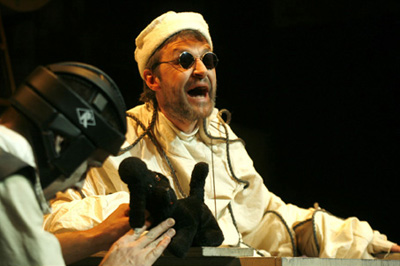
Picture: David Tredinnick and Peter Houghton in Endgame. Photo: Ponch Hawkes

Read More.....

Saturday, August 12, 2006

From the archives

Today, for a couple of reasons, I was going through some old work, and I found this essay. I don't think it has ever been published, and some of you might find it interesting. Among other things, it outlines how my brilliant career at the Bulletin went bung, and gives a snapshot of how I saw things in 1997. And it also articulates many of the reasons why I started this blog. Those who regularly read Theatre Notes will know that I feel rather more hopeful about Melbourne theatre now than I did then, and of course my views have evolved considerably. But of course there is the other argument, that the more things change, the more they remain the same...

Little Alison and her battle against the eunuchs

VLADIMIR: Moron!
ESTRAGON: Vermin!
VLADIMIR: Abortion!
ESTRAGON: Morpion!
VLADIMIR: Sewer rat!
ESTRAGON: Curate!
VLADIMIR: Cretin!
ESTRAGON: (with finality). Crritic!
VLADIMIR: Oh!
He wilts, vanquished, and turns away.

Waiting for Godot, Samuel Beckett

EVERYONE loves to hate critics. All too often, they make it easy. No matter how much you believe in the importance of public debate, no matter how passionately you argue that a vigorous, informed critical culture is essential to the health of a democratic society, some pompous ignoramus will prove to the world in the Saturday supplements that critics are on the bottom rung of intelligent life forms. Nevertheless, one must fight the good fight. This is the story of part of my personal battle, the three years I spent as a theatre critic for the Bulletin and the absurd results of my high-minded crusade to get cultural debate happening in Australian theatre. It is all, like all comedies, tragically illuminating.

In considering the contemporary disappearance of the moral authority of the critic, Hans Magnus Enzensberger comments:

... it seems that the appearance of the critic is related to the rise of bourgeois society, as if he had dominated this society for just as long as this society held on to the idea that the public discussion of cultural norms is something essential: that is, crudely put, from Boileau to Sartre, from Samuel Johnson to Edmund Wilson, from Lessing to Benjamin, from Belinsky to Shlovsky. What characterises these fabulous intellectual beasts? Legend has it, and it is confirmed by reading the works they left behind, that they were writers who wrote about the books of other writers. Further, these critics are said to have been independent people, who owed their significance solely to their work, not to an institution or an industry, at whose service they had placed themselves. Apparently the essay was their preferred form, the journal their favoured medium. They are said to have known what they wanted - obstinate, uncomfortable spirits, looking to long-term results instead of quick turnover.

Enzensberger concludes the days of the critic are over, that what remains are the mouthpieces of an industrial machine. I think he is correct, but at least he has the privilege of speaking out of European culture. Australians might well yearn for such a dilemma. Here, in a culture scarred by colonial insularity, there has never been the cultural curiosity that permitted serious public discussion of literature or art or anything else. Now that snappy advertising allows us to delude ourselves that we are a serious culture, we can catch up breathlessly with the ruins of Europe - a culture polluted by fashion, public relations and the imperatives of the culture industry.

Unlike Germany, we do not have several centuries of brilliant public thinking to shore up at least the idea of critical thought. In a country that has an insecure sense of its place in the world, the merest whiff of criticism is enough to send the so-called aesthetes screaming towards the courts of special pleading. No one thinks of donning their armour for a pyrotechnic bout of intellectual fencing for the delight and illumination of anyone who cares to watch. At best we get a bit of mud slinging, with all its attendant crudity and mess. At worst, we have the edifying anthropological spectacle of tribal groups of cultural heavies licking each other’s bottoms.

It is no accident that some of our most famous exports - Robert Hughes, Germaine Greer and Clive James - are all critics. Nor that they all appear to be singularly isolated talents. One can only speculate what might have happened had they chosen to remain here. The grim guess is, not much. The impregnable fog of stupidity would have stifled them in the end. But this can only be fantastic speculation. There was nothing to keep them here in the first place.

One of our fondest myths is that everything has changed since the dull daze of Menzies. My suspicion is that, despite a glittering cosmopolitan veneer, things are probably worse. At least then it was obvious how bad things were. Australia has proved to be a good breeding ground for brilliant, isolated talents - among them a disproportionate number of extraordinary poets - the only kind tough enough to survive the death by a thousand cuts that is the lot of the artist working in Australia. Nothing is as deadening as apathy. Nothing is as savage as pettiness called to question. Nothing is as unanswerable as wilful ignorance.

I came to theatre reviewing by accident. The first job I was offered as a freelance journalist after I resigned from the Melbourne Herald in 1985, was to write the theatre pages for TV Scene, an execrable tabloid that met its unlamented demise when Rupert Murdoch bought the Herald and Weekly Times. My job for the Bulletin came about because the publicity person for the Melbourne Theatre Company suggested my name to James Hall, then the Bulletin’s art editor, when his incumbent critic couldn’t cover a play. I have no doubt my name was suggested because it was expected that, out of gratitude for the chance to move up the career ladder, I would write glowing quotes for the PR blurbs.

However, I was naive enough to take the job seriously: the chance to write something of substance had come my way rarely as a journalist. The production was Hedda Gabler. I read the play closely, mugged up on Ibsen, went to see the show and was disappointed. I said so, and why, in my review. The publicity lady was grossly offended and the director didn’t speak to me for two years. Invitations to MTC opening nights mysteriously stopped arriving, although this made me perversely ensure I went along anyway. In my beginning, as Eliot was wont to say, was my end.

Two months later James Hall offered me the position of Melbourne reviewer for the Bulletin, a post I held for the next three years. I was, in most ways, a fairly typical reviewer. I had, at best, a sketchy and local knowledge of theatre: I knew only a little of its history, its theory and its techniques and almost nothing at all about contemporary theatre elsewhere. However, in other ways I was not typical.

One was a sound intuition that, in order to write well about theatre, I had to watch it. I wanted to abandon the privileged role of “critic” and participate in the theatre as a member of the audience. I never took notes; I found that if I did this I couldn’t watch the stage. I thought note-taking accounted for the fact that many reviews seemed to be about a completely different play to the one I had seen. I found that with concentration and practice my memory served me very well. I also, whenever possible, read the plays I reviewed, especially if they were new work.

I used the style of tabloid journalism in order to write seriously about art, for two reasons. One was to destabilise the privileged art-speak that dismissed an audience as stupid. I wanted to demonstrate to the people who read my reviews that the audience, also, has a vital place in the theatre, that it isn’t there merely to worship at the hallowed shrine of culture, which is often more accurately the hollow shrine of money and cultural status.

The other reason was pragmatic. Newspaper and magazine editors believe that reviews serve two purposes: to tell their readers where, when and how a production is on, and to act as a consumer guide. To talk about art is considered a wank, as art in itself is not considered interesting. I think art by itself is interesting and wanted to talk about it: and this technique was one way of subverting the formalities of a newspaper review and getting serious ideas in, as it were, under the door.

My ideas about art were informed by the belief that, as Trotsky said, true art is truly revolutionary. I don’t mean that art exists as a form of social engineering - it is ultimately too private an act for such grandiose designs, too complex for ideologies - but that true art can shatter the comfortable constructions we all build within our lives, privately and publicly, and force us to a radical reappraisal of ourselves and our world. “A book,” said Franz Kafka, “must be the axe to break the ice within.”

Theatre can offer such radical experiences. Australian theatre usually doesn’t, because theatre is by its nature a social act. One person cannot make theatre on her own and repressions, conscious and unconscious, operate at almost every level of its production and reception. A major repression is the fear of ridicule and dislike. Our theatrical institutions ensure that the work they produce is acceptable to its audience. This is not a problem confined to Australia; in every Western culture, theatre producers face the bogey of the subscription audience, which is too often the death of theatrical courage. Everything is carefully airbrushed to a nice beige, in order not to offend anyone, and younger artists, rebelling as they must against the prevailing order, produce a lot of radical - beige. It is worth remembering that Patrick White, one of our really great writers, became a monster, a popular cultural icon of artistic nastiness who fulfilled public expectations of his behaviour most obligingly. It is difficult not to suspect that a source of his corrosive anger was the need to assert within himself the validity of excellence in the face of the indiscriminate acceptance of mediocrity.

My own critical practice was largely shaped by my practice as a poet. My work had always been informed by astute and rigorous criticism from other people. I learnt early to distinguish between what I thought of as “useful” and “useless” criticism. Useful criticism was specific, attuned to the ambitions of the work, honest and carefully argued; useless criticism was characterised by generalised statements that responded to a nimbus of preconceptions surrounding the work rather than the work itself. Useful criticism stimulated me to heighten my own critical faculties: it raised questions that forced me to scrutinise my work and evaluate what I was doing there. Useless criticism, positive or negative, stimulated nothing. Perhaps the most important aspect of useful criticism is its implicit love of the art form it interrogates. Useless criticism is devoid of love; it is at best indifferent to art’s imperatives.

I wanted, first of all, to be a useful critic. I saw that theatre and criticism have a dialectical relationship and I wrote my reviews as part of the dialogue, or polylogue, of a continuum called theatre. I never believed they bore the imprimatur of irrefutable judgement: I wrote them to stimulate discussion, to raise questions, to disturb assumptions. I never saw any point in denying my subjectivity, because I thought subjectivity was an essential admission. I worked to make my subjectivity informed, to understand as much as I could of the techniques, histories and ideas that make theatre what it is. In this aim, I was influenced particularly by David Mamet’s passionate address to critics in Writing in Restaurants. I wanted to be a critic like that. I don’t believe I achieved my ambition. But it wasn’t for lack of trying.

The more I reviewed, the more clearly I understood the fraudulence of what often passes for art and arts commentary in our culture. Art in Australia is massively beauracratised and stupidly written about in our mass media: and these things conspire to ensure that art as a genuinely radical dynamic is all but invisible. All art, interesting or not, is blurred into a sludge called culture, an industry which mainly exists to employ mediators who ensure that the “products” are passively consumed. The essentially uncommodifiable quality of aesthetic is pushed off the agenda.

As a substitute we have celebrity, watered-down social issues and the odd trite controversy. The effect is the creation of an “official” culture, well-oiled by public relations, which keeps in place a number of cherished assumptions and careers by the simple expedient of appearing to be challenging, cutting edge, exciting and everything else a culture is supposed to be, without any of the substance. This hypocrisy is endemic in all of our arts and is reflected in the repression of dissenting voices.

While I was reviewing, I was the only critic I knew who regarded it as a full-time job. Most critics worked part-time, having other jobs in academia and journalism, because otherwise they would have been as poor as I was. The media is not interested in having good critics: a mediocre critic serves its purposes just as well and is far less trouble. And there’s no doubt I was troublesome. The Bulletin copped a law suit over one review and many angry letters from outraged recipients of my altruism. I was only 25 when I started, so my innocence is perhaps excusable: I was amazed that people became so angry with me, because I thought it was obvious that everything I said stemmed from my love of theatre, and didn’t they love theatre too?

The major row during my time with the Bulletin was with the Playbox theatre. Contrary to the wisdom of gossip, that harassment didn’t get me sacked. But perhaps it is only from this distance that I recognise with clarity how extensive, malicious and unremitting it was.

The facts are simple and petty. When, during the season of 1990, the Playbox Theatre’s first in its swish new Malthouse Theatre, I reviewed awful play after awful play, Carillo Gantner, who was then artistic director, decided that I was a blot on the landscape that had to be removed for the good of Australian culture. He started with a series of phone calls to the arts editor, Diana Simmonds, in which he suggested it may be a good idea to sack me. When that failed, he tried the Bulletin’s editor, James Hall. When that also failed, he started a smear campaign that attacked my credibility. It included a highly libellous letter to the Victorian Council for the Arts that asked for their help in getting me sacked for my alleged campaign against Playbox caused by my “psychotic” personality (there could be no other reason why I found the plays below par). Finally, he banned me from the theatre for “unprofessional conduct” after an unspecified “incident in the foyer”. James Hall rang me and asked what I had done: had I drunkenly abused the actor involved, or what?

The “incident” bears some examination. Then, as now, I had many friends who worked in the theatre. One day, an old friend, an actor then employed in a Playbox production, rang me and asked me out for a coffee because he was troubled. He told me that the day before, he had been called into Gantner’s office and cross-examined because he had been seen talking to me in the foyer at the Malthouse on the opening night of the play. Our conversation had been, briefly, about the play: I hadn’t liked it and had apologised to him, in advance, for the review.

It was after this that James Hall rang me about Gantner's complaint. Clearly, my speaking to my friend was the “incident”, given some considerable spin by the Playbox machine. I couldn’t ask the actor concerned to stand up for me in public: he would probably never have been able to work in Melbourne again. I had no recourse against this gross slander except to say it wasn’t true. Argument was reduced to the level of the pre-school sand pit - “Did so!” “Did not!” “Did so!” - in which the loudest always wins.

Gantner’s strategy transparently sidestepped the censorship at the root of his actions; he claimed that my banning from Playbox was nothing to do with what he called my “vitriolic” and “personally abusive” reviews. I wrote a letter passionately arguing against the censorship of debate, pointing out how damaging such censorship was to the arts and to the culture. (I have a thick file of the correspondence between the Bulletin, myself and Gantner which is probably most notable now for its absurd comedy.) I even attempted to explain that to criticise someone’s work was not the same as a personal attack. I was making a fundamental mistake: although even Gantner was forced to concede that my reviews were accurate, what was at stake was Playbox’s funding and stature, which he claimed I was directly threatening. The larger arguments of artistic quality, the only questions with which I was concerned, were pushed aside and remained unanswered. It began to dawn on me that some artistic organisations are interested in anything but art.

When it became obvious even to Gantner that he was making a fool of himself, the whole fracas sank into a silent pool of embarrassment. It was tacitly agreed that everyone should just get on with their jobs. By then I was exhausted and sick of the whole affair and its attendant notoriety. I wondered why I had worked so hard, for so little money, for such trivial results. If I had “played the game”, if I had refused to have any thoughts of my own and had simply followed the line of least resistance, no doubt I would still be attending opening nights and dozing my way through reviews. But why would I want to do that? Life’s too short.

Shortly afterwards, on the strength of the free publicity I had given the Bulletin, I wrote and asked for the retainer that I had been promised for two years. I had already decided that if I was to live in abject poverty, it would be more profitable to resign from journalism and concentrate on my real work, poetry. Unfortunately, at the Bulletin my old mate James Hall had been replaced as editor. (The media is a volatile profession). The new editor impolitely told me to go jump. So, impolitely, I did. I think it is no coincidence that I resigned at the same time that I finally felt I knew enough to do the job properly.

It was a most unedifying affair. It did teach me a lot about pettiness, dishonesty and why Australian theatre is peculiarly insulated from ideas.

There is one crucial aspect of theatre that doesn’t apply to most other arts: its temporality. A poem can be read five hundred years later, a film can be watched fifteen times. But if you’re not there at the theatre, you’ve missed it. This means that theatre criticism has another function: as a record. Our theatre history is seriously compromised by our theatre criticism.

I’ll cite one example: former Age critic Leonard Radic’s 1991 book The State of Play. Anyone looking for an informed and stimulating discussion of the past 25 years of Australian theatre will be disappointed. The book is a cliche-ridden, limp regurgitation of received wisdom, written with the false objectivity that masks an entrenched subjective smugness. What it tells you is what we all know: that David Williamson, John Romeril, Jack Hibberd et al started at the Pram Factory and La Mama and thus was Australian theatre born. Williamson scores a whole chapter to himself, and a cringing, crawling summation it is.

There is only the briefest mention, for instance, of the work that was occurring simultaneously in the early 70s and which helped to make that time so exciting: the productions of work by European playwrights like Arabal, Handke, and others, some of which was the first to be performed in English anywhere in the world, or the work by women such as Sue Ingleton. There is no critical intelligence exploring, except in the crudest nationalistic terms, the political agendas that were operating within the theatre. Radic, whose analysis of plays only approaches that of an intelligent high school student, is simply not up to it. The history of the Pram Factory in the early 70s has yet to be written. All the ferment, all the excitement, all the variousness, is pared down to the level of a press release: and now, for a student like me, it may as well not exist.

This uninteresting book wouldn’t matter if other useful critical commentaries were easily available: but they’re not. There is a scrappily researched history produced by Currency Press, but that is as useless. Nowhere do we have, for instance, books like Michael Billington’s One Night Stands or Kenneth Tynan’s collected reviews of British theatre, that can tell you what it was like to be there, why it mattered, why it was exciting.

Radic was the senior theatre reviewer in Melbourne for more than two decades. I have no doubt that in that time he caused immeasurable damage to Melbourne’s theatre culture, by sins of omission as well as commission. For 20 years he told audiences that theatre’s greatest aim was to be “warm hearted” and informed theatre practitioners that the only thing that counted was box office approbation. The theatre of ideas, of imagination, of spiritual and intellectual struggle, of beauty and tragedy, of vulgar comedy and robust protest, the theatre that bore Shakespeare and Aeschylus and Beckett, simply did not exist for him. And Melbourne theatre slowly went into a disenchanted sleep, from which no prince’s kiss has yet awakened it.

Amid the snores, I haven’t been able to rid myself of the desire to write about my responses to art. I do so when I am asked and sometimes when I’m not, for my own reasons. I do not expect any real debate to result from my work. The work, and the rewards, are purely private. I’m quite aware of how ridiculous a position it is since, unlike almost any other literary mode, criticism is primarily a public act. Theatre reviewing remains as dull and ill-informed as it ever was - perhaps a little duller, since no doubt other reviewers took note of what happened to me and took more care not to think. The theatre has, sadly, the critics it deserves: the critics have the theatre they deserve. Who is cheated? Theatre’s audience, and any artist attempting serious work. And most of all, theatre itself.

Melbourne 1997
From a lecture delivered to students at the
Victorian College of the Arts in 1993

Read More.....

Saturday, August 05, 2006

Not Like Beckett

Not Like Beckett by Michael Watts, directed by Michael Kantor. Design by Anna Cordingley, lighting by Niklas Pajanti, sound and composition by Darrin Verhagen. With Russell Dykstra. Beckett @The Malthouse Theatre until August 20.

It's hard to know how to describe Not Like Beckett. Should I take a cue from the title and do some negative theology, attempting to describe it by listing all the things it is not? As it says on the box, it is not at all like Beckett. It isn't like Ibsen or Chekhov or Miller, either.


However, it is, in a particular and very recognisable way, extremely Australian. The iconic Yellow Peril that dominates the set is only the most obvious signal that this is a work about us, from us and for us. But there is nothing earnest - and not a shred of the provincial - in this anarchic, rambunctious and liberatingly offensive piece of theatre.

Not Like Beckett embodies many of the things that I love about Australian culture: its irreverence, energy, intelligence, fearlessness and wit. There is no contradiction in the fact that it highlights our good points by exposing our bad: here, written large, is our racism, the apathy that segues into cruelty, the tinpot triumphalism of colonialisation, the sexual viciousness. But it's in all in the name of good, filthy fun.

Our lone protagonist is a rabbit (Russell Dykstra, sans bunny ears), who may or may not be Walter Walloon Beckett, disreputable scion of the famous Beckett clan of pioneer rabbits, famous travelling comedian and, scandalously, the lover of an indigenous bilby, Boo Boo.

As the play begins, he is caught in a rabbit trap, waiting for the trapper to come and turn him into a fur hat. (As this is theatre, his being caught in a trap doesn't stop Dykstra from scrambling all over Anna Cordingley's ingenious set). He alternately laments his fate, admires the beauty of the view and tell us the story of Walter Walloon's brilliant career.

An outcast at school, Walter Walloon discovers popularity with his signature joke, sticking a carrot up his bum. He then shocks his respectable settler family by entering showbusiness and, most egregiously of all, falling in love with Boo Boo, the last of her race, whom he liberates from a cage in a shop window by buying her.

Walter Walloon's love for Boo Boo - and somehow we believe that he really does love her - doesn't stop him from treating her with the most brutal misogyny. Walter Walloon is monstrous, and knows he is monstrous: hence the increasingly despairing denial of his Becketthood. As the metaphor of the rabbit trap makes plain, this is no simple victim/oppressor narrative: Walter Walloon may be a monster, but it is impossible, all the same, to wholly dislike him. After all, he is us.

And he's hilarious. The laughter he elicits is, to be sure, barbed and uncomfortable. Walter Walloon gives us a picture of colonialisation that is at once fanciful and brutally real. Its critique in fact goes deeper than might be possible in a realistic play, because it permits an irony and heartlessness that in a more literal rendering would be simply unbearable.

While it's a little difficult to disentangle Watts' writing from the full-on production Michael Kantor has given it, it's clear that Michael Watts writes tough theatrical prose that shifts effortlessly between vulgar comedy, mordant wit and delicate lyricism. If the play begins under the shadow of Samuel Beckett, with a sub-Beckettian soundscape of mutters and cries ("I am not like Beckett!") echoing around the hectically-revolving set, Samuel Beckett himself drops out of the picture fairly quickly.

The prologue, at least as staged, is effective; but the least successful part of the play is the first ten minutes, before Watts's writing shakes itself free of negative obesiance to this genius of modern theatre and finds its own identity. Calling so baldly on the ghost of Sam inevitably provokes comparison, and it has to be said that Watts' writing lacks Beckett's astringently mandarin intellect and severe poetry. Nor does it possess the profound understanding of visual art that Beckett brought to his creation of theatrical mise en scene.

Watts, in fact, best invokes Beckett's tradition when he stands as far away from him as possible. The authentic connection between Watts' and Beckett's writing is in their mutual exploitation of music hall and vaudeville. Watts invokes a rich Australian tradition of performance, drawing from the Tivoli and, in particular, Roy Rene's iconic character, Mo McCackie, who is recalled in Dykstra's own white-faced clowning.

The character of Walter Walloon Beckett also plugs into a robust modernist heritage of Australian theatre, and stands with Monk O'Neill, the Beckettian antihero of Jack Hibberd's Stretch of the Imagination, as one of the memorable creations of the Australian stage. Dykstra's astonishing performance - surely among the most sheerly outrageous and courageous I've seen - is, in fact, almost a potted history of Australian performance styles from Roy Rene on. There are shades here of the anarchy of 1980s comedy, such as Tick Where Applicable or Los Trios Ringbarkus, or the 1970s "larrikin" theatre of the Australian Performing Group. (And a touch of Sid Vicious, in case it's all getting too parochial).

Dykstra's performance has more than a little of Jacques Lecoq's bouffon, the grotesque clown to whom nothing is sacred, and whose extreme fooling cleanses the social body. Certainly, to get away with what Dykstra doles out to us requires a certain effrontery. He shamelessly enacts some of the most racist and misogynist jokes in the Australian repertoire. He charms us with the simplest of materials: shadowplay with his hands, or the dumbest products of the joke shop. He spends an inordinate amount of time eating a carrot. The slightest doubt, the smallest hesitation, and the entire performance would collapse into embarrassment; but fortunately, Dykstra owns the stage.

Michael Kantor's direction weaves all the disparate elements at work into a seamless whole and keeps the audience continuously surprised. Not least in the tapestry is Cordingley's set, designed around a model of Ron Robertson-Swann's public sculpture Vault (popularly known as "The Yellow Peril"). This creates its own cascade of associations: Vault was originally designed for the Melbourne City Square and, as is often the way with contemporary art in this culture, fell foul of conservative critics.

The sculpture lasted only six months before it was ignominiously dismantled and removed. It spent some time skulking in Batman Park before it was restored and reinstalled in Southbank, just down the road from the Malthouse Theatre, in 2002. Vault's fate is a tempting metaphor for the outright hostility often faced by contemporary art in Melbourne, and it's rather charming to see it celebrated so fondly in this production, in which it becomes a humpy, a stage, a mountain and even a flight of stairs.

The only thing you can be certain of in this show is that you don't know what is going to happen next (although you suspect that it will all end badly). If part of Kantor's project as artistic director of the Malthouse is to redefine what is meant by the phrase "Australian theatre", this production is a fascinating and powerful addition to the conversation.

Picture: Russell Dykstra in Not Like Beckett. Photo: Lisa Tomasetti

Read More.....

Wednesday, November 10, 2004

Phaedra's Love

Phaedra's Love by Sarah Kane, directed by Julie Waddington, design Julie Waddington and Luke Hails, sound by Nicholas Albanis. With Ben Noble, Georgina Capper, Fabienne Parr, Peter Roberts, Nick Austin, Pablo Calero, Alison Boyce, Jacinta Perry and Keira Lyons. Abstract Chaos with Instorage at the Store Room, until November 21.

Sarah Kane is the most exciting British playwright to emerge in the past decade. Her work was long overshadowed by the tabloid frenzy sparked by the 1995 production of her first play, Blasted, notoriously greeted as the product of a "sick" mind by a succession of rabidly foaming reviewers. The Daily Mail's Jack Tinker memorably labelled it a "disgusting feast of filth".

In common with many English-language writers treated without honour in their own countries (Samuel Beckett, Edward Bond, Howard Barker), European theatre was quick to recognise Kane's significance and welcomed Blasted as one of the most important plays of the 1990s. Critical opinion in Britain began to turn in 1998 with the premiere of Crave, but her suicide the following year made her the poete maudite of her generation. After her suicide, Kane's plays - like Sylvia Plath's poetry, and to their equal detriment - were mostly read as autobiographical expressions which foreshadowed her untimely death. As much as the claim that she wrote to shock for shock's sake, this romanticised notion obscured her uncompromising theatrical innovation.

In Australia, despite her steadily growing international reputation, Kane's work is still the province of the "fringe". She has been staged by theatres like Brisbane's La Boite and Sydney's New Theatre or the Stables, or by small independent theatre companies in Melbourne. I mean no disrespect to independent companies when I say that it's a shameful reflection on Australian theatre that one of the most important contemporary playwrights in the English language is unable to get a gig on a major stage.

Kane was one of a post-Thatcher generation of playwrights which emerged in the 1990s and challenged the pedagogic "theatre of journalism" exemplified most notably by David Hare. Many of them looked to playwrights like Caryl Churchill and Martin Crimp, or to Howard Barker's "theatre of catastrophe", as animating inspirations. As Kane's work evolved, her plays successively attacked the notion of theatrical naturalism in a distinctively visceral way. The revulsion and shock her plays invoke is never gratuitous, but is intended to provoke a re-evaluation of reality.

Although these playwrights were called the Nihilists or the New Brutalists, Kane's vision is far from nihilistic. It exposes a moral universe in which, as Hamlet says, "there is nothing good or bad but thinking makes it so", and searches uncompromisingly for an ethics which can survive the violence of our contemporary world. But even 4:48 Psychosis, her final, excoriatingly beautiful masterpiece, finishes with a fragmentary but stubborn hope that should not be dimmed by her subsequent suicide.

Abstract Chaos' production of Kane's second play, Phaedra's Love, is an uncertain rendering of Kane's work, but worth seeing nevertheless. The night begins promisingly, but by the end has fallen off the unforgiving tightrope that Kane sets up with such deceptively simple assurance. It exemplifies the kind of difficulties - lack of resources, lack of time - faced by independent theatre productions. I should add that some of its problems may resolve as the season progresses.

Phaedra's Love is Kane's take on Seneca's and Euripides' tragedies Hippolytus, which tell the legend of Phaedra, the wife of Theseus. She is cursed by Aphrodite and falls desperately in love with her stepson, the beautiful and chaste youth Hippolytus, with catastrophic results. It is most famously adapted by Racine in his play Phaedre, which is written in what are allegedly (I have to take George Steiner's word for it) sublimely beautiful alexandrines.

Kane's take couldn't be more iconoclastic, although it still has traces of the naturalism which she afterwards abandoned altogether. Phaedra's Love is the most darkly funny of her plays and is also the first which explores the nature of love, a theme that became the major obsession of the later work. Here she perverts Phaedra's tragedy to create what is at once a chilling vision of the nature of obsessive love, and a strange liberation from despair.

In Phaedra's Love, Hippolytus (Ben Noble) is very far from being the chaste and beautiful youth of the original story. He is physically and emotionally repugnant, seen in the opening scene watching tv while wanking into a sock. (He checks that he hasn't blown his nose in it first). Phaedra's (Georgina Capper) fatal passion for him is therefore inscrutable and terrifying; when she declares her love, in a scene of skin-crawling humiliation, she performs oral sex on him while he watches television and snacks indifferently from a bag of lollies.

Yet in his monstrous boredom, his disgust with the falsity of everything that surrounds him, Hippolytus is also a curiously attractive character. Behind his joylessness and refusal of any human contact lies a desire for absolute honesty, a ruthless integrity which will have no truck with a world that disgusts him. The only time he shows anything like wonder is after he hears of Phaedra's suicide: "She really did love me... Bless her." And it becomes clear that Phaedra's accusation of rape against him is not the act of revenge that it appears to be, but a gift: the orgy of violence which follows is, at last, a real moment, in which there is no trace of human deceit. Hence his final words: "If there could have been more moments like this."

Phaedra's suicide is the logical result of the fire which has so consumed her, her abnegation the utter loss of self which is, as Kane perceived, tragically attracted to its opposite, the self that will compromise nothing. The gravity exerted by these extremes detroys everything around them - Phaedra's daughter Strophe (Fabianne Parr) is raped and murdered by Theseus (Peter Roberts) in the final carnage. But Kane's humour here is wicked: the murders of the Royal family are represented as a barbecue, with Hippolytus' genitals becoming a gruesome sausage.

Kane's grand guignol violence contains a serious critique, of classical theatre as much as of the nature of human love and the dilemma of the self. It's in eight tautly written scenes, which move rapidly to its horrifying and obscenely funny conclusion. Unfortunately, Julie Waddington's direction seldom matches the icy clarity of the text, so nothing is ever quite in focus.

Stylised acting at the pitch this play demands requires a depth of polish that the standard four weeks' rehearsal simply cannot achieve with any certainty. Georgina Capper's performance as Phaedra is the most successful in negotiating the challenges of the play's stylistic formality, and has some genuinely thrilling moments. Ben Noble's Hippolytus achieves his character's grossness, but falters at the extremity of his despair and so cannot reveal his perverse nobility. I had the feeling that often the other performances were hesitant or even, at times, without conviction. This means that the final scene has all the faults of stage violence when it doesn't work: despite the liberal application of tomato sauce it merely looks fake, and the audience laughs for the wrong reasons.

I thought the set design a major problem in this production. Admittedly, Kane wrote with a fine disregard for the difficulties of designers: at one point Phaedra's body is meant to be set on fire, which defeated the ingenuity of this production team. At times, however, the set literally gets in the way of seeing the action, and the pace is hindered by cumbersome moveable blocks which are rearranged between scenes. The set changes impede the flow of the tragedy, stilting its emotional movement so it achieves neither apotheoses of horror nor comedy. Despite these reservations, it's a rare chance to see - if through a glass darkly - a fascinating work by a major contemporary dramatist.

Links
The Store Room
Sarah Kane


Read More.....