Review: A Behanding in Spokane, No-ShowReview: Ruben Guthrie, Skin TightReview: Song of the Bleeding ThroatReview: Don Parties OnIn Which Ms TN Discourses At Length2010: or Why I Love Living In MelbourneReview: The NestCollected Works benefitIndependent theatre ~ theatre notes

Wednesday, February 16, 2011

Review: A Behanding in Spokane, No-Show

First, an apology of sorts: Ms TN is wearing another couple of hats at present, and has only so much forehead where they can fit. Worse, one of the hats is generating a bunch of psychic static that gets in the way of everything else. The reason I have no time for the argument that claims that criticism is just the same as making art is that, in my experience anyway, art demands everything that criticism does, and then eats your soul as well. Which means that these responses will be brief.

Secondly, a pointer to the 2010 Green Room Awards nominations, which were announced yesterday, prompting a flurry of tweets. Reading through the nominations reminded me how rich 2010 was for Melbourne theatre: so many shows were outstanding. Go thither and form your own thoughts: the winners will be announced on March 21.


Now to the two shows I saw last week. A Behanding in Spokane is Martin McDonagh's first new play for 15 years: as is well known, the six plays that made his name were drafted in a frenzied nine month period in 1994. Here McDonagh has moved his particular brand of Grand Guignol from a fantasy Ireland to a fantasy mid-West: the action is set in a seedy hotel somewhere in America, and revolves around the pathological state of a one-handed man, Carmichael (Colin Moody). His hand was severed by hillbillies 27 year earlier, and ever since, after exacting revenge on his tormentors, he has been searching for his missing appendage. Two young opportunists, Toby (Bert LaBonté) and Marilyn (Nicole da Silva) hear of his quest and attempt to sell him a hand to make a quick buck - but it is, of course, the wrong hand.

The play is basically about Toby and Marilyn's subsequent attempts to escape from the hotel room after the deal goes pear-shaped, with occasional interruptions from the bellhop Mervyn (Tyler Coppin), a man who has turned disappointment and indifference into an art form. It's swift, funny and black-humoured: a neatly structured four-hander which turns its theatrical tricks with style. It's a shiny version of Sam Shepard's early plays, with the sharper edges of Shepard's dark excavations of the American Dream rounded off: less memorable and strange, and concomitantly less interesting. But there's no doubt it's fun.

What's of note here is Peter Evans's production. From Christina Smith's angled stage-within-a-stage, lavishly draped with red curtains that reveal a hotel room of staggering squalor, to the pitch-perfect performances to Ben Grant's ominous sound design, it's a winner. It takes the absurd premise of the play and turns it into high comedy, stylishly meta-theatrical, holding the balance of belief in a sure hand. On the one hand, we know these characters are fantasies: on the other, in the magic box of the theatre, they generate their own compelling realism.

The performances are, without exception, first class. Colin Moody as Carmichael gives a bravura performance of psychotic obsession, baffled threat in his every footstep, nicely leavened with an undercutting petulance and credulity (some of the funniest dialogue is a phone conversation with his mother). Tyler Coppin equally explores the grotesque with his melancholy "reception guy", who is, like Carmichael, arrested in a permanent state of distorted adolescent fantasy. Both characters are much more childish than the two young people, whose comparative rationality and ordinariness plays against the grotesquerie of Mervyn and Carmichael: LaBonté and da Silva play their characters more or less straight, with just enough exaggerated edge.

The play was accused of racism in its US outing, and it's easy to see why: Carmichael is a white supremacist and the word "nigger" flies around freely. Mostly it was criticised for its stereotypical portrayal of black maleness. In this reading at least, the play seems more a piss-take on racism: LaBonté's characterisation certainly lifts Toby past crude caricature. If anything, it could be accused of sexism, since the least interesting role is the woman's: Marilyn exists mostly as a foil to the other characters, although Da Silva makes the most of the little she has. Each character is in fact a graphically sketched cartoon, but this production finds the life in them.

Richard Pettifer's No-Show (sadly, closed after a short season at La Mama) is at the other end of the theatrical spectrum. As Pettifer explains in his program, it came about because he "had a show fall over a few weeks ago" and made this show to replace it. The no show was a play called Smudged by Megan Twycross, which made a brief appearance at the Brisbane Festival before foundering on the rocks of theatrical difference.

Out of this catastrophe, Pettifer makes a poignant work of anti-theatre. As with all anti-theatre, the focus is on the immediate presence of the performer and the audience as the bedrock of theatrical experience. He is, as it were, surrounded by the rags of the absent show: the set is four chairs labelled with the names of the absent performers, and during the course of the 50 minutes he dons one costume after another, explaining what each character was meant to do. It's irresistibly reminiscent of Forced Entertainment's Spectacular, which I saw in 2009, but with this difference: where Spectacular left me with an empty sense that I'd been had, this show takes off the aesthetic protection and exposes something real and human about the risk that is theatre.

I'm going to cheat now and refer you to The Blogger Formerly Known As Neandellus, Andrew Furhman, who discusses this show with more thoughtfulness and intelligence than I can presently summon. Essential reading about theatre, failure and the avoidance of failure in two posts, here and here, at Primitive Surveys.

Picture: Colin Moody in A Behanding at Spokane. Photo: Jeff Busby

A Behanding at Spokane by Martin McDonagh, directed by Peter Evans. designed by Christina Smith, lighting by Matt Scott, sound design by Ben Grant. With Tyler Coppin, Nicole da Silva, Bert LaBonté and Colin Moody. Sumner Theatre, Melbourne Theatre Company, until March 19.

No-Show, by Richard Pettifer, with excerpts by Megan Twycross. Lighting non-design by Tilly Lunken, sound non-design by Alister Mew. La Mama Theatre. Closed.


Read More.....

Wednesday, February 09, 2011

Review: Ruben Guthrie, Skin Tight

Yes, there is life after David Williamson. It must be said that lately the man has been hard to ignore: even John Bailey found himself adding, with an air of bewilderment, to the pile of words surrounding his latest play. "I can't think of another local play, great or rubbish," says Bailey, that has "provoked so many words from commentators, or [has been] given so much space in the public sphere". No, neither can I. And resisting that mind-numbing vortex proved impossible, even for stern-minded aesthetes such as myself.


If anything proves the marginalisation of theatre in Australia, it's that Williamson - presumably the only recognisable name outside the theatre culture - still so dominates the general discourse. Why is it so, when there's so much more interesting stuff to see or talk about? Take Ruben Guthrie, for instance, presently enjoying a season directed by the playwright, Brendan Cowell, at Red Stitch.

This play has everything Williamson's lacks - wit, energy, emotion, complexity. And it's a play, goddamit. It doesn't even faintly resemble the "non naturalistic" theatre that Williamson, despite all the evidence to the contrary, claims is driving his work off Australian stages. It has characters and plot. It has a beginning, middle and end. If it were on a main stage, not even the most conservative theatre nerd could argue that it wasn't mainstream.

The most immediate difference between Ruben Guthrie and Don Parties On is that Cowell's play is a lot more fun. The second is that its exploration of its chosen theme, the nature of addiction, is a lot more thoughtful. It seems to come from a living mind: from the opening moment, when alcoholic advertising whizz and relationship disaster Ruben Guthrie (Daniel Frederiksen) arrogantly addresses his first AA meeting, the energy is pitched high, and it never slackens for the two hour duration of the show.

The story follows Ruben Guthrie's attempt to sober up. His professional success has been all about excess: it has rewarded him with a top creative job with a mega salary, supermodel girlfriend Zoya (Anna Samson) and harbour views. We meet him at a moment of crisis: his girlfriend, sick of his narcissistic self-destructiveness, leaves him, and he has broken his arm jumping off a roof in a moment of alcohol-fuelled abandon. He goes cold turkey, and immediately discovers that his entire life - work and play - is predicated on alcohol. His boss Ray (David Whitely) isn't interested in the new sober Ruben; his best friend Damian (Simon Maiden) can't bear his not drinking, and even his irritably separated parents (Dennis Coard and Andrea Swifte) think he's a wowser for going teetotal.

Desperately seeking to replace the world he is rejecting, Guthrie meets Virginia (Erin Dewar), former speed addict, and enters the 12-step plan with a vengeance. It's soon clear that he is replacing one addiction with another. Both are evasions of the real issues that drive his catastrophic instincts: the emotional poverties of his life as a high-flying creative are neatly complemented by the empty jargonistic platitudes of his new sobriety. It's not much of a choice: each of the options open to him is a kind of death. What hovers teasingly beyond this stark binary is the never-realised possibility of a engaged life, but only Zoya - beating her own demons - is able to pick this up. She is, in a sardonic note, the character who leaves Australia.

Since it premiered in 2008 this play has had two hit seasons at Belvoir St, and the polish of previous incarnations is amply evident in this production. The script is sharp and supple, achieving a nice balance between comedy, satire and genuine pathos. Cowell's slick production picks it up and goes for it. Peter Mumford's elegant set - designer shelves stacked with designer liquor - permits the action to move swiftly and legibly from one scene to another.

The evening is inevitably dominated by Frederiksen's turbo-charged portrayal of Guthrie, but this is in fact an ensemble production: there's not a weak performance in it. And there are memorable theatrical moments: my favourite is the image of Ruben Guthrie and his father Peter in hospital robes with saline drips, smuggling a flask of liquor under their robes. For a moment, the stage is almost Beckett.

Definitely a don't miss. Life would be a lot more exciting if more of the mainstream looked like this.

Over at Fortyfive Downstairs, there's an interesting production of Skin Tight, by New Zealand playwright Gary Henderson. There's no doubting the energy of this one, which begins with an erotic all-in wrestle between performers Holly Shanahan and Michael Whalley, and continues with a highly stylised physical production that traces the history of a marriage, from its early pre-war years to the ill-health and death of the aging couple.

The striking design places the action in traverse. Lush red curtains open to a narrow angled stage strewn with clothes. The play's time and place - country New Zealand from early to middle last century - is suggested by phonograph music and minimal props. An iron wash tub is filled with water and apples: the water acts as a metaphor for sensuality, the apples for appetite. And there's a pathos in the idea of an old man bathing his ill wife but seeing his young lover, a la Pierre Bonnard, that, even if it doesn't quite emerge, is beautiful.

My major problem is the soft-focus lyricism of the play itself, which never escapes a pervasive sentimentality. I couldn't shake the feeling that I'd seen this play several times before, (although I can't think where); it's full of familiar tropes, and you know from almost the very beginning exactly what is going to happen in the end. This needn't be a problem, but here it is.

The production set up an increasingly bizarre disconnect between the language and performance: although the performance seems to be about articulating the play's subtextual passion, I never felt the passion in the text. Rather than excavating a truthfulness from its play, I felt that most of the time the production was flailing around looking for it. Awkward touches, such as the introduction of an older actor (Karl Peschek) in the play's final moments, add to its lack of focus.

All the same, in the moments where performances strikes truthfully - mainly moments of physical play - the show achieves a genuine power. Both Shanahan and Whalley are actors to watch, and their full-on sensual intensity means this show is worth a look.

Picture: From left: Erin Dewar, Daniel Frederiksen and Anna Samson, from Ruben Guthrie.

Ruben Guthrie, written and directed by Brendan Cowell. Design by Peter Mumford, lighting by Stelios Karagiannis, sound by Marlene Samosn and Jonathan Shaw. With Daniel Frederiksen, Anna Samson, David Whiteley, Dennis Coard, Erin Dewar, Andrea Swifte and Simon Maiden. Red Stitch until March 5.

Skin Tight,
by Gary Henderson, directed by Justin Martin. Lighting design by Marco Resondeck, sound design by Jared Lewis, choreography by Tom Hodgson. With Holly Shanahan, Michael Whalley and Karl Peschek.
SaySIX Theatre and The Groundswell Division, @ Fortyfive Downstairs until February 11.

Read More.....

Monday, January 31, 2011

Review: Song of the Bleeding Throat

On a mild summer evening in the ivy-clad courtyard of The Eleventh Hour's headquarters in Fitzroy, it's not difficult to think that you have suddenly been transported to a different era. The lawn is studded with marquees; a door behind the temporary bar opens teasingly to a private house with shuttered upstairs windows, which you can't help but imagine must look like something painted by Bonnard or Vuillard. Even your host, artistic director William Henderson, could have stepped out of a daguerreotype.

Maybe it's Europe circa 1912, before world war and revolution wracked the planet, when a disparate bunch of radical artists were creating something that would be called "modernism". Only it's Melbourne 2011: a different place, a different era. Given the present sense of social urgency, perhaps it's not surprising that so many artists are looking to the modernism that flowered as the anxieties of its times thickened and convulsed, picking up the threads of experiment and discovery and attempting to make something new of them. Certainly, this investigation is a crucial part of The Eleventh Hour's eclectic, intelligent theatre, and why they're one of Melbourne's must see companies.


This time, instead of reworking classic texts, The Eleventh Hour presents a new play by David Tredinnick, who is better known as an accomplished actor. Song of the Bleeding Throat is described as a "burlesque", meaning its older sense of comic parody rather than strip-tease. And it's a fascinating beast indeed. Tredinnick is parodying ideas, in particular some of the formative 19th century notions behind contemporary Britain and America. His burlesque features such notables as the historian and social commentator Thomas Carlyle; his wife, Jane Welch (and their dog Nero), Abraham Lincoln, Walt Whitman, Lincoln's assassin John Wilkes Booth and the Statue of Liberty.

The text is foremost a torrent of words. Tredinnick has created a bizarrely Beckettian collage out of quotations and almost-quotations from public figures ranging from PT Barnum to Marx: statements about empire and revolution jostle with domestic intrigues, fancies, poems and obscene malapropism. The language of high oratory or Romantic poetry is continually exploded by the decay and weakness of the body: Carlyle (Richard Bligh) is tormented by his bowels, Welch (Anne Browning) is a drug addict, Nero the dog (James Saunders) is beaten within an inch of his life, Lincoln (Neil Pigot) is dying (or dead). The only personage who seems above all this bodily flux is Whitman.

Each phrase is buffed to a dark lustre. Everyone speaks as if they all wrote out their thoughts in a goose-quill before uttering them. It's about as far as it is possible to get from the conventions of contemporary theatre: this is a text that has little truck with ideas of character or narrative. Its characters are symbols, mouthpieces, carefully constructed puppets - parodies, as Tredinnick claims. But parodies of what? There are all the obvious answers - they parody the vanity of intellectual achievement in the face of death; the selective consciousness of heart-stirring cries for liberty and revolution that ignores, say, those who happen to possess black skin; the tragic gap between ideal and reality (the play itself is prefaced by a quote from the greatest pragmatist of them all, Josef Stalin).

But most of all it seems to me that it parodies language itself. Language, which promises so much, here collapses inward on itself, revealing a pile of rubble that stinks of death, or is anerotically absorbed in the cultural body. The production often forbids us easy access to listening: Nero stutters, the Carlyles speak in Scots accents. Even its visionary clarities decay: Whitman's magnificent "I sing the body electric" becomes a narcissistic anthem in the musical Fame. The only recourse at the end is the solitary voice, Whitman's "song of the bleeding throat", which is cut off in mid-sentence.

This density of meaning and linguistic relations means that if you don't pay close attention, you will soon be quite lost. Even if you do, it's easy to feel that, as Lincoln says at one point, "I’m trying to blaze a way through this swamp". The weight of this orotund 19th century language, almost completely unleavened by contemporary brevity, often lies heavy. The danger of employing this diction is that it attenuates the work's political clout: what do all these words have to do with Now?

If it's anything, Song the Bleeding Throat is an overtly political work, at once exploring and mocking the formative nationalism of our time, US patriotism. Through the figure of Carlyle, a major Romantic essayist and thinker, it picks up European revolution and imperialism, connecting these ideals to the hopes and betrayals of the brash democratic exercise in America. Yet this is an oblique tracing, more a kind of animating of ghosts which still colour the assumptions behind so much public speech.

I find myself oscillating between feeling on the one hand that the text rings its changes very successfully, and on the other thinking that all this luxuriant excess of language ends up obscuring itself, that there is, in short, too much of it. (Certainly, coming from a school that prefers poetry of the theatre to poetry in the theatre, I think there's a little too much poetry). Its ideas are in fact often presented with an unsettling clarity, but the whole seems too much jostle. I suspect that there is a myopia of focus, an obsessive close-up attention that forgets the larger architecture of the play's argument and diffuses its point. It's common to claim that less is more, and it's not always true; but in this case, I think it might have been.

Perhaps the only director in Melbourne who could tackle a text like this is Brian Lipson, whose theatrical imagination is as baroque and elliptical as the playwright's. The production is as finely polished as the text itself: it features astonishingly disciplined and, frankly, riveting performances from its cast, although Neil Pigot as Abe Lincoln is the stand-out. The alienations in the text are realised in the theatre with a playful theatricality: in the first half, the three characters are formally placed as in a portrait (the staging is in fact based on a famous portrait of the Carlyles at home), with Nero - an English shepherd dog in the painting - becoming a working class lad in a cloth cap. In the second half, in a stunning coup de theatre, the entire space is reversed, and the audience finds itself looking up at the death bed of Lincoln.

There is no moment that doesn't feel utterly worked, down to the least gesture: even the twilight shading to darkness through the windows outside. And it glints with a dark humour that segues to sheer playfulness: when Carlyle decides to light a spill from the fire, for instance, and irritably summons the dogsbody/author to crouch behind the empty mantelpiece with a lighter. There are theatrical moments which are as good as anything you'll see, seriously, but somehow it meanders, creating palpable longueurs. I kept thinking of a necklace, a string of marvellous pearls with no string. And yet, again, this isn't wholly true.

It's often very funny, but underneath the whole is a vein of pure seriousness that harks back to those 20th century modernists, in particular the formalist experiments of Piscator and Meyerhold. Maybe my reservations exist in its timeliness. It was odd to watch this play last week, as the popular revolution in Egypt and elsewhere in the Middle East lit a more violent flame beneath the pieties that Song of the Bleeding Throat explores. Suddenly these ideas - democracy, revolution and their betrayals - seem invested with more urgent feeling and moment than seems adequate to burlesque. But then again, the song of the bleeding throat is precisely what is consciously elided in the play: its concern is with everything that silences that song. In any case, this is certainly an intriguing work, uncompromising and painstakingly realised, and worth seeing for that alone. Definitely not for those who like their theatre on a plate.

Picture: Neil Pigot as Lincoln in Song of the Bleeding Throat.

Song of the Bleeding Throat, by David Tredinnick, directed by Brian Lipson. Design by Brian Lipson and Alexis George, costumes by Alexis George, lighting by Niklas Pajanti and Nicola Andrews. With Richard Blight, Anne Browning, James Saunders and Neil Pigot. The Eleventh Hour, 170 Leicester St, Fitzroy, until February 12.

Read More.....

Sunday, January 16, 2011

Review: Don Parties On

Every time David Williamson writes a new play, the Australian theatre world launches into one of its favourite games. It goes like this.

There's a flurry of pre-publicity in which we hear, again, that Williamson is our best-selling playwright, a "national myth-maker" who takes the pulse of our times and touches the receptive hearts of the masses. We hear that "the critics" are unkind and out of touch with ordinary folk, and that the only reason people dislike his plays is because he's too popular. We hear that the theatre world is continually chanting that "you can't have naturalism on stage". Preferably, somewhere in the middle of this, someone mentions Barrie Kosky.


Then a good chunk of the theatre community gets dressed up to the nines and heads off to the premiere. The play occurs. Some people laugh. Some people leave at interval. A sizeable proportion of the audience applauds rapturously. Another sizeable proportion emerges in various states of crankiness and flees for a debriefing session over a stiff drink.

Then the fun begins. Some critic, bristling with righteous fury, writes a slashing review of the Williamson phenomenon. Said critic is in turn accused of general nastiness, humourlessness and elitism. Williamson fans point once again to the box office. Various right wing pundits weigh in to opine about Williamson's leftiness. Various left wing pundits complain about his lack of leftiness. Someone (often it's me) says something plaintive about art. And everyone, his or her expectations satisfyingly met, has a marvellous time.

Lather, rinse and repeat.

So it is with Don Parties On, the sequel to Williamson's 1970s mega-hit Don's Party, which opened at the Melbourne Theatre Company last Thursday. And here's my contribution to this particular circle of Hell.

In Don's Party: The Sequel we meet the central characters from the first play 40 years on, as they gather around Kerry O'Brien for the ABC telecast of the 2010 election. As Williamson says in his program note, he's doing a Seven Up on his fictional characters. Baby Richard (Darren Gilshenan) is now a Generation X advertising executive with marital problems. Don (Garry McDonald) is still married to Kath (Tracy Mann), who brings up a decades-old infidelity every two minutes or so. We hear that Don finally did write his novel, which sank like a stone after offending all his friends, and is the cue for some self-referential jokes about commercial writing not being proper art.

Don's mentor Mal (Robert Grubb) and his sharp-tongued wife Jenny (Sue Jones) have divorced, and Jenny has subsequently built a political career. Cooley (Frankie J. Holden), as lascivious as ever, has turned into an obscenely rich right wing lawyer with emphysema, and is married to a patient woman with a social conscience, Helen (Diane Craig). There's a sententious grand daughter, Belle (Georgia Flood), who watches Twilight DVDs and calls herself a Greenie, and Richard's lover Roberta (Nikki Shiels), a redhead whose histrionics are apparently explained by her Italian genes.

At the beginning of the play, Don and Kath are, once again, preparing tidbits for an election night party. Mal turns up early and asks Jenny along, to Don and Kath's dismay, as they haven't spoken for decades after a disagreement about Twisties. Meanwhile there is much rhubarb about Richard, who has left his wife for Another Woman. Richard's daughter Belle is displeased. Richard's wife makes a suicide attempt and ends up in hospital, and is promptly forgotten until the end of the play. Cooley turns up with an oxygen bottle and mask and his wife Helen, and lusts after the grand daughter until he has to put on his oxygen mask.

The actors watch 30 seconds of Kerry O'Brien and then mute the tv for some expository dialogue about the good old/bad old days. There are in-jokey references to Play No. 1. Richard turns up and makes the entire audience wonder how a whiny, hysterical boy-man could possibly be holding down a mega-buck job in advertising. There are revelations, a couple of heart-unwrenching confessions and some reheated scandal. Belle overhears it all and is displeased. Richard's lover turns up in high heels and low-cut dress and has conniptions. Belle is displeased again. And so on. And on.

Well, I practically went to sleep writing that. Williamson's great gift is that he is incapable of surprise. He is at once so popular and so reviled because he knows exactly how to meet the expectations of his audiences. It creates a dilemma for me, because I hate repeating myself; so forgive me for pointing to some earlier essays. In 2004, when Williamson announced his retirement, I wrote an essay on the Williamson phenomenon which basically sums up my responses to his work. You might also be interested in my review of Peter Evans's sparky production of Don's Party for the MTC in 2007, which incidentally features the same designers and the same set - for this production, Dale Ferguson's hyper-real evocation of a 1970s Lower Plenty house is updated to 2010.

In the 2004 piece, I discussed how troubling it is that state theatre companies, forced to make commercial decisions by their financial bottom lines, are so anxious to bruit Williamson as not only a best-selling playwright - which he undoubtedly is - but as a great playwright - which he emphatically is not. Harry Kippax did Australian theatre no favours at all when he compared Williamson to Chekhov. And this claim to artistic quality is my beef about Williamson, although the beef is smaller these days.

One of the things that seems clear in this round of the Williamson Game is that the theatrical conversation has shifted markedly. For instance, it seems (even more) ridiculous to claim that naturalism isn't allowed, when so many young companies are exploring it themselves. And I can't get too exercised about state companies making commercial decisions, given the paucity of their subsidies; although it could be I'm just tired of the argument. And really, who cares? Nobody said that people will be shot if they like going to Williamson plays. Some people merely objected when Williamson was promoted as the ne plus ultra of Australian theatre.

Recently, some defenders of the Williamson oeuvre have begun to say that Williamson is not a naturalistic playwright, a la Chekhov or Ibsen, but more a playwright of heightened social satire, a crafter of comedies of manners. This is in fact a much more accurate placing of his work, but it means that one has to assess him in the company of Sheridan or Feydeau or his contemporary Alan Ayckbourn, all masters of stage business. One of the things that has puzzled me for years about Williamson's reputation is that he is such an inept theatrical technician. Popular, as these other playwrights demonstrate, doesn't have to mean bad; but in the Dan Brown-Charles Dickens continuum, Williamson is definitely thumping the tan.

In Don Parties On, all his writerly clumsiness is writ large - the dire expository dialogue, the stereotypical characters, the almost neurotic repetitiveness, the constant machinations of getting people on and off stage. Much of the dialogue - the pronouncements on baby boomers, greenies, Australian politics and so on - in fact sounds as if it's been cribbed from some of Australia's more active political blogs. The people-moving is about as clunkily done as I've seen - characters are constantly announcing that now they must go into the garden to show each other photographs of their children, or to the bedroom to check on someone hysterical, or to the study to watch a DVD, so that two or three people can be left on stage to reminisce or reveal something shocking. Alternatively, you get rows of frozen actors standing on stage watching as two or three others do their dialogue.

Robyn Nevin's direction makes as decent a fist as is possible of this stylistic rubble - I left feeling that it could have been a lot worse. The actors fail to make the characters credible, but it's hard to blame them given that they are all written as walking cliches; although Sue Jones gives some feisty life to the character of Jenny. But for me, there was no escaping the creeping numbness as the evening wore on.

Naturalism this certainly isn't. Considered as a comedy of manners, it lacks the grace, wit and formal mastery that gives the form its champagne fizz. A direct comparison with Don's Party starkly demonstrates how stale Williamson has become: the lively colloquialism of the original, its chief virtue, has long leached out. This really is zombie theatre, devouring the brains, not only of its audience, but of its own playwright.

Yes, some people love it. The guy next to me, for instance, was having a super time: he kept up a running commentary and walked out happily humming the Credence Clearwater Revival song that is the subject of one of the running gags. As always with Williamson plays, it will continue to please those who like his work and annoy everybody else. He's still making the box office go ka-ching, and as long as people keep buying tickets, companies will keep programming his work. And there it is.

Picture: Don Parties On. Top row, l-r: Frankie J. Holden, Garry McDonald. Bottom row: Sue Jones, Diane Criag and Tracy Mann. Photo: Jeff Busby

Don Parties On, by David Williamson, directed by Robyn Nevin. Set by Dale Ferguson, lighting by Matt Scott, sound by Russell Goldsmith, costumes by Jennifer Irwin. With Diane Craig, Georgia Flood, Darren Gilshenan, Robert Grubb, Frankie J. Holden, Sue Jones, Garry McDonald, Tracy Mann and Nikki Shiels. Melbourne Theatre Company, Arts Centre Playhouse, until March 8.

Read More.....

Wednesday, December 29, 2010

In Which Ms TN Discourses At Length

KO: REVOLUTION. What takes place as indicated by Ko is believed in only after it has been accomplished. Hexagram 49, I Ching.

It's no exaggeration to claim that there has been a revolution in local theatre over the past five years. From this end of the telescope, it might appear to be a Boojum revolution, during which certain verities about theatre have "softly and suddenly vanished away". Consider how times have changed! Next year almost every major company in Australia, from Melbourne to Brisbane, has a new artistic leader, ushering in a new generation of theatre makers. Even that stalwart defender of the deadly middlebrow, Robin Usher, is writing laudatory pieces about independent theatre, and I haven't seen a snarky mention of "the fringe" in the local mainstream press for ages. Suddenly everything, it seems, is groove and roses.

It was not always thus, and I'm not sure that it is thus even now; the present accord on the virtues of the young seems more to me like a strange detente. The amnesia and kneejerk conservatism of much mainstream commentary is, after all, as evident as it ever was, and its capitulation to the inexorable rise of a new generation of theatre makers probably signifies less than it seems. For once, vital theatre is where it belongs, in the limelight. Theatre has even become hip. Yet our media culture, with certain honourable exceptions, has a short attention span and an even shorter memory, as every artist who has worked for more than a decade knows to his or her cost.


For all that, it's beyond argument that Melbourne's theatrical landscape - and more widely, Australia's - has changed out of sight over the past five years. In 2004, a main stage hit like Hayloft's Thyestes was all but unimaginable in Melbourne. You might have seen something like that in the "fringe", heroically staged without sufficient resources or time, as Australians have always had a talent for poor theatre. But rapturously received on a main stage? Only by the rarest of accidents. Now the presence of work from companies like Hayloft or My Darling Patricia in main stage seasons around Australia barely makes anyone bat an eyelid. This change has happened so rapidly and so completely that it's easy to forget how impossible it once seemed.

There are many reasons for this shift, and to talk about all of them requires a book. This post will focus on Melbourne, with the caveat that there were other, equally important things happening elsewhere. In a few years, somebody else will write the history of what happened in Australian theatre culture in the first decade of the new millenium (and I seriously doubt it will be me). This is my report, from one of the many frontlines. And it is, as this blog has been from the beginning, a personal account.

There are four major reasons why Melbourne's surge of artistic vitality flourished and evolved, rather than its promise withering, as happened so often in the past, on the vine. Two were major institutional appointments. The most significant was the remaking of the moribund Playbox Theatre as the Malthouse, after the appointment of Michael Kantor as artistic director and Stephen Armstrong as executive producer, on which I'll mainly focus in this post. As Kantor and Armstrong leave the Malthouse and usher in a new team headed by Marion Potts and - later in 2010 - associate director Matt Lutton, it seems timely to reflect on what has been achieved over the past five years.

Another crucial appointment was Kristy Edmunds as artistic director of the Melbourne Festival, a position she held for four years from 2005, building on the artist-centric festivals that characterised Robyn Archer's tenure. Equally important was a surge of new talent - especially from the VCA, perhaps the true heritage of the radicalism of the Australian Performing Group and the Pram Factory - which has seen a generation of autonomous and skilled theatre artists who were not prepared merely to be industry fodder, and who sought to shape the culture to fit their ambitions, rather than the other way around.

And lastly, there was the rise of the theatre blog. For I've been part of this change as well as a witness to it, bearing out the adage that observation inevitably changes what is being observed. There are, as I've often pointed out, many theatre blogs; but Theatre Notes was the first in Australia, and can take a little credit for the changes in public discussion that followed. Not all, by any means: a conversation cannot exist without other voices. Nevertheless, the story of the past six years is, in part, mine as well; and if I don't tell it, nobody else will. (I feel I ought to do as Neil Gaiman does in his twitter notices, and label this: WARNING: Blog post contains me.)

What has been at stake in all the cultural conflicts of the past few years has been the question of legitimacy. When Peter Craven and Robin Usher attacked Kristy Edmunds's festival programming in 2006, part of one of the most sustainedly vicious campaigns I've seen against an artistic director, it was on the grounds that the work she programmed was "fringe" work, not fit for our main stages. Since the issue was the main stages of Melbourne, it was unsurprising that the Malthouse came in for some collateral damage. Craven described Benedict Andrews's brilliant production of Marius von Mayenburg's Eldorado as "resolutely anti-mainstream, sometimes to excruciating effect". Whatever that means. The message was clear: "fringe" theatre, whatever that was, was ok in dusty church halls and small theatres, where it could be safely ignored: but an anti-mainstream mainstream (whatever that was) was an abomination not to be tolerated.

I wrote an opinion piece for the Age in response, in which I pointed out that the term "fringe" was meaningless, and that the fringe/mainstream dichotomy was almost entirely false. And there it might have rested, as a minor flurry in the press that passed without disturbing the status quo. This is certainly how it always worked in the past; theatrical energies have, again and again, been successfully marginalised by attacking and, at the last, ignoring them. Once a show closes, the only place it exists is in the memory of those who were there: in the absence of meaningful critique, the public record becomes a record of amnesia. But a funny thing happened on the way to the forum: the forum changed. The internet, with its challenge to the monopoly on public discourse held by the mainstream press, came into its own.

The web was so foreign to theatre culture in 2004 that, when I rang theatre companies to give them the glad news that I was starting a review blog, almost everyone asked me what a blog was. As I outlined in my first post, Theatre Notes was an experiment: I had no idea whether a critic with no institutional ballast behind her could create an online readership. Three years later I was straddling the print-digital divide as Melbourne theatre critic for the Australian, a post I enjoyed but never sought, and which I have now resigned. (And hello to my successor, my Esteemed Colleague Mr Chris Boyd!) Last year I won the only prize that exists in Australia for critical writing, the Geraldine Pascall Critic of the Year. The speed of the transformation of Ms TN from unknown blogger to one-woman cultural institution was startling, and it's fair to say that I feel deeply ambivalent about it. But there's no doubt it's been a fun ride.

What I didn't know six years ago was how exceptionally lucky I was. There could not have been a better time and place to begin a serious theatre review blog than Melbourne, 2004. Unlike London or New York, Melbourne is a relatively small city, but large enough to sustain a diverse culture and, significantly, to support audiences for independent theatre. At the same time, the theatre culture in particular suffered from limited arts coverage in the major dailies, where it was mainly regarded as a branch of "entertainment". Aside from Real Time, there was almost no serious discussion of the performing arts anywhere. Theatre Notes was the right thing at the right time: an independent review blog that by the sheerest chance was launched right at the beginning of a theatrical renaissance. What a gift.

I was also - and have always been - a different kind of theatre critic. Not a new kind, despite using pixels instead of print. My idea of criticism is, in fact, rather old-fashioned. Since I began reading critics in my 20s, those I found most illuminating were almost always artists. My models included the visual art criticism of Frank O'Hara, who wrote about his colleagues and friends Jackson Pollock, Willem de Kooning and Cy Twombly; the poetry criticism of Octavio Paz or Randall Jarrell or Yves Bonnefoy; or the literary thinking of Samuel Taylor Coleridge, who practically invented modern literary criticism. It seemed to me that practising artists who worked as critics brought a different weight, tact and imagination to their writing about art, and I aspire to do the same. (Aspiration, I might add, doesn't mean achievement).

I have never been interested in writing consumer guides, which is generally what theatre reviewing is considered to be. I wanted to talk about art - what it is, what it might be - which can only be done with any real meaning by considering individual examples. I wanted to think about theatre seriously, as a unique, fascinating and volatile form and a socially embedded art. I am, I guess, a rather literary theatre critic: writers reviewing their peers has been commonplace in literature since Goethe. That there is a place for this kind of criticism in the theatre became evident very quickly.

Like the critics I admired, I was reviewing my peers and colleagues. Michael Kantor, for instance, has directed my writing twice. The first was The Burrow, an opera based on Kafka's short story with a score by Michael Smetanin that premiered at the Perth Festival in 1994 to, as the Song Company's manager remarked with disgust, "critical acclaim". This remains one of the works of which I am most proud: I thought it beautiful, strange, powerful and moving. A couple of years later, Kantor directed a theatre text I wrote based on Georg Büchner's story Lenz, which premiered at the Melbourne Festival. I was so dismayed by the production that I wanted my name taken off the credits and refused to attend the opening night. Perhaps these polarised experiences might balance out as "objectivity"; it's more likely, I think, that they add up to a lively appreciation of Kantor's virtues and faults as a director.

I mention this history because of the oft-cited "bias" that my critics claim I have toward the Malthouse. For all my distaste for generational generalisations, it's perhaps not surprising that I should have similar values to others my own age, who were, for better and worse, young artists under the Baby Boomers. At their best, the Baby Boomers remain keepers of the radical flame, and are invaluable repositories of cultural memory; at their worst, schooled in bitter divisions and simplistic binaries, they became ever diminishing defenders of their own power bases. (I am speaking here of poetry as much as of theatre).

Just as I was excited by the possibilities unleashed by Edmunds's Melbourne Festivals, and have always kept an interested eye on Melbourne's independent artists, I have never made any bones about supporting the Malthouse's project to enliven and diversify Melbourne's main stage theatre. God knows that it needed to change. My interest in this was entirely selfish: having decided to stay in Melbourne, after several years dithering over whether to move to Europe, I would much rather live in an exciting culture than in a dull one.

This has never meant that the Malthouse gets a free pass, and there are reviews on this blog to prove it. Like Robert Brustein, Michael Billington or Kenneth Tynan, I consider myself a critic-advocate, but I have never believed that advocacy is an uncritical act. Bias, at least in the conventional meaning of the term, always is.

Six months after I started TN, Kantor and Armstrong took over the Playbox and redesigned its corporate structure from the ground up. Kantor's first production, early in 2005, signalled their intent: to redefine Australian theatre. It was, shamefully, the Melbourne premiere of Patrick White's The Ham Funeral, in repertory with a new adaptation by Tom Wright of Daniel Defoe's Journal of a Plague Year. As I said in my review, "Michael Kantor's first presentation ... offers an alternative means of imagining Australian theatre, outside the narrowly nationalistic or topical concerns which have dominated the Playbox aesthetic since the early 1990s. And although I don't feel it's an unqualified artistic success, I left feeling more hopeful about Melbourne theatre than I have for many years."

The significance of headlining White, our only Nobel laureate, was clear: it was about choosing the road less travelled, looking back and picking up the threads of a modernism that had been abandoned in favour of an increasingly jejune blend of naturalism and "issue-based" plays. Most importantly, it was about seeing theatre as a whole phenomenon, in which design and performance were as important (not more important) as the writing. Predictably enough, this led to the Malthouse being attacked for abandoning writers, a puzzling criticism given that they premiered at least as many new plays as the Playbox. But it's true that they have never programmed David Williamson.

My hopefulness was borne out in the work that followed, in a series of seasons that plugged into and, crucially, encouraged the richly diverse independent scene. It's hard to over-emphasise how important this has been: not only directly, in commissioning and re-staging work, but in how it legitimised a diversity of theatre practice that had formerly been consigned to the "fringe" as minor and unimportant. This second point is more significant than the first, although less easy to measure. The Malthouse encouraged a culture of dialogue and exchange, a culture that welcomed intelligent criticism, rather than attempting to shut it down, and in tandem with the increasing digital conversation, and a good bar, it began to be a social and artistic hub.

A notable feature of the Malthouse under Kantor and Armstrong has been its fostering of younger talent, giving proper support and productions in the main season, rather than fobbing them off with workshops and readings. And it was the first company to recognise the potential of the blogosphere, one year printing a long list of theatre blogs in its program. In tandem with Edmunds's festivals - and, importantly, Belvoir St and the STC in Sydney - it fostered an outward-looking, internationally confident theatre culture that was unapologetic about taking the art seriously.

This institutional support in turn led to an increasingly confident independent scene, which at last had an intelligent establishment to both woo and resist. One of the great pleasures of the past five years has been watching the evolution of so many young companies from small, co-op productions in venues such as La Mama or Fortyfive Downstairs or tiny rooms in Brunswick or Northcote to main stage triumphs (and back again - the preferred "career" model is not so much a ladder leading upwards in a straight line, as multiple platforms of parallel practice). I've seen so much good theatre that I have become parochial (me!): there are times when I can't imagine a better place for a theatre enthusiast to be.

One should always resist triumphalism; as the UK government is presently demonstrating with alarming brutality, decades of work can be destroyed with the mere stroke of a pen. As a more diverse menu of theatre has been offered by the Malthouse and the Melbourne Festival, public taste and curiosity has, however slowly, widened. Importantly, young people are now going to see theatre again.

This influence has filtered through to the Melbourne Theatre Company, both by raising the bar and suggesting possibilities. This year the MTC will produce Malthouse regular Lally Katz for the second time. Benedict Andrews's first adventure in Melbourne, the aforementioned Eldorado by Marius von Mayenburg, was critically slammed (though not by me) and a box office disaster. A year later, in 2007, his STC production of White's The Season at Sarsaparilla, artistically the equal of Eldorado, swept the Green Room Awards when it was programmed at the Melbourne Theatre Company. And earlier this year, Marius von Mayenburg's The Ugly One was given an exquisitely elegant sell-out production in the MTC's Studio by Peter Evans, which deserved way more kudos than it received.

It's impossible to second-guess the future of the MTC after the departure of Simon Phillips, since there is no word yet on the new artistic director; but a critic is always hopeful. If the MTC continues to broaden its aesthetic purview, and especially if it continues to support the new works program fostered under Aidan Fennessy, Melbourne theatre will thrive.

Melbourne's contemporary theatrical landscape has been created by many hands, but it is simply unimaginable without the Malthouse. Having transformed the view, it's right that Kantor and Armstrong should leave the company in the capable hands of new AD Marion Potts, again breaking the rules: it used to be that artistic directors hung on to the plum jobs with every fibre of their being, until forced out with a crowbar and/or death.

But what of Kantor's artistic achievement over the past five years? It bears some examination, and not only because Kantor has often been dismissed, inaccurately in my view, as a mini-Kosky. In a familiar pattern, Age critic Cameron Woodhead, while saluting the institutional legacy outlined here, savaged Kantor's work in his year-end wrap-up this week. "When Patrick White said that the enfeebling vice of Australian theatre was amateurism," says Woodhead, "he couldn't have picked a better example than Kantor."

Woodhead labels Kantor's work as part of a "wider movement" called "post-dramatic theatre". He vaguely equates this with the director-auteur, who "devalues" narrative and character and claims that the text is dead. It's not at all clear that Woodhead has a clue what post-dramatic theatre is: he dismisses it as "really just a modish phrase for postmodern theory applied, belatedly, to theatre", and furthermore declares that it refers to no art of any interest. Woodhead's excoration is even more puzzling when you consider that he lauds Thyestes - as pure an example of the post-dramatic theatre as one could point to - as one of the shows of the year.

For the record, "postdramatic theatre" is a term that was first used in the 1970s to describe "happenings". It was given ballast by German critic Hans-Thies Lehmann in an influential 1999 book, Postdramatic Theatre, in which he analysed through a broad theoretical lens some of the most important post-war theatrical experiments. Artists he considered included Robert Wilson, Tadeusz Kantor, Heiner Muller, the Wooster Group, Forced Entertainment, Theatre de Complicite and Societas Raffaello Sanzio. (And what a bunch of mediocrities they are.)

Kantor is, like his peers Barrie Kosky and Benedict Andrews, an inheritor of these late 20th century influences, and like Kosky and Andrews, he has forged his own aesthetic. Unlike both of them, he draws from profoundly Anglo traditions of performance. I haven't always liked the results, but I've enjoyed a lot of them; and some deserve to stand with the best theatre Melbourne has seen in the past five years. His directorial strengths and weaknesses were on show in his first productions of The Ham Funeral and Journal of a Plague Year, and over the past couple of years I would argue that his work has refined into considerable achievement. There have certainly been occasions when I agree that he simply settled for empty visual spectacle. But to claim this comprehends the entirety of his work, or to mistake his various explorations of rough theatre for "amateurism", is deeply unjust.

What has often been most striking - and often controversial - about Kantor's work at the Malthouse is its cheerful mixing of high and low art. One of the most common criticisms has been that "it's just pantomime". To which I would answer, why, yes! Stripped of its pejorative overtones, it's an accurate description of a key part of Kantor's aesthetic. Especially early in his tenure, he commonly drew on lowbrow forms such as pantomime, vaudeville or the rock eisteddfod to explore his particular brand of rough theatre.

Perhaps Kantor's greatest sin was to bring these manifestly uncool popular forms into the purview of the serious stage (it wasn't long before criticisms moved from the Malthouse being "too elistist" to its being "too populist"). Underneath all this, there's a strong argument to be made about the connections between the deeply English phenomenon of pantomime and Brechtian epic theatre; among other things, it seems to me that Kantor was nativising some European ideas in Anglo traditions. At the same time, it's salutory to remember that he was reaching into other areas of contemporary art: he brought dance into theatre not only in his programming, but in his Bessie-winning collaboration with Gideon Obarzanek and Lucy Guerin, Tense Dave.

In the past couple of years, Kantor has applied his understanding of vulgar performance to serious writing and created some stunning theatre. He has always been at his best when, as in The Ham Funeral, he is constrained by a brilliant text. His tragic-burlesque production of Dario Fo's Elizabeth: Almost by Chance a Woman in April this year was absolutely true to the spirit of the playwright, and one of the most restrainedly stylish shows he has done. And it's churlish to ignore his brilliant 2009 production of Happy Days, which miraculously sited Beckett in a set of visual lushness and framed one of the most moving performances of the year, in Julie Forsyth's portrayal of Winnie. Now that Kantor is freed of administrative pressures, it's going to be fascinating to see what happens next.

As always, there are many more narratives to unfold, but they'll have to wait for another time. I'm winding up a year in which I've said plenty, and looking forward to a 2011 which promises to be as theatrically rich as the last. I'll be continuing the blog, but in what shape is a question for the future: at this point, I have no idea. On my holidays I'll be rewriting my novel, summoning up my first column for Overland and working on the opera libretto. And maybe doing some web tinkering - it's about time I made a version of this blog for mobile phones. There is, as they say, no rest for the wicked.

See you next year. And prost!

Picture: Julie Forsyth as Winnie in Happy Days.

Read More.....

Thursday, December 16, 2010

2010: or Why I Love Living In Melbourne

It's that time of year again. Mechanical Santas litter the pavements, cheering on the shopping with catatonic hohohos, and those of us who should know better are threatening the bank balance with imminent annihilation. And Ms TN is posed at her desk in strenuous attitudes of thought, magisterially weighing up the annals of 2010.

I think that all Melburnian theatre geeks agree that 2010 has been an exceptional year. Despite my stern resolution a year ago to focus more on my own work and cut down my theatre going to sane levels, I actually reviewed many more shows in 2010 - 90 as opposed to 66 - and probably saw in toto close to 100. This demonstrates two things: that (a) I should not make resolutions for fear of looking like an idjit, and (b) how much was on our stages that I felt I couldn't afford to miss. And even given my disastrous lack of anti-theatre discipline, there was a disproportionate number of works that I regretted not seeing. There was way more happening in this town than one person could satisfactorily write about.


Looking over 2010, I listed 37 shows that I thought top notch. (Those wondering about the bases for these judgments can read, as well as the reviews themselves, something I prepared earlier on my process of critiquing). On the other hand, the number of (reviewed) shows that made my toes curl was very low - it amounted to five. The remainder are shows that are merely good; that is, most of the shows that don't turn up on either list were not mediocre.

This is actually fairly startling. It was enough to pull me up and make me wonder if I'm going soft in my old age: but further thoughtful scrolling through the list only made me add a couple more titles to my initial list. There is, naturally, a certain amount of self-selection here - I am much more likely to be wooed from my couch by work I anticipate will excite me. Yet high expectations can be the more easily disappointed.

I think that, as much as anything, this year's theatre reflects how high the bar has been lifted. We expect our theatre, no matter how small the venue or lean the budget, to be intelligent, deeply felt, well produced and well performed. And we especially expect it to be well designed: I've commented often on Australian sound design culture, but equally lighting and stage design are consistently good. This abundance of talent and achievement hasn't apparated out of nowhere. I've been keeping a close eye on Melbourne for six years now - that is, since I started this blog - and I've watched with fascination how a tsunami of change has thundered through the theatre culture, transforming the landscape out of sight.

So this post will be Part One of a longer meditation. Part Two - which, if my plans don't go astray, will be up in the next few days - will take a wider view: I want to think about what has happened in theatre culture - mainly in Melbourne, but with an eye to the rest of the country - over the past few years. The end of the decade seems a good time to ruminate on this change, and not only because it's numerologically satisfying. As of next year, as Ben Eltham usefully outlined in Crikey last week, there is a change of guard in almost every major company in Australia. It seems timely to take stock.


To return to 2010. Working out a Top Ten list felt particularly arbitrary this year. And so, after a bit of debate with myself, I decided not to do one at all. I could come up with a Top Ten, of course, but - like summing up a show in three and a half stars - to do so distorts what's been brilliant about seeing theatre in Melbourne this year. What's more interesting is to consider the range, depth and quality of work that has been on offer. So this is the list labelled "shows I loved in 2010": a Top 37. I liked these shows for all sorts of different reasons, as you will find if you click the links to the reviews, but all of them made me think theatre was the place to be.

You'll notice I've included Daniel Keene's plays, which I didn't review because I'm married to the playwright. I thought both productions excellent; and given the responses they elicited from others, it would be absurd to exclude them.

In alphabetical order:

66A Church Road, by Daniel Kitson. Victorian Arts Centre.

A Woman in Berlin by Anonymous, adapted by Janice Muller and Meredith Penman. Malthouse Theatre.

Acts of Deceit (Between Strangers in a Room), directed and written by Gary Abrahams, from a novel by James Baldwin. Courthouse Theatre, La Mama.

Bare Witness, by Mari Lourey, directed by Nadja Kostich. La Mama Theatre, Fortyfive Downstairs.


Bromance, directed Alisdair Macindoe, choregraphed by Alisdair Macindoe and Adam Synnott. Next Wave Festival.

Creditors by August Strindberg, directed by David Bell. Red Stitch.

Crime and Punishment, by Fyodor Dostoevsky, adapted by Judith Armstrong, directed by Alex Menglet. Stork Theatre.

Elektra by Sophokles, translated by Anne Carson, directed by Adena Jacobs. Fraught Outfit @ The Dog Theatre.

Elizabeth: Almost By Chance a Woman, by Dario Fo, directed by Michael Kantor. Malthouse Theatre.


Fatboy, by by John Clancy, directed by Marcelle Schmitz. Red Stitch.

Hole in the Wall by by Halcyon Mcleod, directed by Hallie Shellam. Next Wave Festival.

Human Interest Story, choreographed by Lucy Guerin. Malthouse Theatre & Perth International Festival.

Life Without Me, by Daniel Keene, directed by Peter Evans. Melbourne Theatre Company.

Measure for Measure, by William Shakespeare, directed by Benedict Andrews. Belvoir St Theatre.

Moth, by Declan Greene, directed by Chris Kohn. Arena Theatre and Malthouse Theatre.

Peer Gynt by Henrik Ibsen, adapted by Four Larks.

PropogandA by Acrobat, North Melbourne Arts House.

Richard III, by Shakespeare, directed by Simon Phillips. Melbourne Theatre Company.

Sappho... in 9 fragments, by Jane Montgomery Griffiths, directed by Marion Potts. Malthouse Theatre.

Stifters Dinge, by Heiner Goebbels. Melbourne Festival.

The Beckett Trilogy, by Samuel Beckett, Conor Lovett and Judy Hegarty Lovett. Melbourne Festival.


Irony is not Enough: Essay on my Life as Catherine Deneuve, by Anne Carson. Fragment 31.

Maybe Forever, choreographed and performed by Meg Stuart and Philipp Gehmacher. Malthouse Theatre.

The Animals and Children Took to the Streets, by Suzanne Andrade. 1927 @ Malthouse Theatre.

The Bedroom Project by The Rabble.

The Nest by Maxim Gorky, adapted by Benedict Hardie and Anne Louise Sarks, directed by Sarks. The Hayloft Project.

The Nightwatchman, by Daniel Keene, directed by Matt Scholten. If Theatre @ Theatre Works.

The Tell Tale Heart, adapted by Barrie Kosky after Edgar Allan Poe, remounted by Michael Kantor. Malthouse Theatre.

The Raft, by Bill Viola. (Yes, I know this isn't theatre, but visual art. Still, one of my performance high points this year. And it's still on view). Melbourne Festival.

The Trial, by Louise Fox, directed by Matt Lutton, after Franz Kafka. ThinIce and Malthouse Theatre.

The Ugly One, by Marius von Mayenburg, directed by Peter Evans. Melbourne Theatre Company.

Twelfth Night, by Shakespeare, directed by Lee Lewis. Bell Shakespeare.

Thyestes, after Seneca, directed by Simon Stone. The Hayloft Project and Malthouse Theatre.

This Kind of Ruckus, by Version 1.0, Victorian Arts Centre.

Triple Bill of Wild Delight, Moira Finucane and Jackie Smith, La Mama Theatre.

Vertical Road, by Akram Khan, Akram Khan Company. Melbourne Festival.

Ngurrumilmarrmiriyu (Wrong Skin), by Nigel Jamieson. Malthouse Theatre.


Schadenfreude: there is some. Below were the shows that caused me pain in 2010. It's striking that (a) there were so few and (b) so many were from the MTC. Although, to be fair, the MTC was absolutely happening mid-year, when The Ugly One and Richard III - both among the best shows I've seen there - were running simultaneously; and the worst experience I had in the theatre this year was actually courtesy of an independent company. I didn't review it, since there is no satisfaction in sticking the knife into a work that is already manifestly sinking, and so will keep schtumm on its identity. Although I will say that I thought my colleague Cameron Woodhead - who wrote a scathing review of this particular debacle - was being kind.

Dead Man's Cell Phone by Sarah Ruhl, directed by Peter Evans. Melbourne Theatre Company.

The Grenade by Tony McNamara, directed by Peter Evans. Melbourne Theatre Company.

King Lear, by Shakespeare, directed by Marion Potts. Bell Shakespeare.

Madagascar, by RT Rogers, directed by Sam Strong. Melbourne Theatre Company.

The Swimming Club, by Hannie Rayson, directed by Kate Cherry. Melbourne Theatre Company.

So that was 2010. What a year! And it's been a bit dizzying for Ms TN on other levels, too.

On a personal note, I calculated this week that I have written approximately 200,000 words for publication over the past 12 months. A swathe of that was for this blog, as well as reviews and features for The Australian. I also wrote several scholarly-type essays for journals such as Overland or Theatre Forum, and various think pieces for other blogs around town - The Drum, the Wheeler Centre, Overland, and others. In between all that, I wrote a novel, Black Spring (which looks likely to be published in Australia next year); a piece of music theatre, Night Songs, with Daniel Keene for Bell Shakespeare; and I started on a libretto for Sydney composer Michael Smetanin on the poet Mayakovsky. This perhaps accounts for my recent raggedness.


Partly in response to that raggedness, I've resigned as Melbourne theatre critic for The Australian, as of the end of this year. I've wholly enjoyed working for the Oz, which has reason to be proud of its arts coverage, and hope to continue my relationship with them as occasional feature and profile writer. I've resigned also because of conflicts of interest brought about by my writing for the theatre again - something I thought was well over when, three years ago, I was offered the job - which make being a daily print critic problematic. I don't see these issues being a problem on the blog, where I have always written as an artist first and an improper critic second, and where my interests are declared here and here for anyone who cares to look.

More importantly, resigning as Australian Melbourne Theatre Critic will permit me to rethink the blog, which has, by default, been operating under the matrix of being a daily print reviewer. This rethink is a necessity: I have a slew of new and interesting commitments next year. Many are looking rather literary: I'll be doing a regular column for Overland; and I'm part of the editorial advisory board for the new-look Meanjin, under editor Sally Heath. Also, I planned out a new epic fantasy I want to write. And there's that Mayakovsky libretto, which I had better finish before my composer has conniptions.

Nevertheless, while Melbourne theatre keeps on being so exciting, I can't imagine stopping the blog. It's too much fun, and way too rewarding in every sense except the pecuniary (which appeals to my Quixotic nature). Over the past 12 months, my stat counter tells me that there have been just under 220,000 unique visitors here, around 60,000 of them return visits, and that's a lot of reasons to keep going. All the same, my body is reminding me firmly that I have to be sane about my output. I have been about as exhausted this past month as I have been in my life, and I assure you, I'm an expert on all the varieties of weariness. But I will definitely be here to see what happens next year.

All that remains is to thank all of you - artists, companies, readers and commenters - who have made this blog so lively with tickets, time, thoughtfulness, encouragement, brickbats and, above all, the art that makes it all happen. You've made my life very rich indeed, and I'm deeply grateful.

Pictures: from top: Thyestes, The Hayloft Project; The Trial, Malthouse & ThinIce; Bare Witness, Fortyfive Downstairs; Fatboy, Red Stitch; Richard III, MTC; 66A Church Rd, Daniel Kitson; Stifters Dinge, Melbourne Festival.

Read More.....

Saturday, December 11, 2010

Review: The Nest

A fascinating phenomenon over the past few years has been the revival of naturalism as a theatrical force. For years, commentators divided Australian theatre into two strands: "naturalism", the accepted form of the mainstream or proto-mainstream; and "non-naturalism", which covered everything from mime to Barrie Kosky. Naturalism was linked to the so-called "well-made play", in which theatre did its best to imitate the conventions of television. Non-naturalism had a suspicious internationalism about it, and was best left to the Europeans or people who dressed exclusively in black and lived in Fitzroy.


This did theatre no favours, since the artform overspills such simplistic binaries. And not unsurprisingly, this binary - which also masquerades as the division between the "mainstream" and the "fringe" - has been collapsing, along with many other theatrical truisms, over the past decade. It's worth remembering, however, how recent this collapse is: only three years ago, critic Hilary Glow argued in her book Power Plays that naturalistic, character-based drama was a defining form of the "mainstream".

The state theatre presence of artists like Benedict Andrews or Tom Wright is a telling symptom of this shift. Just as telling is as the fact that some of the most interesting independent work around Melbourne in recent years - ranging from Beng Oh's production of Franz Xaver Kroetz's Tom Fool at Hoy Polloy, to floogle's production of Duncan Graham's Ollie and the Minotaur, to Daniel Schlusser's theatrical reworkings of classics - has been re-examining naturalism. Which brings me to The Nest, Hayloft's exquisite version of Maxim Gorky's first play, The Philistines.

Written by Benedict Hardie and Anne-Louise Sarks, The Nest at once returns naturalism to its radical, poetic roots, and liberates it into the present. It's an impressive work of adaptation: Hardie and Sarks have cut Gorky's unwieldy two and a half hour drama back to a finely-honed 90 minutes, filleting out its essentials from Gorky's baggily structured original. In doing so, they have created a piece of theatre that situates itself convincingly in contemporary Melbourne, while at the same time retaining an unmistakeable sense of Russianness, an achievement which almost feels like sleight of hand.

The Nest is a scathing indictment of a bourgouis family, which in Gorky's original play is a metaphor for Tsarist society on the brink of the Bolshevik Revolution. Here it's shifted, with a surprising aptness, to middle class Australia: a generation that defined itself through stability, security and authority is threatened by a world of bewildering global and technological change. Anti-globalisation protests are not quite the 1917 Revolution; the Revolution has already happened. And this is key to the poignancy of this adaptation, in which the shadow of the past is a dark smudge beneath the present.

The action revolves around Victor (James Wardlaw), in this version a widower, who is the miserly and viciously angry father of Tanya (Julia Grace) and Peter (Benedict Hardie). Victor is embittered and bewildered by his loss of authority over a rebellious new generation - his children and their friends, his young lodgers, even the maid. His avariciousness extends to his children: unable to let them go into adulthood, he finds he is equally unable to keep them. He is desolatingly lonely: some of the most powerful moments of the evening feature Victor alone in his house, tidying up the kitchen in rubber gloves, punching uselessly at the buttons of an iPod to turn off the music his children have left carelessly blaring through the house, or sitting emptily in his patriarchal seat in the dining room.

The Nest isn't simply about the divisions between generations; it is also about the profound connections - of habit, affection, grief, memory - between them. The young are as lost as their elders are, falling into patterns of which they are not even conscious. It's clear, for instance, that for all his rebellion against his father, Peter will follow in his footsteps. That these complexities play so beautifully is a tribute to the Hayloft ensemble: this is a strong, focused cast, each member of which deserves mention, and the various characters are played with beautiful emotional detail.


Claude Marcos's design sets the action in the round; the audience sits one deep around a wide playing area, dotted with the solid furniture of an old, middle-class Australian house representing a loungeroom, a kitchen, a hallway, a bedroom, a dining room. Russell Goldsmith's sound design unobstrusively heightens this reality with ambient sound and music - passing traffic, bird calls. The imaginary walls and doors are at first meticulously observed in the performances; as the work subtly shifts into a heightened stylisation, the "walls" dissolve, becoming a poignant sub-conscious metaphor for the dissolution of the family.

The audience is almost in the house, visible and invisible just as the walls are. This makes scenes like an impromptu party in the loungeroom intensely direct, almost as if we are at the same party; it's this directness of communication, placing events explicitly in the same social space as the audience, that is the real strength of contemporary naturalism. Anne-Louise Sarks's direction modulates this immediacy with subtle reminders of artifice: this is not theatre that aims to seduce us into an unthinking acceptance of its conventions.

Attention constantly shifts, without apparent effort, from one space to another; as the action progresses, there are more and more simultaneous moments - a couple making love in a bedroom, Tanya swallowing poison in the kitchen, a group on the back verandah - which gives a textured, increasingly powerful sense of individual privacies crossing in a mutual space. It's one of those shows which manages the delicate balance between deep polish, the result of craft and work, and yet in which each moment glows with spontaneous discovery.

Since their first production, in 2007, I've learned to expect a lot from Hayloft: I rather suspect, after Thyestes and The Nest, that my expectation has wound up another notch. Looking over this company's body of work, what's most striking is that they have never repeated themselves, although each project has deepened what appears to be a very singular exploration. Which seems to me the very definition of exciting art.

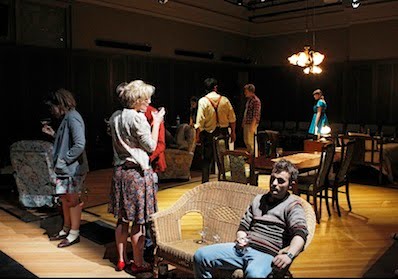
Pictures: Top: James Wardlaw; bottom, The Nest cast. Photos: Jeff Busby

The Nest, by Anne-Louise Sarks and Benedict Hardie, after Maxim Gorky's The Philistines. Set by Claude Marcos, costumes by Mel Page, lighting by Lisa Mibus, sound and composition Russell Goldsmith. With Sarah Armanious, Stuart Bowden, Stefan Bramble, Alexander Englabnd, Brigid Gallacher, Julia Grace, Benedict Hardie, Carl Nilsson-Polias, Meredith Penman and James Wardlaw. Northcote Town Hall, Studio One. Until December 19. Details and bookings.

Read More.....
Wednesday, December 08, 2010

Collected Works benefit

Collected Works, under the proprietorship of Kris Hemensley, is one of the treasures of Melbourne. It is that rarest of businesses, a poetry bookshop. As The Wheeler Centre comments today, Victoria boasts over 300 book shops, but its City of Literature submission singled out Collected Works as “unlike any other shop in the country… specialising in poetry and ideas, and is the most substantial retail outlet for poetry in Australasia, giving local literature a sense of where it sits within a global sphere”.

A recent rent hike threatens its existence, and so tonight, from 5.30-7pm, a bunch of literary peeps have organised a Collected Works Benefit. There's even a raffle, with donations from a range of poetry folk, including Australian Poetry, Victorian Writers’ Centre, Hunter Publishers, University of Queensland Press, John Leonard Press, and over twenty writers including Kevin Brophy, Joel Deane, David McCooey, Robyn Rowland, Alex Skovron, Chris Wallace-Crabbe and me. More details from SPUNC. At Collected Works Bookshop Nicholas Building Level 1, 37 Swanston Street, Melbourne.

Read More.....

Tuesday, December 07, 2010

Independent theatre

The Australian today publishes my whistle-stop and inevitably partial guide to Australian independent theatre. Feel free to note significant omissions, especially outside the Sydney/Melbourne axis...

Read More.....