Review: Song of the Bleeding ThroatMIAF: EndgameReview: Not What I am: Othello RetoldReview: For Samuel BeckettThe Crucible ~ theatre notes
Showing posts with label eleventh hour. Show all posts

Monday, January 31, 2011

Review: Song of the Bleeding Throat

On a mild summer evening in the ivy-clad courtyard of The Eleventh Hour's headquarters in Fitzroy, it's not difficult to think that you have suddenly been transported to a different era. The lawn is studded with marquees; a door behind the temporary bar opens teasingly to a private house with shuttered upstairs windows, which you can't help but imagine must look like something painted by Bonnard or Vuillard. Even your host, artistic director William Henderson, could have stepped out of a daguerreotype.

Maybe it's Europe circa 1912, before world war and revolution wracked the planet, when a disparate bunch of radical artists were creating something that would be called "modernism". Only it's Melbourne 2011: a different place, a different era. Given the present sense of social urgency, perhaps it's not surprising that so many artists are looking to the modernism that flowered as the anxieties of its times thickened and convulsed, picking up the threads of experiment and discovery and attempting to make something new of them. Certainly, this investigation is a crucial part of The Eleventh Hour's eclectic, intelligent theatre, and why they're one of Melbourne's must see companies.


This time, instead of reworking classic texts, The Eleventh Hour presents a new play by David Tredinnick, who is better known as an accomplished actor. Song of the Bleeding Throat is described as a "burlesque", meaning its older sense of comic parody rather than strip-tease. And it's a fascinating beast indeed. Tredinnick is parodying ideas, in particular some of the formative 19th century notions behind contemporary Britain and America. His burlesque features such notables as the historian and social commentator Thomas Carlyle; his wife, Jane Welch (and their dog Nero), Abraham Lincoln, Walt Whitman, Lincoln's assassin John Wilkes Booth and the Statue of Liberty.

The text is foremost a torrent of words. Tredinnick has created a bizarrely Beckettian collage out of quotations and almost-quotations from public figures ranging from PT Barnum to Marx: statements about empire and revolution jostle with domestic intrigues, fancies, poems and obscene malapropism. The language of high oratory or Romantic poetry is continually exploded by the decay and weakness of the body: Carlyle (Richard Bligh) is tormented by his bowels, Welch (Anne Browning) is a drug addict, Nero the dog (James Saunders) is beaten within an inch of his life, Lincoln (Neil Pigot) is dying (or dead). The only personage who seems above all this bodily flux is Whitman.

Each phrase is buffed to a dark lustre. Everyone speaks as if they all wrote out their thoughts in a goose-quill before uttering them. It's about as far as it is possible to get from the conventions of contemporary theatre: this is a text that has little truck with ideas of character or narrative. Its characters are symbols, mouthpieces, carefully constructed puppets - parodies, as Tredinnick claims. But parodies of what? There are all the obvious answers - they parody the vanity of intellectual achievement in the face of death; the selective consciousness of heart-stirring cries for liberty and revolution that ignores, say, those who happen to possess black skin; the tragic gap between ideal and reality (the play itself is prefaced by a quote from the greatest pragmatist of them all, Josef Stalin).

But most of all it seems to me that it parodies language itself. Language, which promises so much, here collapses inward on itself, revealing a pile of rubble that stinks of death, or is anerotically absorbed in the cultural body. The production often forbids us easy access to listening: Nero stutters, the Carlyles speak in Scots accents. Even its visionary clarities decay: Whitman's magnificent "I sing the body electric" becomes a narcissistic anthem in the musical Fame. The only recourse at the end is the solitary voice, Whitman's "song of the bleeding throat", which is cut off in mid-sentence.

This density of meaning and linguistic relations means that if you don't pay close attention, you will soon be quite lost. Even if you do, it's easy to feel that, as Lincoln says at one point, "I’m trying to blaze a way through this swamp". The weight of this orotund 19th century language, almost completely unleavened by contemporary brevity, often lies heavy. The danger of employing this diction is that it attenuates the work's political clout: what do all these words have to do with Now?

If it's anything, Song the Bleeding Throat is an overtly political work, at once exploring and mocking the formative nationalism of our time, US patriotism. Through the figure of Carlyle, a major Romantic essayist and thinker, it picks up European revolution and imperialism, connecting these ideals to the hopes and betrayals of the brash democratic exercise in America. Yet this is an oblique tracing, more a kind of animating of ghosts which still colour the assumptions behind so much public speech.

I find myself oscillating between feeling on the one hand that the text rings its changes very successfully, and on the other thinking that all this luxuriant excess of language ends up obscuring itself, that there is, in short, too much of it. (Certainly, coming from a school that prefers poetry of the theatre to poetry in the theatre, I think there's a little too much poetry). Its ideas are in fact often presented with an unsettling clarity, but the whole seems too much jostle. I suspect that there is a myopia of focus, an obsessive close-up attention that forgets the larger architecture of the play's argument and diffuses its point. It's common to claim that less is more, and it's not always true; but in this case, I think it might have been.

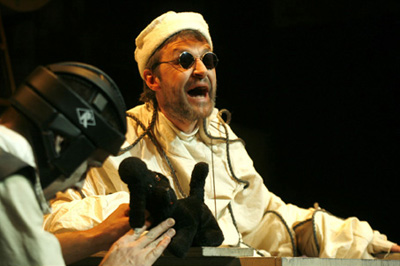
Perhaps the only director in Melbourne who could tackle a text like this is Brian Lipson, whose theatrical imagination is as baroque and elliptical as the playwright's. The production is as finely polished as the text itself: it features astonishingly disciplined and, frankly, riveting performances from its cast, although Neil Pigot as Abe Lincoln is the stand-out. The alienations in the text are realised in the theatre with a playful theatricality: in the first half, the three characters are formally placed as in a portrait (the staging is in fact based on a famous portrait of the Carlyles at home), with Nero - an English shepherd dog in the painting - becoming a working class lad in a cloth cap. In the second half, in a stunning coup de theatre, the entire space is reversed, and the audience finds itself looking up at the death bed of Lincoln.

There is no moment that doesn't feel utterly worked, down to the least gesture: even the twilight shading to darkness through the windows outside. And it glints with a dark humour that segues to sheer playfulness: when Carlyle decides to light a spill from the fire, for instance, and irritably summons the dogsbody/author to crouch behind the empty mantelpiece with a lighter. There are theatrical moments which are as good as anything you'll see, seriously, but somehow it meanders, creating palpable longueurs. I kept thinking of a necklace, a string of marvellous pearls with no string. And yet, again, this isn't wholly true.

It's often very funny, but underneath the whole is a vein of pure seriousness that harks back to those 20th century modernists, in particular the formalist experiments of Piscator and Meyerhold. Maybe my reservations exist in its timeliness. It was odd to watch this play last week, as the popular revolution in Egypt and elsewhere in the Middle East lit a more violent flame beneath the pieties that Song of the Bleeding Throat explores. Suddenly these ideas - democracy, revolution and their betrayals - seem invested with more urgent feeling and moment than seems adequate to burlesque. But then again, the song of the bleeding throat is precisely what is consciously elided in the play: its concern is with everything that silences that song. In any case, this is certainly an intriguing work, uncompromising and painstakingly realised, and worth seeing for that alone. Definitely not for those who like their theatre on a plate.

Picture: Neil Pigot as Lincoln in Song of the Bleeding Throat.

Song of the Bleeding Throat, by David Tredinnick, directed by Brian Lipson. Design by Brian Lipson and Alexis George, costumes by Alexis George, lighting by Niklas Pajanti and Nicola Andrews. With Richard Blight, Anne Browning, James Saunders and Neil Pigot. The Eleventh Hour, 170 Leicester St, Fitzroy, until February 12.

Read More.....

Wednesday, October 22, 2008

MIAF: Endgame

Festival diary #9: Monday

Beckett: Endgame/Bach: Chaconne
by Samuel Beckett and JS Bach. Directed by Anne Thompson and William Henderson, designed by Julie Renton, lighting design by Niklas Pajanti. With David Tredinnick, Peter Houghton, Evelyn Krape and Richard Bligh. Violin by Miwako Abe. The Eleventh Hour, Leicester St, Fitzroy, until October 25.


(Note: season extended to November 8, bookings 1300 136 166)


Every time I visit The Eleventh Hour's beautiful little theatre in Fitzroy, it seems to me that this company is just getting better. Over the past few years, directors Anne Thompson and William Henderson have built up a loyal audience with their vital productions of classic texts. The Eleventh Hour eschews museum performances, searching instead for the live spark of creation, and they've often taken a robust approach to the texts they've produced. Sometimes this has been less than successful, but you can never claim that they are not interesting.

They seek, as they say, "poetry in the theatre, theatre in the poetry" (it seems I can't avoid poetry in this year's Melbourne Festival). Hence their interest in the arch poet of the theatre, Samuel Beckett. This superb production of Endgame premiered two years ago as A Tribute to Samuel Beckett, and was justly lauded for its remarkable performances, which netted Peter Houghton a Best Actor gong in the 2006 Green Room Awards.


They've remounted Endgame for the Melbourne Festival, and among other things this production demonstrates the immense value of revisiting successful work after it's been seasoned in front of an audience. It gives a company a chance to deepen and refine their understandings, to make a clearer draft of something that was already good. And The Eleventh Hour has taken this opportunity and run with it.

This production has certainly evolved from its last outing, and has ironed out all its bumps. Originally it began with a showing of several scenes from Buster Keaton's films, which then segued into a live performance of a Chaconne from Bach's Partitas for solo violin, played by Miwako Abe. The play itself was introduced with an extract from Molly Bloom's monologue from James Joyce's Ulysses. The aim was to contextualise the work, but the effect was distracting and effectively destroyed the play's beginning, with knock-on effects on its rhythm. Beckett is such a stringent and unsparingly intelligent theatre writer that it's very difficult to depart from his vision without making it lesser.

This time, the contextualisation works just fine. The production opens and closes in total darkness, with the violin playing close by. Sitting in in the dark listening to a live performance of Bach is an experience I can recommend; you will seldom hear music with such sharpened ears. And Bach's stern, formal loveliness is an excellent counterpoint to Beckett's writing, a kind of aesthetic cleansing for what occurs in between.

Keaton now is a graceful allusion, rather than a didactic lecture. A brief film, Neighbours, plays above Clov's head as he appears as a grotesque still life framed in the doorway in the final few minutes of the Chaconne. The music ceases, the lights come up and the play begins.

Julie Renton's traverse design has been turned around, and is at once simpler and more essentially playable. At one end the door in the wall, which was basically ignored last time, becomes the door to Clov's kitchen and Hamm's chair (throne? cupboard?) is on a dais at the other, reached by a ramp. There's less white and more distressed grey around the walls.

But where the remount really pays off is in the detail of the performances. They were already blindingly good; now there are deeper resonances - the Shakespearean echoes in Beckett's text are, for instance, beautifully played - and a more confident theatricality. And as with Shakespeare, there are no small parts: Evelyn Krape and Richard Bligh as Nagg and Nell reprise the cruel comedy of their roles, with a shade more pathos this time; Nell if anything seemed more wistful, more despairingly bleak, in her impotent lustfulness.

David Tredinnick as Clov gives a performance of startling physicality, striding awkwardly around the stage on unbending legs, all savage clownishness. His final monologue - the only time when Clov really gets to be more than a peg to Hamm's mallet - is as finely honed acting as I've seen, each phrase edged with passionate bitterness that plays hard against his liberation from the game of life ("When I fall I'll weep for happiness").

But the night again belongs to Peter Houghton's portrayal of Hamm. I don't know how he managed to age 30 years for this production - it's not merely an effect of make-up - but that impatient, imperious, cruel profile dominates the production. It's a marvellous performance, rich in actorly flourish that exploits every nuance of Beckett's language.

If there's a criticism to be made, it's that occasionally in the vaudevillean to-and-fro the dialogue was a little rushed; sometimes I wanted a little more air. But I suspect that was an effect of opening night, as it abated as the play progressed. And that's really picking nits. This is a work of deep and thoughtful integrity, that finely balances Beckett's merciless humour with his profound compassion. You'll rarely see such a vital production of Beckett's work, and all those who managed to get their hands on tickets can feel justly smug.

My review of the original production (where I talk a little more about the play) is here.

Picture: Peter Houghton (Hamm) and David Tredinnick (Clov) in The Eleventh Hour's production of Endgame. Photo: Ponch Hawkes.

Read More.....

Thursday, November 29, 2007

Review: Not What I am: Othello Retold

Not What I Am – Othello Retold by William Shakespeare, directed by Anne Thompson. Conception and dramaturgy by Anne Thompson, Stuart Orr, David Treninnick and cast. Design by Julie Renton, lighting by Kick Pajanti, composer Wally Gunn. With Rodney Afif, Shelly Lauman, David Trendinnick, Jane Nolan, Stuart Orr and Greg Ulfan. The Eleventh Hour, The Eleventh Hour Theatre, Melbourne, until December 15. Bookings: (03) 9419 5649.

For several years The Eleventh Hour has been one of the treasures of the Melbourne theatre scene. From their base in an enviably beautiful little theatre in Fitzroy, they’ve built an enthusiastic following.

And rightly so. Under directors William Henderson and Anne Thompson, this company – which exists entirely on private funding – has offered fresh interpretations of playwrights as various as Sarah Kane, Samuel Beckett, Oscar Wilde and Arthur Miller, with a particular emphasis on Shakespeare.

They create a fascinating form of stylised physical theatre, with inventive mise en scène and choreography. As far as I’m concerned, their robust approach to plays can sometimes be controversial – for example, an otherwise superb production of Beckett’s Endgame last year suffered from extra-textual interruptions.

But, agree with them or not, their productions are always intelligent, beautifully performed and superbly produced. Their radically reworked version of Othello, Shakespeare’s tragedy of the Moor of Venice, is no exception.

Not What I am – Othello Retold is a cut-and-paste of Othello which at times almost turns Shakespeare’s text into an oratorio.

Playing on the ambiguity of Moorishness, Othello (Rodney Afif) is Arabic rather than African. He and Desdemona (Shelly Lauman) form the central axis of the production. The rest of the cast – Iago (David Trendinnick), Emilia (Jane Nolan), Cassio (Stuart Orr) and Roderigo (Greg Ulfan) – doubles as a chorus, sinisterly cloaked in anonymous black.

The chorus represents Venice itself. They introduce themselves as the seven deadly sins, exemplified in Shakespeare’s play by Iago, one of his most charismatically evil characters. In this version, Iago’s wickedness is distributed through the populace of Venice, which collaborates to destroy Othello and Desdemona’s scandalously miscegenous marriage.

The lush design, a construction of Moorish walls and windows gorgeously lit in ochres and umbers, centres on Othello’s marriage bed. And from the beginning, the erotic marriage of sex and death is in the foreground: Othello’s final speech before he murders Desdemona is here performed as a seduction, exploiting the ancient pun that orgasm is a “little death”.

The other characters are as sexually charged as the central pair, drawing every erotic implication out of Shakespeare’s loaded language. As the tragedy nears its inevitable bloodbath, the production becomes almost hallucinatory, like a glimpse into Othello’s madness.

The excellent cast is equal to the extreme vocal and physical demands and is sometimes skin-pricklingly good.

As a colleague perceptively remarked afterwards, this is Othello as a revenge tragedy. Or, perhaps, as a spoken opera. Definitely one for the diary.

This review appeared in today's Australian.

Read More.....

Monday, November 27, 2006

Review: For Samuel Beckett

For Samuel Beckett: Endgame, by Samuel Beckett, directed by William Henderson and Anne Thompson. Design by Julie Renton, lighting design by Niklas Pajanti. With David Tredinnick, Peter Houghton, Richard Bligh and Evelyn Krape, music performed by Miwako Abe. Eleventh Hour Theatre, 170 Leicester St, Fitzroy, until December 9.

I've never understood those who accuse Samuel Beckett of being a miserablist. If he were as nihilistic as his critics claim, he would have written nothing, and he wouldn't have been half as funny. And he is often very funny indeed.

Comedy is always cruel, and perhaps it is most pitiless when it springs from a compassion as profound as Beckett's. Beckett's compassion is not of the kind that can be easily construed in humanist terms; it is far beyond looking for transcendent meaning in the human condition. Rather, Beckett grants his strange characters a space in which the trivia of their existence in a godless, inhuman universe is given its proper dignity. Where nothing means anything, everything becomes significant.


In Beckett's work, this dignity is most often expressed through refusal. Winnie's sprightly self-deception in Happy Days has a kind of bleak heroism that is not so far from the Woman's "Fuck life" in Rockabye. Hamm and Clov's refusals in Endgame are comprehensive: they refuse even the possibilities of pity, redemption, life itself. What is left is the performance, the game, the play.

In Beckett's theatrical oeuvre, this game takes many forms: some of his plays are more like installations, and not all of them are comedies. But all of them, without exception, pierce to the quick of existence. If Beckett is one of the great writers of the 20th century - and I would argue that he is - it is because of the utterly uncompromising rigour of his vision. I know of no writer more truthful and less self-deceiving than Beckett. Nor can I think of a writer who is more concerned with formal beauty.

Because of this, it is a fine stroke to begin and end the performance of For Samuel Beckett with a performance of two of Bach's Partitas for Solo Violin. Like Bach, Beckett was a master of the art of repetition and variation, and the performance by Miwako Abe induces a mood of receptive meditation that is wholly appropriate for a Beckett performance. There were other aspects of the framing of Endgame that I was less taken by, but more of that later.

This is, simply, a brilliant performance of Beckett's greatest play. Endgame is as close to perfect as a play can get, as precise as a great piece of music in its modulations of tone and rhythm, and here it is served by a superb cast. It is, as the title implies, a performance of ending, a play in which everything is negated. "Something," as Clov says, "is taking its course". That something is, of course, death; but it is also life. The play is a process of discarding: the list of things that no longer exist drop through the text like a refrain. There are no more bicycles, nature, Turkish Delight, coffins or painkillers. Clov and Hamm want to be very sure that there are no more human beings to continue the farce of human existence; even a flea raises the possibility of a new evolution, and must be exterminated.

Without casting for cheap laughs, the actors fully exploit the vaudevillean quality of the dialogue. This conversation, for example, between Nagg (Richard Bligh) and Nell (Evelyn Krape) is straight Abbott and Costello:

Nagg: Can you hear me?
Nell: Yes. And you?
Nagg: Yes. (Pause) Our hearing hasn’t failed.
Nell: Our what?
Nagg: Our hearing.
Nell: No.
Because of the nature of this play, it is easy to think of it as a two-hander. But, as in Shakespeare, there are no small parts: Nagg and Nell are as crucial as Clov and Hamm. The legless parents of Hamm, they are shut in ashbins, just as the aged are shut in Old People's Homes. Krape infuses Nell with a kind of scatalogical pathos, investing her with a wistful lustfulness that is both comic and genuinely sad. Nagg hasn't Nell's romance with memory: as he says, "One must live with the times". Hamm's "accursed progenitor" is both Hamm's past and his future: the cruelty Hamm visits on him is only a reflection of the cruelty he visited on Hamm as a child; and he presents Hamm with a vision of what will greet him in old age. Richard Bligh gives him the pathos of the dethroned patriarch, at once vicious and impotent and pitiable.

But the evening inevitably belongs to Hamm (Peter Houghton) and Clov (David Tredinnick). These two are superlative: their timing is faultless, exploiting to the full the comic potential of the dialogue. In their hands, the play rattles along like Boadicea's chariot, cutting down swathes of illusion with savage flair. The light I have always seen in Beckett is switched on at 1000 watts.

I had no idea (my oversight) that Peter Houghton was such an actor; this is a consummate actor's role, a performance of a performance, and it permits him the full range of his abilities. Hamm is presented in his full motley: manipulative, tyrannical, ungenerous, sardonic, cruel, hammy, vain; but also wholly without self-pity or self-deception. Tredinnick is an apt foil: crouched into a question mark, he clumps noisily and clumsily around the stage, rebelliously obedient, dour, savage and resentful. Their performances are a joy.

Julie Renton's design puts the audiences on two sides of the stage, with the famous windows (portholes) at one end, and Clov's kitchen hidden behind white cloth on the other. It's surprisingly effective; it makes it rather like watching a tennis match, which suits the rapid-fire dialogue. Hamm's wheelchair is a kind of mobile chest of drawers and both actors are dressed in variants on clown costumes, which again put a subtle spin on the play without being intrusive. And the whole thing is sumptuously lit.

It would be a nigh perfect night in the theatre, were it not for some mystifying add-ons by the directors, William Henderson and Anne Thompson. The evening is called For Samuel Beckett, which signals it is not simply a performance of Endgame. It opens with a couple of brief contextualisations: a projection of Buster Keaton's One Week, and an extract from Molly Bloom's monologue at the end of James Joyce's Ulysses. Keaton's piece seems merely didactic in relation to the whole, there to show how Beckett was influenced by this sort of comedy. Less easy to understand is the Molly Bloom piece. It is said - beautifully, it must be admitted - by Evelyn Krape as a disembodied voice inside the ashbin, just before the beginning of Endgame. Those unfamiliar with the work could be forgiven for thinking it was part of the play.

It is an ill-judged move, all the more baffling for the quality of the production that follows. The Joyce/Beckett connection is at once cliched and often overstated: it is very hard to see any real connection between Molly and Nell and, if one wanted to do such a thing, it might have been more interesting and illuminating, say, to excerpt Celine. And it effectively destroys the beginning of the play which, in a work as formally crystalline as Endgame, is a high price to pay. The further the play progressed, the more I missed the symmetries that are set up in the opening minutes. Similarly, if less grievously, Nell's death is signalled by a short violin solo, and it takes a little time for the play to find its rhythm afterwards.

It's a tribute to the performance of Endgame that it transcends these decisions. Beckett is one of the few theatre writers - perhaps the only writer - of whom it can be said that departing from his instructions is almost always a mistake. As this production amply bears out, his strictness can offer unique freedoms.

Picture: David Tredinnick and Peter Houghton in Endgame. Photo: Ponch Hawkes

Read More.....

Tuesday, September 13, 2005

The Crucible

The Crucible by Arthur Miller. Directed by Anne Thompson and William Henderson. Designed by Bruce Gladwin, lighting design Niklas Pajanti. With Nicole Nabout, Shona Innes, David Trendinnick, Fiona Todd, Peter Houghton, Evelyn Krape and Christopher Brown. The Eleventh Hour, 170 Leicester St, Fitzroy, until October 1.

It was not only the rise of McCarthyism that moved me, but something which seemed much more weird and mysterious. It was the fact that a political, objective, knowledgeable campaign from the far Right was capable of creating not only a terror, but a new subjective reality, a veritable mystique which was gradually assuming even a holy resonance...the astonishment was produced by my knowledge, which I could not give up, that the terror in these people was being knowingly planned and consciously engineered, and yet that all they knew was terror. That so interior and subjective an emotion could have been so manifestly created from without was a marvel to me. It underlies every word in The Crucible.

Arthur Miller

Miller could be writing about contemporary America: a consciously engineered terror which attains a "holy" mystique, where dissent against the ruling powers attains the status of blasphemy. The Crucible premiered in the US in 1953, but its political insight strikes fresh sparks in the age of the Global War on Terror (or GSAVE - the Global Struggle Against Violent Extremism - for those who missed the changing of the acronyms). If ever there were a play for our times, The Crucible is it.

It also happens to be a personal favourite of mine. With Death of a Salesman and A View from a Bridge, The Crucible shows Miller at the height of his dramatic powers, in fruitful agonistic struggle with theatrical aesthetic and form. He was not yet America's Great Playwright, and the urge to didacticism - always strong in Miller - had not yet gained the upper hand. Here is passion tempered by formal intelligence, ideological critique informed by intuitions of human contradiction and frailty. These plays exemplify the very best of the American liberal tradition.

The timeliness of The Eleventh Hour's decision to stage Miller's masterpiece (for it may be fairly called that, especially if, following Randall Jarrell, one thinks of a masterpiece as a work of art with "something wrong with it") is therefore praiseworthy. But it must be said that the company's treatment of the text is utterly baffling.

The focus of the production is deliberately shifted from complex political critique to Miller's private life ("the affair that led to the destruction of his first marriage"). To this apparent end, the directors - Anne Thompson and William Henderson - have eviscerated the text. The Crucible runs for something like half its original length, and many of its secondary characters have been cut out completely. Its formal structure looks something like Fallujah after the Americans finished with it, with the odd graceful wall poking out of the ruins to show what had been there.

The company's stated objective in the program is to "wrest this classic from its traditional performance framework" in order to "create a performance landscape that allows the force of Miller's extraordinary language and the passions fuelling it to live in a new way." To be honest, I am not at all sure what this means; but I do know that a work of art is inseparable from its form. There is no purer "content" which might be ripped out of a frame: in a radical sense, the frame is the content. In other words, you fiddle with a work as artfully made as The Crucible at your peril.

I should say at this juncture that I am no friend of the museum treatment of "classics". A good play should be able to withstand - in fact, requires - intense interrogation and disrespectful, even violent treatment, if it is to live in performance. True, texts can be cut and sometimes to their advantage, Hamlet being only the most obvious example. And one thinks of the power of the Wooster Group's treatment of The Hairy Ape, performed as extreme physical theatre, as if it were a boxing match, its vocal assault electronically amplified... but the Wooster Group performed O'Neill's play, however they attacked the text. The Eleventh Hour, on the other hand, put The Crucible through some process of "composition": that is, they rewrote it. The big question is, why?

Partly, perhaps, to focus an emotional experience on some perceived essential quality of language? The play is performed as stylised physical theatre: certainly the cast is choreographed with a beautiful precision, and lushly lit in the dark cavernous spaces of the theatre to create tableaux which sometimes possess an arresting and disturbing beauty. And, except in the later scenes (which are also the least grievously cut) where, perhaps, the passion of the writing begins to inhabit the performances, the language is declaimed with deliberate artifice, each word enunciated as if it exists on its own. I don't understand this decision, as it wrecks Miller's rhythms; in plays, as in poems, rhythm is the heart of linguistic vitality.

Clearly the directors wish to take The Crucible beyond its naturalistic conventions - which, in Miller's hands, have more than an edge of the poetic - to a more heightened experience. I suspect that in doing so, they mistake the artifice of Miller's naturalism.

Miller wrote a play in four acts, each in a different setting, through which the action evolves seamlessly and dynamically. The more you study the play, the more you admire its economy, how artfully he integrates emotional and political worlds, suggesting the complexity of a small community by a deft phrase here, a throw-away line there. Miller invokes the remorseless machinery of tragedy: The Crucible is, if you like, an instrument tuned finely in all its parts to create the final cathartic scene, where John Proctor grasps his "goodness" at last in the face of his own wilfully chosen death.

The Eleventh Hour's "composition" of Miller cuts these fluid, intricately worked acts into a series of truncated scenes separated by blackouts. This transforms the action into a series of tableaux, and the sense of stasis is reinforced by hymns sung by the cast at each blackout. These refinements have some fairly profound effects on the play's political texture. More devastatingly, I think, they fatally corrode the emotional force of the play: though the final meeting between Elizabeth (Fiona Todd) and John Proctor (Peter Houghton) still holds some of its original power, basically because most of it is still there, it is deprived of much of its poignancy because we have not seen the simple domestic scene that introduces Elizabeth, in which the bones of their marriage are laid bare through their painful, tentative conversation.

By assuming that Miller's political impulses evade the personal, the company also mistakes him. His politics were never simple - he refused the claim that he wrote "political plays" - and never eschewed the personal. "I can't write plays that don't sum up where I am," he wrote. "I'm in all of them. I don't know how else to go about writing." Miller's plays place themselves, optimistically, in the tradition of liberal individualism. John Proctor's choice not to betray his friends and to redeem himself is the archetypal gesture of the individual asserting his (in Miller's case, it was nearly always "his") identity in the face of social repression. For Miller, this was an anguished and continuous conflict between imperatives of inner and outer selves which could end only with death.

But he was more than an observer of the human conscience. The idea of property, of who owns what, is meticulously noted in The Crucible; Miller is extremely conscious of the economic relationships in the small Puritan community of Salem. Removing altogether characters like Giles Corey, the cantankerous landowner who will neither plead guilty or not guilty so his sons can inherit his property after he dies, removes a crucial subtext from the play: the Protestant equation of ownership with virtue. It's the poor and dispossessed who face the hangman first, and conflict over property fuels many of the accusations of witchcraft. Miller is too acute to portray the accusers simply as venal hypocrites; what he shows is how public hysteria can all too easily meld with private self interest.

One aspect this production highlighted for me, and which might have been a fruitful area of further exploration, was a brooding sense, as pervasive as the Puritanical sexual repression, of unacknowledged violence. Proctor's threat to whip his servant, Mary Warren (Evelyn Krape), is viscerally disconcerting. Tituba (also Evelyn Krape) is a slave, taken by force from Barbados, and before that, from Africa. Abigail's (Nicole Nabout) recollection of her parents' violent deaths at the hands of Indians reminds that the disputed properties of Salem have a prior claim, that of the native Americans who first lived there, and whose lands were taken by force. Behind the hysteria of the witch hunt lies also the guilty conscience of the coloniser, the sense of a primal crime.

There are lines in The Crucible which strike with renewed force, because they have, again, found their time. The polarised vision of Good and Evil that informs the present White House and, unfortunately, the discourse of our own government - "you're either with us or against us" - is unsettlingly echoed in Danforth's declaration that "a person is either with this court or he must be counted against it". The seduction of the absolute and the destructiveness of certainty have particular resonance now, and have implications for both the private life of conscience and that of public action. It wasn't that Miller thought anything as banal as "the personal is political", which I rather fear informed the interpretation here; but he was an acute observer of the relationships between these different spheres of being.

I liked the simple and effective design - trestle tables which were manipulated to create several performance levels. And despite my serious reservations about the production, I enjoyed individual performances, especially those of David Trendennick as Parris and Danforth, and Christopher Brown as the tormented Man of God, Reverend Hale. It makes you sigh for a missed opportunity: if, as the director's note says, one impulse behind this experiment was "to try to understand the relationship between private emotion and political action", it would have been far more illuminating to perform the play Miller actually wrote.

Read More.....