A reminderReview: Sizwe Banzi Is Dead/medEiaBrook's LearReview: The Damask DrumMIAF: I La GaligoHamlet ~ theatre notes
Showing posts with label peter brook. Show all posts

Tuesday, May 26, 2009

A reminder

The more a critic becomes an insider, the better. I see nothing but good in a critic plunging into our lives, meeting actors, talking, discussing, watching, intervening. I would welcome his putting his hands on the medium and attempting to work it himself. Certainly, there is a tiny social problem - how does a critic talk to someone he has just damned in print? Momentary awkwardnesses may arise - but it is ludicrous to think that it is largely this that deprives some critics of a vital contact with the work of which they are a part. The embarrassment on his side and ours can easily be lived down and certainly a closer relation with the work will in no way put the critic into the position of connivance with the people he has got to know. The criticism that theatre people make of one another is usually of devastating severity - but absolutely precise. The critic who no longer enjoys the theatre is obviously a deadly critic, the critic who loves the theatre but is not critically clear what this means is also a deadly critic: the vital critic is the critic who has clearly formulated for himself what the theatre could be - and who is bold enough to throw this formula into jeopardy each time he participates in a theatrical event.

Peter Brook, The Empty Space

Read More.....

Thursday, October 18, 2007

Review: Sizwe Banzi Is Dead/medEia

Melbourne Festival #4

Sizwe Banzi Is Dead by Athol Fugard, John Kani and Winston Ntshona, directed by Peter Brook. Adapted into French by Marie Helene Estienne. Lighting design by Phillipe Vialatte. With Habib Dembélé and Pitcho Womba Konga. Merlyn Theatre, CUB Malthouse, until October 27. Geelong (GPAC October 30-31), Bendigo (The Capital, November 2-3), Adelaide (Festival Centre November 6-17), and Sydney (Playhouse, Sydney Opera House, November 26 to December 16).

medEia, devised and performed by Oscar van Woensel, Manja Topper and Kuno Bakker. Beckett Theatre, CUB Malthouse, Melbourne, until October 20. Bookings: 9685 5111.

Over the past couple of years, the Melbourne Festival program has copped a lot of flak for its supposed “elitism” and lack of interest in “ordinary” people. These criticisms emerge from a popular – if not very accurate – assumption that innovative art places itself, by its very nature, above the common herd.

So it’s fascinating to see that a major preoccupation emerging in the festival’s first week is one of the most ancient and popular arts of all – that of story telling. All the theatre I’ve seen, from Barrie Kosky’s uncompromisingly brilliant realisation of The Tell-Tale Heart to stand-up comic Daniel Kitson’s charming C-90, is about telling stories.


We tell each other stories for many reasons: to confirm our identities, to amuse each other, to understand and question the world. Most of all, story-telling asserts a sense of community, inviting us to consider not only the differences between us, but what we have in common. It is, crucially, how we build relationships with one another.

This is something the South African playwright Athol Fugard understands profoundly. The other thing he understands is the primacy of the actor in what he called “the pure theatre experience“. “The ingredients of this experience are very simple,” he wrote. “They are: the actor and the stage, the actor on the stage.”

It’s very easy to see the attraction of Fugard’s writing to an actor-centred director like Peter Brook. And Brook’s production of the first of Fugard’s famous Statement plays, Sizwe Banzi Is Dead, is an exemplary demonstration of how performance and text can be united into the third thing that is theatre.

Athol Fugard wrote his three Statement plays, Sizwe Banzi Is Dead, The Island and Statements After An Arrest Under the Immorality Act, in the 1970s, at the height of Apartheid, working from improvisations with the actors who first performed them, John Kani and Winston Ntshona.

They were acts of immediate (and at the time, perilous) political urgency, but Fugard – a theatre writer of sophistication as well as urgency – knows that political writing, if it is to mean anything, has to reach both higher and lower than the banalities of ideology, into the heart and mess of human lives.

So Sizwe Banzi Is Dead eschews any kind of moralising or lecturing. Its richly comic story is simply about the absurdity and tragedy of being Black in an Apartheid state, when every trivial detail of your life is ruled by your Pass Book and identity number.

Sizwe Banzi (Pitcho Womba Konga) has arrived in New Brighton from the country, seeking work to support his family, who are not allowed to move to town with him. But his residency rights are revoked when he is arbitrarily arrested in a raid.

When he and his friend Buntu (Habib Dembélé) discover a dead man in the street, they steal his identity, turning the illegal Sizwe Banzi into the legal Robert Zwelinzima; a move that will work, Buntu tells him, as long as he stays out of trouble.

“A black man stay out of trouble?” responds Sizwe with incredulity. “Impossible, Buntu. Our skin is trouble.” But, as he writes to his wife, “for the time being” his troubles are over, and that, in this world, is enough to ask.

This two-hander is infused with the irrepressible, contagiously subversive humour of the oppressed – it opens with a wonderful shaggy dog story, told by Dembélé, who plays multiple parts, which satirises a visit by the US chief executive to the South African Ford factory. But the play communicates, effectively and movingly, the heavy price of living in a police state.

And it’s impeccably realised. It is performed on a bare stage, on which are placed a number of simple objects – a rubbish bin, bundled piles of cardboard, wardrobe racks. The focus is on the performances, and these are, from the first moment Dembélé appears on stage as the young, mischievous photographer Styles, a rich, utterly seductive pleasure.

It’s deeply detailed work, every tiny gesture opulent with meaning. Dembélé is such a hugely gifted actor that he seems like some kind of magician: in the blink of an eye he transforms before your eyes into an old woman, an old man, a child. Konga, whose identity ironically remains stable as Sizwe Banzi/Robert Zwelinzima, powerfully and touchingly evokes his character’s simple dignity.

Dutch company Dood Paard’s medEia tells an older tale: the story of Medea, who betrayed her own people for the sake of her love for the invader Jason, only to be betrayed in her turn, and who murdered her own sons in revenge.

The spare, direct text has been devised by the performers, Oscar van Woensel, Manja Topper and Kuno Bakker, from Euripides’ original play. Where the ancient Greeks used tropes like “wine-dark sea” to prompt oral memory, the writers have employed a contemporary equivalent: immediately recognisable lines from popular songs prickle the text with sly humour.

For the first few minutes, my heart sank. I wasn’t in the mood for a lot of words. It was – as, in fact, is also true of classical tragedy – quite clear from the beginning what the performance was to be. But it wasn’t long before I found myself riveted: again like classical tragedy, the production has the clean, focused urgency of a single action.

The performers arrange themselves before a wide paper blind. Before them, on the floor, are laid two more blinds. They are successively hoisted up by the actors and then, literally, torn down (you understand swiftly why they are a maze of masking tape), bringing each act of the tale successively closer to the audience.

Medea’s story is told from the point of view of the chorus, those ordinary folk on the sidelines who watch and suffer with the protagonists, but are powerless to influence events. The performers enact, with scant attention to the gender of the actors, the roles of Medea and Jason and Creon as well as the old-woman gossips in the street.

And far from being dull or evasively ironic, this simple retelling is cumulatively powerful: our involvement deepens as the performances animate these ancient passions, until they resonate in our own contemporary language with a new and bitter clarity.

An edited version of this review is published in today's Australian.

Picture: Pitcho Womba Konga (left) and Habib Dembélé in Sizwe Banzi Is Dead. Photo: Pascal Gelly / Agence Bernand Performers

PS: Ms Pedant (recklessly ignoring the adage that people in glass houses shouldn't throw stones) notes that the Age's Cameron Woodhead has Sizwe Banzi as "the second" of Fugard's Statement plays. It says so, after all, in the MIAF program (tsk tsk, copywriters). For the record, Sizwe Banzi premiered in 1972, The Island in 1973, and Statements in 1974.

Read More.....

Tuesday, August 21, 2007

Brook's Lear

It's a truism to say that Peter Brook's film King Lear is a masterpiece. But what is a masterpiece? Saying this of a work can be a way of not looking at it: the artwork becomes "timeless", a glazed exhibit in the museum of our cultural self-regard. It turns into a monument.

Thinking this over after watching Brook's film recently, it seems to me that when I say something is a masterpiece, I mean that its achievement is not that it rises into some lofty empyrean sphere where history no longer exists. It's a masterpiece because it does the opposite: because it makes a gesture so potent that it seems to draw all human experience into its gravity, because it reaches deep into individual and collective memory and hauls experience, naked and bloody, into the present.


When Paul Scofield lifts his dead daughter in his arms and howls in the desolate landscape of battle, for a moment he is every father who has stood in the ruins of his home, holding the corpse of his murdered child. When Alan Webb as Gloucester is roughly bound to a chair in his own house and stares at his captors in disbelief and growing fear, he is every prisoner staring at those who are about to become his torturers, pleading a claim of common humanity in the face of everything that denies it. When Lear confesses to Cordelia (Anne-Lise Gabold) that he has wronged her, it touches everything we know about forgiveness: the grief, the shame and the mutual love of the act.

Watching King Lear now is a different experience from watching it when it was made: our world has changed since 1971. But this film illustrates Ezra Pound's truism that art is "news that stays news". Perhaps what is most shocking about Brook's film - and it remains shocking - is how profoundly it galvanises our present. Gloucester is a prisoner in Abu Ghraib; Lear is a bereaved father in Chechnya or Lebanon. The loss, the grief, the cruelty and the love are all of our own time.

Brook's stripped-back adaptation, which uses all the avant garde film techniques of his day, draws from Jan Kott's insight that Lear, like Beckett's Endgame, reveals a world devoid of consolation, morality or universal justice. To underline the Beckettian connection, Brook uses two of Beckett's favourite actors: Patrick McGee, who plays the coolly sadistic Duke of Cornwall, and Jack MacGowan, who plays the Fool. Brook filmed it in the bleak landscape of a wintry Denmark, and portrayed Lear as a king of 10th century Britain, tyrant of a petty kingdom. The eye is undiverted by pomp and luxury: here both nature and man are brutal.

Brook gives us a complex Lear. He is a king whose madness is evident at the beginning of the story, a man whose fierce will is the only force that controls the madness that stirs inside him. The opening scene is a sweeping shot of the commoners who stand outside the door of the throne room, awaiting a fate that will be decided by capricious forces beyond their control.

What follows is a stark examination of the mechanisms of power. Its victims are not only those who are its objects, but those who brutalise themselves in their lust for it. Perhaps the scene that speaks most of this is near the end, when Brook includes Edmund (Ian Hogg) in the background of the shot as Lear speaks to Cordelia when, having lost their campaign against Regan and Goneril, they are led to prison:

When thou dost ask me blessing, I'll kneel down
And ask of thee forgiveness. So we'll live,
And pray, and sing, and tell old tales, and laugh
At gilded butterflies...

Behind them, Edmund listens. His face, marked by the blood and grime of battle, hardens to stone as he realises that such humility, humour and love, such trust, are lost to him forever. His order that Lear and Cordelia be killed is an act of visceral anguish and denial, a recognition of what he has murdered in himself and cannot bear to witness in others.

Brook's film is a devastating realisation of the play: a pitiless examination of the cruelty and emptiness that lies at the heart of the lust for power. But it is by no means a nihilistic portrayal of humanity. It breaks your heart not because it unflinchingly reveals how cruel human beings can be - that would be merely horrifying - but because it reveals the fragile human possibility that is destroyed by this cruelty.

In King Lear, Shakespeare shows us humanity at its most abject, and - almost miraculously - a great beauty shines within its abjection. When Lear, at the height of his madness and humiliation, prays for those who "bide the pelting of this pitiless storm", lamenting their "loop'd and window'd raggedness", it is a plea to all of us to "show the heavens more just". As too often in this world, the heavens remain unjust: but within that prayer is the awakening of a true compassion that illuminates the value of all real justice.

And maybe that compassion might awaken within those who listen to Lear's speech. That we might "see better" is, after all, what art might legitimately offer us: a slight hope perhaps but, all the same, real and obdurate in a world which so often seeks to make us blind.

Read More.....

Sunday, November 12, 2006

Review: The Damask Drum

Mishima in the City: Duets of Desire. 2: The Damask Drum, adapted from the plays by Yukio Mishima and Zeami, directed by Robert Draffin. Film by Ivanka Sokol, set design Ina Indira Shanahan, lighting design by Luke Hails, sound design and music performance by Jethro Woodward. Performed by Alan Knoepfler and Mary Sitarenos. Film acting, voices and stage business by Paul Robertson, Raffaele Rufo, Claire-Larisse Nicholls. Liminal Theatre, 70 Nicholson St, Abbotsford (between Gipps & Langridge St; opposite Sophia Mundi School) until November 26. Bookings: 9539 3669

With the international richness of the Melbourne Festival still fresh in my mind, The Damask Drum is a salutary reminder that we have our own visionary directors close to home. Robert Draffin has been working quietly in Melbourne, evolving his unique practice, for around three decades. And his production of Yukio Mishima's play, now on in an anonymous warehouse in Abbotsford, deserves to stand with the best of the work I saw at the festival.

In the countless productions he has overseen, Draffin has never been afraid of ambition. In 1991, for example, working with the young troupe Whistling in the Theatre, he created a magnificent six-hour adaptation of The Thousand and One Nights at Anthill (one of the small-to-medium theatres that disappeared in the Australia Council's last orgy of cultural vandalism). Or there was his epic 1992 Theatreworks production of Dostoevsky's novel The Idiot. More recent work includes a celebrated production of Genet's Le Balcon at the VCA, where he has been teaching some of the young theatre artists who are putting so much zap into the Melbourne scene at present.

I confess, gentle reader, that it's been a long time since I've seen Draffin's work. More fool me. Like Peter Brook or Ariane Mnouchkine, he works with a committed ensemble of artists, creating the long-term relationships that are the core of great theatre: this particular production is the result not only of short-term rehearsal but of year-long workshops. Funded, perhaps it ought to be noted, by no one except the artists themselves.

Again like Mnouchkine and Brook, his work is deeply concerned with cross-cultural exchange: in Draffin's case, a long history of exchange with Asian theatre artists and practice. And as with Mnouchkine, entering his theatre is to be welcomed into a democratic social space where, until the performance begins, no distinction is made between artists and audience. When you arrive at The Damask Drum, you are ushered to a carpeted space at the back of the warehouse, behind the stage, with cushions, low tables and flowers. Where Mnouchkine provides dinner, Draffin makes you green tea.

And there, perhaps, the resemblances end. Unlike these two theatrical superstars, Draffin's company, Liminal Theatre, is not extravagantly funded; and Draffin's practice is all his own.

The Damask Drum is, in fact, the second instalment of a larger work, Mishima in the City: Duets of Desire, which aims to perform all eight of the plays Mishima adapted from the classical Noh canon.

Mishima's play updated Zeami's Aya No Tuzumi, which tells the story of an old gardener who glimpses a princess and falls obsessively in love with her. Mockingly, she gives him a drum made of damask, and says that if he can make it sound in the palace, she will visit him. Of course, the old man can't make any sound at all from the drum, and drowns himself in despair. After this, the "angry ghost" of the old man "possessed the lady's wits, haunted her heart with woe".

In Mishima's version, the woman, Hanako, lives in an apartment block opposite the old man, Iwakichi, and he has to make the drum sound above the city traffic: but the obsession, the mockery, the vengefulness of the old man's ghost and the woman's regret remain. Draffin has fused Mishima's and Zeani's texts to create a kind of collage, in which sound and song play as significantly as semantic sense.

When the plays were first performed in Japan in the 1950s, they were produced in a naturalistic style: a totally revolutionary decision in the context of the Japanese theatre of the time. Instead, in this production Draffin draws from a range of classical Asian theatre techniques, skilfully combining them with images projected from a hand-held cyclorama and an amplified sound score. Black-clad stage hands operate the projections, fabrics, mirrors, smoke and other stage business. This is certainly not Noh, but it's impossible to overlook its Noh ancestry.

The design exploits the length of the warehouse, seating the audience at one end. The set consists basically of a small stage made of black polished wood that is set immediately before the audience, from which stretches a narrow walkway to a door in the back wall. It's a free adaptation of the hashigakari, or bridge, by which actors sumptuously enter the stage in traditional Noh.

Jethro Woodward's soundscape is astoundingly good. It combines sometimes thunderous electronic sound with a collage of amplified voices that fill the space - mostly inhabited by one actor - with unseen people. The Asian orchestra and chorus are embodied in Woodward himself, who stands in the performance space, to the left of the wooden stage. He plays live electric guitar, singing some parts of the story.

The opening scene demonstrates the potency of the elements Draffin is exploiting here. The play begins in blackness, with Woodward bowing haunting melodies from his guitar. Very gradually, a dim light rises on the far end of the stage: a white figure is partially revealed in the distance. It seems to float in a globe of light through the darkness, like a ghost or a goddess, and moves towards us with hieratic slowness.

It is impossible to tell whether the figure is male or female until he is quite close: then you see it is a half-naked man (Alan Knoepfler), who is wearing a long, white, very full skirt that is held up on either side, like royal robes, by the stage attendants. He collapses before us face forward on the small stage, the skirt like a foaming wave that has washed him up from the darkness.

Knoepfler's performance of the old gardener devastated by obsessive erotic love is utterly compelling. He is on stage, mostly solo, for the whole play, and maintains without wavering the physical, vocal and emotional extremity of his performance. His body is the expressive site of his ecstatic torment and self disgust: he is in turn grotesque, abject, ennobled, despairing, tender. He is well met by Mary Sitarenos as the woman, whose entrance late in the show is almost as beautiful as Knoepfler's.

There are more than a few moments of breath-taking mise en scene in the course of this show. If it has flaws, they are of the kind that are hard to pinpoint: slight hesitancies, perhaps, that may manifest in an overdressed moment here or there. Its strength, as in the writing it is manifesting, is in its simplicity, the courage of both restraint and passion that underlies formal artistic beauty.

The Damask Drum is not only theatre that has poetry in it - which is one thing - but something rather more rare: a poetic theatre, working transformations rich and strange.

Read More.....

Monday, October 23, 2006

MIAF: I La Galigo

Festival Diary #5

As we enter the third week of the Melbourne Festival, TN finds herself a little alarmed by how easily she fades these days. I had to pass on Lucy Guerin's Structure and Sadness and Kota Yamazaki's dance company Fluid hug-hug's Rise:Rose out of sheer exhaustion. Dammit. Mind you, I have never been much good at wholesale cultural consumption: there's always the danger of the experience becoming undifferentiated artistic sludge, like mixing too many colours on a palette. So, with the idea of stringing individual jewels along the MIAF narrative, I will stop regretting what I haven't seen, and get on with what I have...

I La Galigo, from the Sureq Galigo, adapted by Rhoda Grauer, directed by Robert Wilson. Music by Rahaya Supanggah, co-set designer Christophe Martin, lighting by AJ Weissbard, dance master Andi Ummu Tunru. State Theatre, Victorian Arts Centre

It's impossible to underestimate the influence of Asia on modern Western theatre. Ever since Antonin Artaud reviewed a Balinese theatre troupe at the Paris Colonial Exposition in 1931, its theatre has been a major stimulus for the avant garde. Artaud was inspired by the Balinese dancers, who for him articulated the possibility of a theatrical language free of the chains of literature, and his rewritten review later became one of the key essays in his hugely influential book, Theatre and Its Double. A little later, in 1935, Bertolt Brecht saw the Peking Opera in Moscow, and his experience of "strangeness" profoundly underlaid his Epic Theatre and its theory of verfremdungseffekt, most often translated as the "alienation effect".

In 1978, Edward Said published his ground breaking (and much misrepresented) work about the political implications of Western portrayals of the East, Orientalism. By the time Peter Brook undertook his extraordinary nine-hour adaptation of the Indian epic poem, The Mahabharata, in 1985, the issue of cultural appropriation had entered the intellectual mix. Intercultural artists like Brook (and Ariane Mnouchkine, for her epic production of Les Atrides) were accused of a kind of neo-colonial banditry, "raiders across a frontier", according to one critic, who brought back "strange clothes as their loot".


In assuming that cultural influence only runs one way, this rather ignores Said's argument about the mutuality of cultural influence in colonised societies. Even more problematically, it can encourage a museum-mindset around minority cultures, preserving them in a kind of motionless prehistory that is hermetically sealed from the present. Some of the complexities around this question can be seen from the arguments sparked by Wesley Enoch's appropriation of Medea in his production of Black Medea: as Enoch himself said, "I've been amazed how many 'purists' have come out of the closet saying that this kind of appropriation is 'not allowed'."

Given this history, it's easy to see why Robert Wilson - one of the major innovative directors of our time - was so attracted by the Sureq Galigo, an epic poem from the Bugis people in South Sulwesi in Indonesia, and also why he has been so careful in his approach, consulting extensively with the culture to whom it belongs. The original epic runs to something like 6000 pages and exists in innumerable versions, making it one of the longest literary works in the world. In realising this text on stage, Wilson has pulled off a considerable aesthetic coup: he has created a work of breathtakingly sensual splendour that neither compromises his practice nor traduces the Asian traditions on which he is drawing.

Anyone who saw the National Theatre of Cambodia's production of the traditional Cambodian epic Weyreap's Battle at MIAF last year will be familiar with the theatrical traditions at work here: the narrative is chanted or sung, while dancers, masked and unmasked, enact the story with stylised, even heiratic movement. It's theatre that combines elements of the sacred and profane, beginning with a blessing and including elements of vulgar comedy.

Librettist Rhoda Grauer has adapted what are generally understood to be the most significant characters and events of this creation myth. The Middle World - the realm in which we live - is created and populated when the gods of the Upper and Under Worlds, in an irresistably Blakean observation, realise that they are not gods if there is no one to worship them. Patotoqe, boss god of the Upper World, sends down his son Batara Guru, and Guru ri Selleq, god of the Under World, sends up his daughter We Nyiliq. The two marry and, in a festival of fertility, everyone gives birth except the Queen. That's because her twin son and daughter have decided they like the womb and don't want to be born.

Bissu priests are brought in to help the Queen, and after a blood sacrifice in which the people battle, she gives birth to Golden Twins. Sawerigading, the warrior king, is born like Athene in full armour, while We Tenriebeng, his sister, destined to the priesthood, is born in Bissu regalia. After this difficult birth, an oracle tells the parents that their children must never meet, as they are destined to fall in love, and incest would destroy the kingdom. The princess is hidden in the palace, while Sawerigading is sent out to explore the world with his clownish cousins.

Of course, the twins meet and fall in love: but despite Sawerigading's bloody tantrums, which involve killing most of the population, they are not allowed to marry. Trying to forget We Tenriebeng, he marries We Cudaiq, a proud and stubborn princess in Cina, and begets I La Galigo. Eventually Sawerigading returns to his home kingdom and meets his sister again, at which point the gods announce the purging of the Middle World. The gods return to their worlds, Sawerigading's son and We Tenriebeng's daughter are sent down to the Middle World to be its new rulers, and the gates between the realms are closed forever, leaving the young royal couple alone on the godless earth.

When we enter the theatre, we see the blank stage, obscured with a scrim that is decorated with the original script of the epic. The show begins with the entrance of the orchestra, who settle themselves stage right, and a figure dressed gorgeously in yellow silk, Puang Matoa Saidi, who sits cross legged on a small hanamichi at the front. Puang Matoa Saidi is the main chanter and also a Bissu priest: he sits motionless through the entire show, slowly turning the pages of a book that lies in front of him on a wooden rest. Then the scrim rises and we witness the emptying of the Middle World: a procession of people carrying a miscellany of objects - pots, musical instruments, spears, baskets - cross the stage from right to left, silhouetted against the blank screen that is the major feature of the stage, and which now is a deep blue brightening to sunrise. The slow, heiratic movement introduces the pace of this production, which induces a deep, contemplative attention.

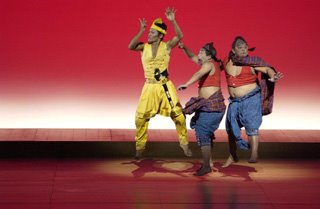
The show itself lasts for three hours, but it seems somehow appropriate that I lost all sense of time while I was watching it. Wilson orchestrates the rhythm beautifully: long ritualised scenes, such as the first meeting of the royal couple, when We Nyiliq Timoq rises in royal splendour from the sea, are contrasted with the burping-and-scratching vulgarity of Sawerigading's disreputable cousins or the comically beautiful entrance of the animals - masked monkeys and frogs, deer with antler and an unlikely-looking giraffe, each with its own musical signature. Wilson's cast of more than 50 Indonesian performers enacts the stylised dances and mimes with a precise and compelling expressiveness. This is the kind of performance that flowers from a core of stillness and contemplation, making each gesture and each change of rhythm charged and meaningful.

The costumes are, like the set design, elegant contemporary adaptations of traditional Asian designs. Perhaps what is most striking in the production is the colour: it is at once lush and spare, employing a palette of clear, luminous colours, like those used in dyeing silk. It didn't surprise me afterwards when I read that the costume designer Joachim Herzog adhered strictly to traditional Indonesian notions of colour use and heraldic symbology in his designs (yellow for royal, for example), as the colours in both the lighting and costumes have a deep coherency, which works even for those who do not understand the codes.

Likewise, Rahayu Sapanggah's original music, which draws on traditions from all over Indonesia and beyond, sounds at once deeply ancient and modern, and features some thrilling drumming as well as songs of heart-stopping poignancy. One of the instruments sounds exactly like a cello, but in fact no Western instruments were used.

Wilson escapes the trap of making a patronisingly anthropological treatment of a fascinating but obscure text: this is utterly contemporary theatre that dynamically reworks this ancient epic, bringing it freshly alive. All the various elements are seamlessly woven together to create a work of profound elegance that, like the myth it enacts, is at once lucid and mysterious. It epitomises the kind of intercultural exchange that Said himself would have welcomed; if all meetings of East and West were this fruitful, the world would be a different place.

Read More.....

Friday, December 10, 2004

Hamlet

Hamlet by William Shakespeare. Directed by Oscar Redding, with Richard Pyros, Adrian Mulraney, Nicki Paull, John Francis Howard, Thomas Wright and Ben Packer. DDT Studio, 515 High Street, Northcote. La Tragedie d'Hamlet, directed by Peter Brook, with Adrian Lester, Jeffery Kissoon, Natasha Parry, Bruce Meyers, Scott Handy, Shantala Shivalingappa, Rohan Siva, Asil Rais, Yoshi Oida, Akram Khan, Nicolas Gaster, Antonin Stahly, Jerome Grillon. DVD, Agat Films 2001.

On the face of it, it may seem very unfair to compare these two versions of Hamlet. One is a filmed production by one of the greatest theatre directors of the past century, created in Brook's gorgeous Paris base, the Théâtre des Bouffes du Nord; the other an exemplary example of poor theatre, put on by a young Melbourne director in a shop front in High Street, Northcote.

As it happens, it is not unfair; theatre is a great leveller. Perhaps for similar reasons - a certain straightforwardness in approaching Shakespeare - both are notable for their clarity, and they share a great text and remarkable actors. Where Redding's production lacks Brook's exquisite aesthetic polish, it gains in robust irreverence and visceral power. But what strikes me most is how both these productions spin the focus on this most protean of texts, to reveal a Hamlet in whose body itself turns the sword of politics.

The great Shakespearean critic Jan Kott says of Hamlet that it is a play that absorbs its times. So there are, among many others, the Romantic Hamlet of the 19th century, wanly melancholic; the mid-Century Hamlet, which Kott particularly documented, in which interpretation leans on the pitiless wheel of power; and now this 21st century Hamlet, at once sensuous and full of loathing, raging against the mortal trappings of his flesh.

Part of the reason for these many Hamlets is that the six hour text is seldom performed entirely as written. It means that each production is cut according to the cloth of its interpretation. Both Brook and Redding take a broadly similar approach, removing the cumbersome opening scene with the ghost, and cutting out entirely the complicated narrations of battles and politics. They fillet out a claustrophobic family tragedy of individuals trapped in remorseless passions. In these productions, the personal is most assuredly political.

This approach rejects most modern interpretations of Hamlet, in which the character of Fortinbras is brought to the foreground. Fortinbras - who claims the throne of Denmark after all the corpses stop twitching on the floor - is in some versions an alter ego of Hamlet, in others, the legitimate heir to the throne, the man who restores order to the broken kingdom. "If one wishes to places Hamlet's moral conflicts into a historical context," says Kott, "one cannot ignore the role played by Fortinbras".

Well, in these versions Fortinbras has disappeared entirely. But I think this is not so much a symptom of ahistorical consciousness, as a lack of belief in the possibility of the restoration of order, or even in the possibility of order itself. No king now comes to make it all right: the plays ends with the slaughter. Today's Hamlet is considerably darker than previous versions: it contains no illusion of consolation.

The brooding sense of claustrophobia is reinforced by the doubling, some of which is repeated in both productions: in both, Polonius and the gravedigger (Bruce Meyers in Brook's, and John Francis Howard in Redding's), and Claudius and the Ghost (Jeffrey Kissoon and Adrian Mulraney respectively) are played by the same actor. The doubling of Claudius in particular throws Hamlet's revulsion against his uncle into ironic relief: we are reminded that he is importuned to kill his own kin, outraging familial ties just as his uncle did in murdering Hamlet's father.

Redding goes much further, doubling the roles of Gertrude and Ophelia (Nicki Paull), which makes the play's incestuous sexual drama even more knotted. His most audacious move is to double the roles of Hamlet and his friend Horatio: Horatio is played as a handpuppet. That you accept this without question is a considerable tribute to the intensity and skill of Richard Pyros' performance. What is fascinating is its theatrical ambiguity: part of the time, it is quite possible to imagine seriously that a ridiculous pair of pink eyes is Horatio, Hamlet's only friend; at other times, the hand puppet seems another aspect of his madness and loneliness, a crazed aspect of Hamlet's splintered self.

Adrian Lester's Hamlet is gentler than Richard Pyros', whose wit is crueller and violence more dangerous (especially when he is holding a huge kitchen knife to Gertrude's throat). Lester's performance is framed by lush, rich sensuousness: the rust-red walls of the theatre, the naked flames of lamps, luxurious crimson fabrics, the melancholy scrape of a cello. Pyros, on the other hand, is working in a bare, scruffy space lit by fluorescent tubes, with the sound of high street traffic as background accompaniment.

But again I was struck by similarities as much as differences: these Hamlets are mercurial, impelled by savage laughter rather than by dark melancholia. They describe an intelligence tormented by circumstance: that circumstance being primarily mortality, the fate of all flesh, but also its sullying, a fatal disgust at moral and fleshly corruption.

Of course, there is more to Hamlet than Hamlet; and these productions feature ensemble casts of great depth. One would expect that of Brook; but Redding has gathered together some very fine actors, who have created a subtlety and depth of performance which rivals, and in the case of Ophelia surpasses, that Brook elicited from his. All deserve mention, but Adrian Mulraney's authoritative and subtle performance as Claudius - both unrepentant usurper and repentant brother - never falters.

In Redding's production, the women's roles are strong and disturbing. Nicki Paul plays Gertrude as an alcoholic, constantly sipping from a jam jar, who imperceptibly becomes more and more drunk as the play progresses, until by the final scene she can barely stand. Her announcement of Ophelia's death - told through uncontrollable fits of laughter - brings home the terror of the girl's suicide in a way that no sober rendition could. And Ophelia's mad scene is shaming and pitiable, in the way that real madness is.

It is very clear in this drama how the women are destroyed, both morally and physically, by their entrapment within male power. The single power Gertrude and Ophelia possess is their sexuality: it is their "virtue", a commodity which belongs to the family, not to themselves, and it is not theirs to bestow freely. Laetres (Thomas Wright) and Polonius lecture Ophelia at length about how she ought to be behave, and Hamlet likewise has no hesitation in censuring his mother for outraging the legitimate bonds of marriage. The fear of women's anarchic sexual desire lurks uneasily beneath the surface of the action, erupting in male disgust ("Frailty, thy name is woman!") or in female madness and despair.

But it is not the women who are treacherous, but the men: most notably, Claudius's murder of his brother to gain the crown, the betrayal which unravels all the rest. And there is also Hamlet's feigned detestation of Ophelia, which drives her to suicide; Rosencrantz and Guildernstern's deceptive spying on Hamlet, betraying the bonds of friendship; Laertes' betrayal of honourable combat, by poisoning his sword.

Hamlet is, more than almost any other Shakespearean play except perhaps The Tempest, deeply concerned with the provenance of theatre itself. Almost no one in the play is who he or she seems to be: all are playing roles, whether self-imposed or not, and this is underlain by our knowledge that the "real" characters are played by actors, who are also not who they seem to be. Is this merely deception and betrayal? Hamlet's pretended madness is, rather, an attempt to find the truth: as he says, "the play's the thing/ In which to catch the conscience of a King". These potent ambiguities, the mask as a revealer of truth and as a lie, drive the fascination of the action as much as the repressed sexual passions.

There is a vital difference between these two productions: one was performed four years ago, and was watched on a screen; the other occurred live, feet away from me. No recorded performance beats the living experience, no matter how artfully filmed it might be. But they both gave me a new Hamlet, and reminded me that it is, as Kott says, "the strangest play ever written".

Both productions tear away the cultural barnacles that so often weigh down this most monumental of English icons - the deadening reverence, the fear of poetry, the stereotypical expectations - and deliver it into the present, with all the complexities and contradictions of a living thing. It's a rare experience that always leaves me elated. And such experiences are why I persist in going to the theatre.


Read More.....