Review: Exit the King
Exit the King by Eugene Ionesco, directed by Neil Armfield. Designed by Dale Ferguson, lighting by Damien Cooper, composer John Rodgers, sound design Russell Goldsmith. With Billie Brown, Julie Forsythe, Gillian Jones, Rebecca Massey, Geoffrey Rush, David Woods, music by Scott Tinkler. Merlyn @ the Malthouse until April 21.
Like Samuel Beckett, Eugene Ionesco is aging well. As the years roll on, he just looks more and more hip. While contemporaries like John Osborne or Arthur Miller have gained a tinge of sepia, the mark of the "classic" that is an expression of its time and must be seen through a lens of metaphor in order to reflect ours, Ionesco sparkles with contemporary bite: he took a short cut and made a metaphor in the first place. He was never concerned with the social applicability of his work, and directed his intelligence towards very simple things - death and loneliness, mainly - writing about them with a directness and clarity that, paradoxically, gave him a reputation as a fiercely difficult playwright.
In a 1958 review of a revival of The Chairs, Kenneth Tynan accused Ionesco of turning his back on reality. "M. Ionesco certainly offers an 'escape from realism': but an escape into what?" he asked. "A blind alley, perhaps... [his] theatre is pungent and exciting, but it remains a diversion. It is not on the main road." Ionesco's reply, in which he claimed that man as a social animal was inevitably alienated, prompted a storm of voices talking at cross-purposes, that in 2007 looks at once faintly puzzling and depressingly familiar. Ionesco's refusal to hoist himself to a progressive ideology, his horrified rejection of any political or social agenda, could only be regarded by his peers as the most reprehensible nihilism. Yet Ionesco's final reply seems to me to be an immensely moving statement of faith in the possibility of what remains, in the face of all of the confusions and impossibilities of language, communicable between human beings:
When my lieutenant and my boss are back in their homes, alone in their rooms, they could, for example, just like me, being outside the social order, be afraid of death as I am, have the same dreams and nightmares, and having stripped off their social personality, suddenly find themselves naked, like a body stretched out on the sand, amazed to be there and amazed at their own amazement, amazed at their own awareness as they are confronted with the immense ocean of the infinite, alone in the brilliant, inconceivable and indisputable sunlight of existence. And it is then that my general or my boss can be identified with me. It is in our solitude that we can all be reunited.
As the brutal history of the 20th century collapsed the categories of right and left ideologies into a maze of contradictory mirrors, it began to look rather as if Ionesco's dark but surprisingly joyous vision might have been more prescient than it was allowed in his time. His sceptical humanity is bracing when the possibility of belief seems to be decaying into a kind of mediaevalism, and when the pressures of modernity have made the self uniquely atomised and lonely. Certainly, Exit the King - which charts the gradual death of a monarch who has reigned past his allotted time - has lines that bite deeply into the political present. But the play is ultimately a lament for human mortality, all the more poignant for its pitiless and anarchic comedy.
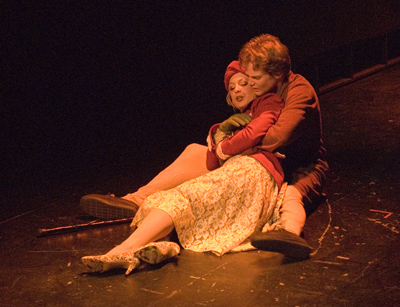
Berenger, the King (Geoffrey Rush) is a parodic portrayal of the ultimate patriarch. He has seen better days: his demesne once extended over 9000 million people, but now he rules over less than a thousand prematurely-aged subjects, and what is left of his kingdom keeps falling into an abyss. His court is reduced to a shabby retinue: there's the domestic help Juliette (Julie Forsythe), who also fulfils the functions of nurse, cook and general dogsbody, the Guard (David Woods) and the Doctor (Billie Brown), who is also the astrologist and executioner, and his two rival queens, Marie (Rebecca Massey) and Margeurite (Gillian Jones).
As we are informed, the King must die by the end of the play. The play itself is simply a matter of getting there, as Berenger howls against his fate, moving from denial to terror to pathos to a final, moving acceptance. Ionesco has literalised the tyranny of the ego, which at the point of death refuses to contemplate its own annihilation, and will give anything - even the destruction of the entire world - if only it can go on living. But even the King, who once, we are given to believe, could command the sun itself, has to bow before death.
It's fair to say that I went to this production with high expectations. Not only is it a wonderful play with passages of breathtakingly beautiful writing, but Armfield's production features a cast of such depth and talent that it sizzles on the page. It could have become a star vehicle for Rush - and he is, after all, a genuine star - but Armfield has wisely ensured that his production is more than a frame for Rush's performance. Still, I was looking forward to seeing Rush on stage again.
I've seen him in some remarkable roles. Neil Armfield's 1989 production of Gogol's Diary of a Madman, with Geoffrey Rush as Poprishchin, the obsequious clerk whose banal life slides into pitiable madness, was one of the great moments in Australian theatre. Rush's wonky entrance on stage, teetering beneath improbably high carrot-red hair, is one of my cherished theatrical memories. Equally memorable was his performance as Khlestakov in The Government Inspector at the Sydney Opera House, again under Armfield's direction, in a carnivalesque production that seemed to include half of the stand-up comics in Sydney. He also made a wickedly good John Worthing in Simon Phillips' justly celebrated production of Wilde's The Importance of Being Earnest. That was, of course, before he became hugely famous, when he was simply the best comic stage actor in Australia.
In Exit the King, he makes a triumphant return to his natural element. Rush is the brilliant centre of a sparkling ensemble: after a slightly sticky twenty minutes or so at the beginning of the play, his performance is as remarkable as any I've seen. Rush is a great clown, and this role gives him plenty of scope for physical humour, especially in a scene in which (as the Guard announces) "The King is Marching!" But his skill is evident in his restraint; he never allows grotesquerie to degenerate into mere cartooning. Like Ionesco's writing, he keeps his options open: anything is possible at any time. He plays the full range of the text, from broad comedy to brutality to sheer pathos, until he becomes the everyking we all are, alone and afraid in our shabby kingdoms, facing the dark.
Neil Armfield's production fully exploits the shadowy spaces of the Merlyn, with Dale Ferguson's set sprawling the width of the theatre, its various exits leading off into darkness. The throne room is draped with huge tapestries, the throne itself rather tacky. The colours are rich and warm, glowing in the darkness, creating a sense of delapidated grandeur. The musician/herald Scott Tinkler is spotlit in the balcony, opening the stage up again to wider perspectives. Underneath Russell Goldsmith's subtly textured sound design is an ominous, subliminal rumbling, something like the sound of heavy trucks going by, as if the whole building is about to collapse. The actors are miked, giving their performances a certain extra formality and alienation which is not inappropriate, but it was the only aspect of the production I wasn't sure of; the sound was a little wobbly the night I saw it, and it slightly flattened the actors' voices. (On balance, though, I think this decision paid off in the end.)
Rush is surrounded by some excellent performances, and each actor has his or her moment of virtuosic display. David Woods, whom I last saw in the Ridiculusmus production of The Importance of Being Earnest, is another accomplished clown, clanking around the set in his armour and announcing every petty detail of the action. Billie Brown as the Doctor, the avatar of death or fate, is a model of obsequious tyranny, and Julie Forsythe, who has possibly the most ridiculous hairstyle I've seen, is at her comedic best as the harrassed and resigned maid Juliette. Rebecca Massey as Queen Marie, the symbol of sensuous pleasure, trembles with a kind of luminous courage in the midst of her melodramatic excesses. Gillian Jones' performance as Marguerite, the first wife who reminds him of his unpleasant duty to die, is quite fascinating. At first I was a little puzzled, as she seemed strangely monotonal (if satisfactorily regal), but by the end of the play I was completely bewitched.
In the final scene of Exit the King, Ionesco reverses the perception of death, which we generally see as a departure from the world. The King is, after all, the subject of this play, in every sense of that word, and it is not the King who departs, but everything else. The vanishing of Berenger's world and his entrance into death is accompanied by a hypnotic monologue from Marguerite in which she conducts him through the process of relinquishment, towards the landscape of death. The writing recalls Rilke's Tenth Duino Elegy or perhaps aspects of Dante's Comedy, but it is, in its final refusal of illusion, all Ionesco's own. The last ten minutes or so of this production is, quite simply, astounding theatre, the kind that makes you hold your breath and reminds you why you persist with this beautiful, frustrating artform, so apt to failure and disappointment. Theatre can summon a joy that's like anguish, an exhilaration at once ephemeral and unforgettable, that you can find nowhere else.
Picture: Geoffrey Rush and Julie Forsythe in Exit the King. Photo: Lisa Tomasetti